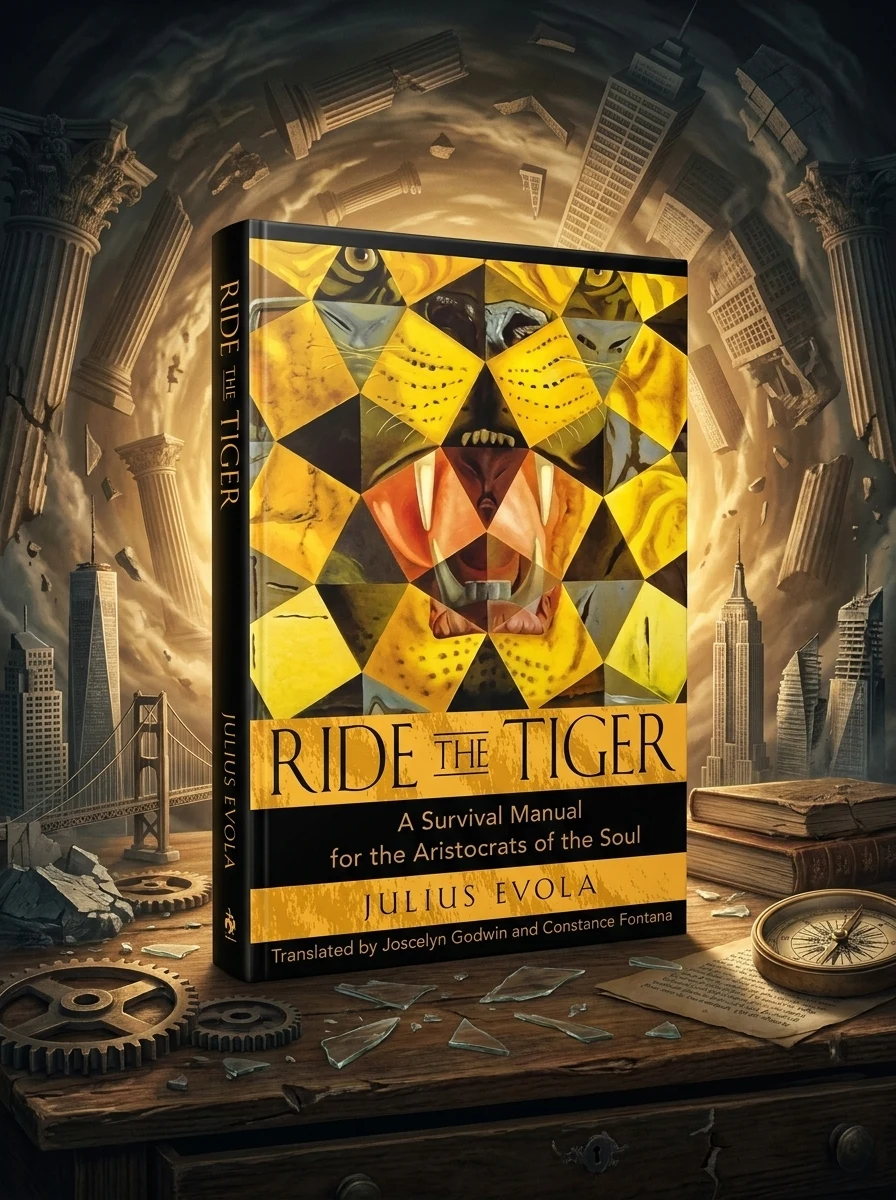

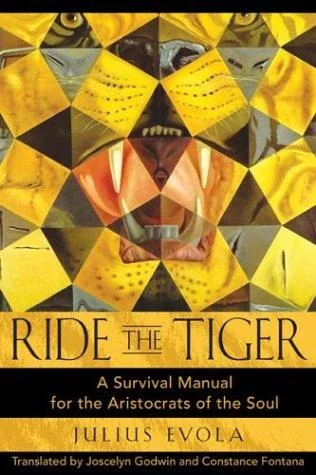
Ride the Tiger: A Survival Manual for the Aristocrats of the Soul
✍️ Julius Evola, Joscelyn Godwin, Constance FontanaA Traditionalist critique of modern nihilism and a manual for inner liberation amidst cultural dissolution.
This volume presents an implacable critique of modern illusions through the lens of ancient spiritual principles. Divided into six structured parts, it moves from the breakdown of European morals and active nihilism to detailed critiques of existentialist thinkers like Sartre and Heidegger. Evola examines how contemporary science, modern art, jazz, and nature sentiment contribute to the anonymization of the individual. By contrasting modern decay with transcendent dimensions, action without desire, and Apollonian or Dionysian invulnerability, the work outlines how a specific type of human can transform external destruction into inner freedom.
Written by an authority on world esoteric traditions from the war generation, this text addresses the contemporary collapse of traditional civilization. It offers a critique of mid-twentieth-century European philosophy, existentialism, modern science, and post-war cultural movements.


Praise for this book
“Evola is one of the most interesting minds of the [world] war generation.”
📝 Description: Ride the Tiger: A Survival Manual for the Aristocrats of the Soul
📑 What's inside
- Part 1: Orientations 1. The Modern World and Traditional Man
- 2. The End of a Cycle--"Ride the Tiger"
- Part 2: In the World Where God Is Dead
- 3. European Nihilism--The Dissolution of Morals
- 4. From the Precursors of Nihilism to the "Lost Youth" and the Protest Movement
- 5. Disguises of European Nihilism--The Socioeconomic Myth and the Protest Movement
- 6. Active Nihilism--Nietzsche
- 7. "Being Oneself"
- 8. The Transcendent Dimension--"Life" and "More Than Life"
- 9. Beyond Theism and Atheism
- 10. Invulnerability--Apollo and Dionysus
- 11. Acting without Desire--The Causal Law
- Part 3: The Dead End of Existentialism
- 12. Being and Inauthentic Existence
- 13. Sartre: Prisoner without Walls
- 14. Existence, "A Project Flung into the World"
- 15. Heidegger: "Retreating Forwards" and "Being-for-Death"--Collapse of Existentialism
- Part 4: Dissolution of the Individual 16. The Dual Aspect of Anonymity
- 17. Destructions and Liberations in the New Realism
- 18. The "Animal Ideal"--The Sentiment of Nature
- Part 5: Dissolution of Consciousness and Relativism 19. The Procedures of Modern Science
- 20. Covering up Nature--Phenomenology
- Part 6: The Realm of Art--From "Physical" Music to the Drug Regime 21. The Sickness of European Culture
- 22. Dissolution in Modern Art
- 23. Modern Music and Jazz
- 24. Excursus on Drugs
- Part 7: Dissolution in the Social Realm
- 25. States and Parties--Apoliteia
- 26. Society--The Crisis of Patriotic Feeling
- 27. Marriage and the Family
- 28. Relations between the Sexes
- Part 8: The Spiritual Problem
- 29. The "Second Religiosity"
- 30. Death--The Right over Life
- Notes Index
💎 Expert review
📖 Why choose it
Why this book is worth reading
This book serves as an essential manual for those seeking absolute meaning amidst profound societal dissolution. It is ideal for readers who feel alienated by modernity and wish to cultivate unyielding inner sovereignty rather than engage in external political revolution. Those desiring to transform destructive forces into pathways for personal liberation will find deep value here. It offers a rigorous framework for maintaining traditional values and individual autonomy when the world around you abandons them. If you are an aristocrat of the soul looking for resilience against the tides of contemporary emptiness, this guide provides the necessary tools for spiritual survival and enduring peace.
⭐ Reader reviews
Reader rating
Evola’s culminating work offers a piercing critique of societal illusions, demanding a high level of intellectual and spiritual fortitude from its audience. It is not suitable for those seeking comfort, easy answers, or progressive political engagement. The text requires readers to confront the pervasive emptiness of contemporary structures without offering external salvation. While powerful for those committed to inner liberation and traditional values, it may alienate readers uncomfortable with its austere assertion of aristocratic superiority. It is a demanding exploration of autonomy, best appreciated by those willing to endure its challenging perspective on modern dissolution to achieve genuine spiritual resilience.
❓ Frequently asked questions
📖 Who should read this
If you feel adrift in the currents of modern materialism and seek a philosophy for profound personal resilience, this book is for you. It's for those who yearn to define their own meaning and uphold transcendent values in a world that increasingly denies them, offering a radical counter-narrative for spiritual self-preservation.
🎯 Key themes and symbolism
Traditional Values' Decline
Evola meticulously details how the organizations and institutions once providing individuals with purpose and a clear moral compass have vanished. He argues that modern society stands in direct opposition to the world of Tradition, where life was structured by timeless, transcendent principles. This theme explores the pervasive decay and spiritual void left by this historical shift.
Inner Liberation Amidst Chaos
This book offers a radical approach to personal freedom in a world perceived as degenerate. Rather than despairing, Evola shows how individuals can turn the destructive processes of modernity into catalysts for profound inner emancipation. It's a philosophy for cultivating spiritual independence and finding meaning when external society offers none, by leveraging the very forces of chaos.
The "Tiger Rider" Archetype
Evola introduces the concept of the 'tiger rider' – an individual capable of asserting absolute meaning in their life, even as society unravels around them. This archetype represents a spiritual warrior who doesn't fight the destructive forces of the age but rides them, guiding their power towards personal transcendence and maintaining an unshakeable connection to the eternal principles of Tradition.
📜 Historical context
📚 Glossary
- Tradition
- Dissolution
- Aristocrats of the Soul
📔 Questions to reflect on
- How do you identify 'idols' or 'illusions' in your own contemporary environment, and how might they influence your inner state?
- Consider a personal 'destructive process' you've encountered. How might Evola's philosophy of 'inner liberation' apply to transforming that experience?
- What 'principal values' do you recognize as your own, and how do you defend or uphold them in a world that often challenges them?
📖 Read on the blog
🏛 Books from this publisher Inner Traditions International
All books from this publisher →





You might also like
See more →

Have a question about this item?
Ask about the edition, condition, delivery or anything else — we reply by email or phone, usually within a day.
