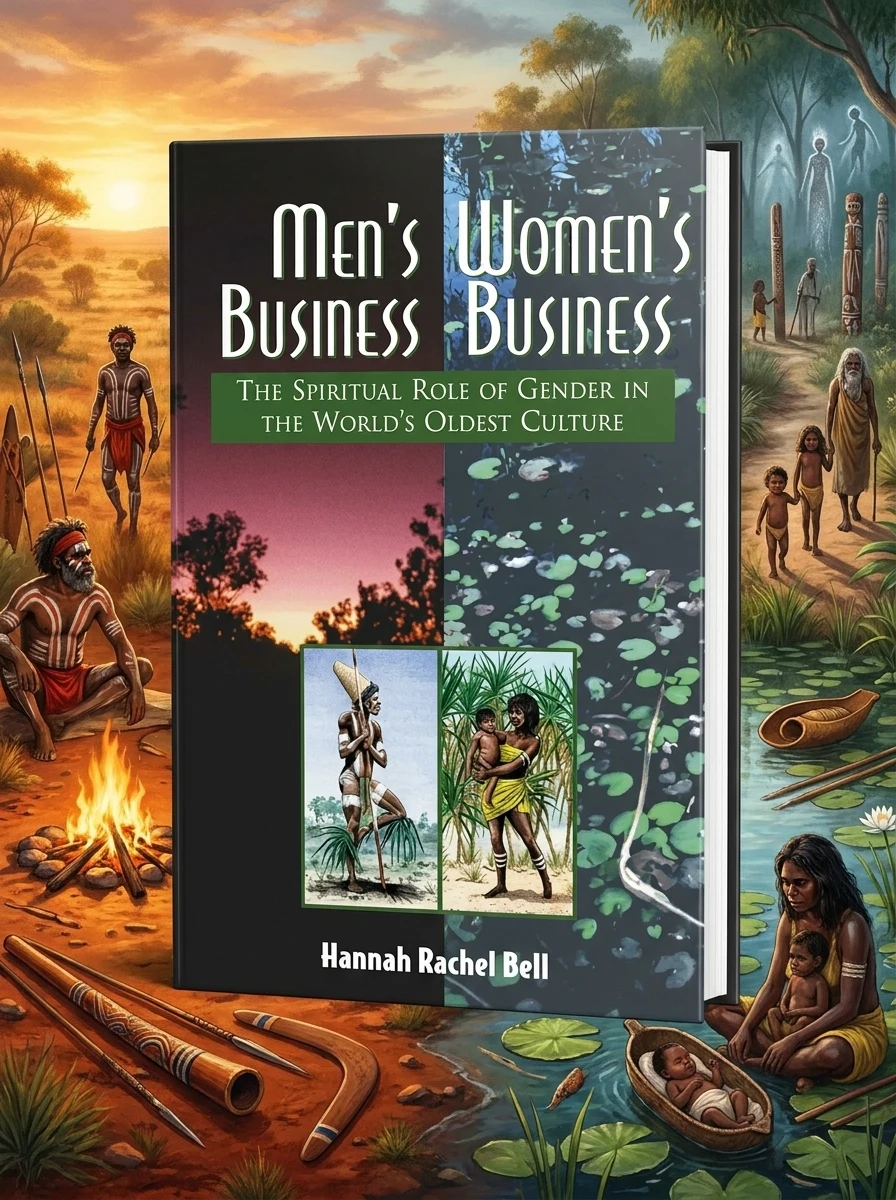
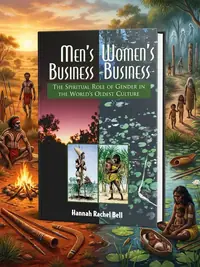
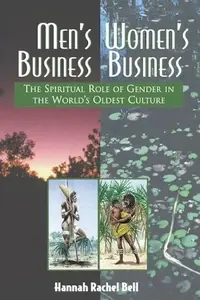
Men's Business, Women's Business: The Spiritual Role of Gender in the World's Oldest Culture


This edition can be ordered. No arrival date is confirmed.
Ancient Australian gender laws reveal how harmonious duality heals modern fragmentation.
Hannah Rachel Bell chronicles her transformative twenty-five-year collaboration with Aboriginal Lawman David Mowaljarlai, exploring the Ngarinyin people’s strict division of spiritual labor. The narrative traces a boy and girl through life’s stages, contrasting the profound respect inherent in their gendered roles with Western individualism. By immersing herself in a society where every action obeys mythic law, Bell discovers that true balance arises not from sameness, but from honoring the distinct, essential power of the other. This work challenges feminist assumptions, offering a path to wholeness through complementary difference rather than uniform equality.
This work sits within the genre of comparative religion and esoteric anthropology, bridging Western occult frameworks with Indigenous Australian cosmology. It contributes to the ongoing dialogue on gender dynamics within spiritual traditions that emphasize complementary dualities over uniformity.


📝 Description: Men's Business, Women's Business: The Spiritual Role of Gender in the World's Oldest Culture
💎 Expert review
📖 Why choose it
Why this book is worth reading
Readers seeking a profound shift in their understanding of gender will find this book transformative. Those interested in the spiritual foundations of Aboriginal Law and the Ngarinyin people’s cosmology will gain deep insight into how strict division of labor creates harmony. It is essential for anyone feeling fragmented by modern individualism, offering a tangible path to wholeness through complementary difference. Feminists willing to question uniform equality assumptions will discover new perspectives on respect and power. Ultimately, it appeals to spiritual seekers looking for ancient wisdom that heals contemporary disconnection by honoring the distinct, essential power inherent in each gender.
⭐ Reader reviews
Reader rating
My book club chose this last month. Solid binding, decent paper — holds up to heavy use. You can tell why this work has endured. Delivery took a bit longer than quoted. Solid, if not essential.
Added this to my reference shelf. It pairs well with more modern commentaries on the same tradition. The print is clean and easy on the eyes for long sessions. Definitely recommend.
My book club chose this last month. It reads better in small doses — a chapter at a time with notes. Definitely recommend.
Bell’s narrative offers a compelling look at the Ngarinyin people’s spiritual structure, yet it may alienate readers expecting a conventional feminist critique. The text challenges modern assumptions by prioritizing complementary difference over sameness, which might feel uncomfortable or regressive to those invested in uniform equality frameworks. While the account of her twenty-five-year collaboration is detailed, the strict adherence to mythic law may seem rigid to Western readers accustomed to fluidity. It is not for those seeking a simple validation of current gender theories but rather for those open to examining how ancient laws enforce balance through distinct roles. The work demands an openness to cultural contexts vastly different from Western individualism.
❓ Frequently asked questions
📖 Who should read this
Readers seeking alternative spiritual frameworks, anthropologists interested in gender dynamics, and anyone feeling disconnected by modern Western egalitarianism who desires a deeper, mythic understanding of masculine and feminine energies.
🎯 Key themes and symbolism
Complementary Gender Roles
Indigenous Law and Myth
Cross-Cultural Feminism
💬 Quotes from the book
“Only when the two genders work in harmony does their culture function as it should.”
“She found her beliefs challenged and finally changed.”
📜 Historical context
📚 Glossary
- Lawman
- Ngarinyin
- Dreaming
📔 Questions to reflect on
- In what ways does your daily life reflect a forced sameness rather than a harmonious balance of complementary energies?
- How might respecting the 'otherness' of the opposite gender deepen your understanding of your own identity?
- What modern social structures could be healed by adopting a model of sacred division rather than forced integration?
🏛 Books from this publisher Inner Traditions International
All books from this publisher →




You might also like
See more →