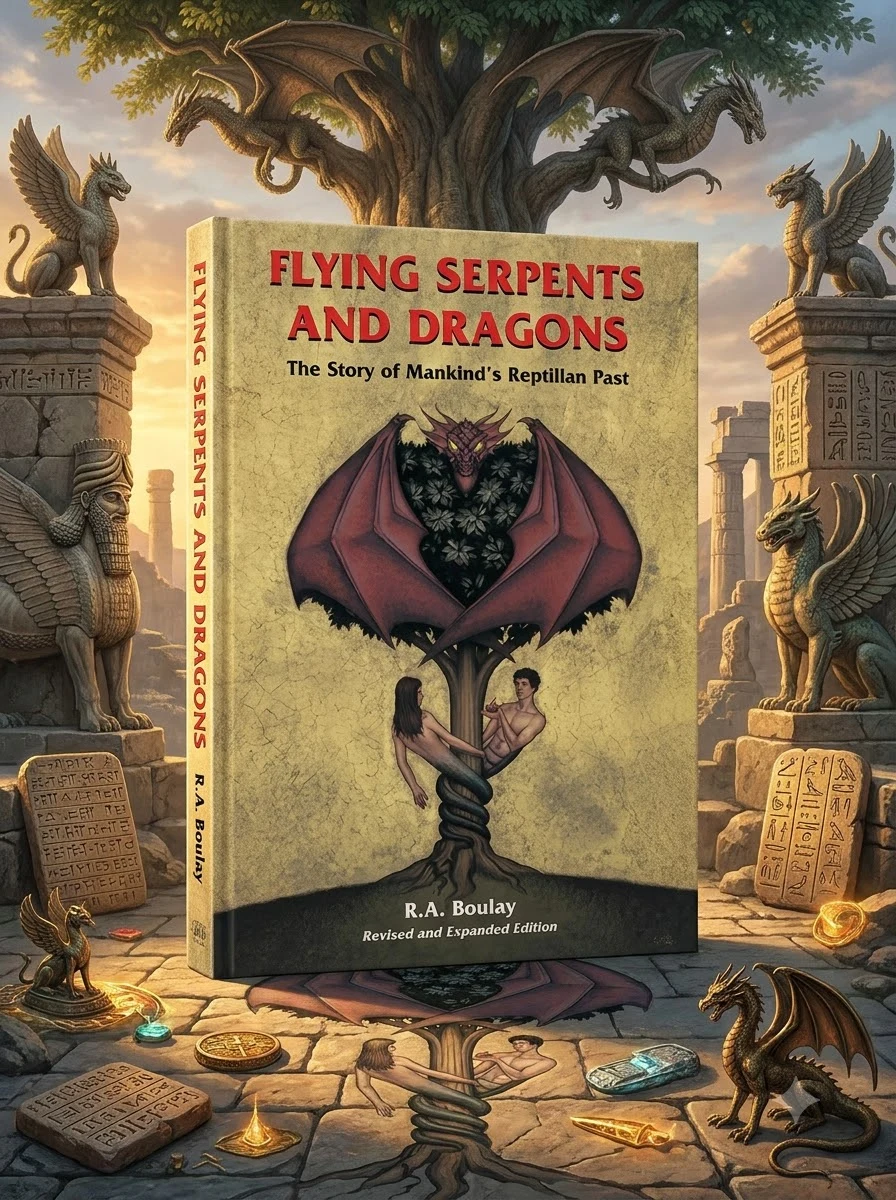
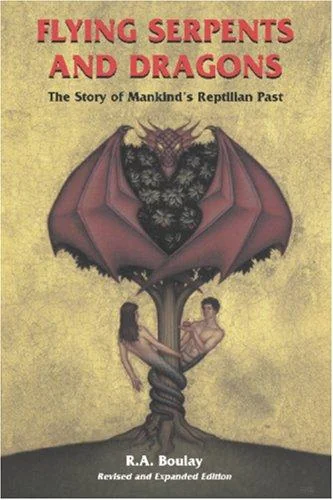
Flying Serpents and Dragons: The Story of Mankind's Reptilian Past (Revised)
R. A. Boulay's revised work boldly challenges established narratives of human origins, proposing that ancient reptilian entities were the true architects behind the earliest civilizations. Drawing from a vast array of global myths, religious texts, and archaeological anomalies, Boulay reinterprets iconic stories—from the Garden of Eden and the Nephilim to the "flying serpents" of Sumeria—to paint a picture of extraterrestrial intervention. This book invites readers to reconsider the very foundations of our past, offering provocative answers to history's most enduring mysteries and questioning humanity's place in the cosmic order.


📝 Description: Flying Serpents and Dragons: The Story of Mankind's Reptilian Past (Revised)
📑 What's inside
- Prologue
- Introduction
- 1. The Dragons of Eden
- 2. The Invisible Bible
- 3. Western or European Dragons
- 4. Non-European Dragons
- 5. What Exactly was a Dragon?
- 6. Arrival of the Reptile Gods on Earth
- 7. The Sumerian Names for Dragons
- 8. The Sumerian Serpent-Gods
- 9. The Activities of the Younger Ruling Gods
- 10. The Attempt to Seize Power in the Pantheon
- 11. The Plural Gods of the Old Testament
- 12. Physical Conditions Before the Deluge
- 13. When Was the Deluge?
- 14. The Dragons Go Underground
- 15. The Creation of Adam: The Reptile Man
- 16. The Fall of Man or the Creation of Homo-Sapiens
- 17. The Patriarchs: Demi-Gods of the Antedilivian Period
- 18. The Rephaim: Warrior Gods of Palestine
- 19. Cannibalism and Human Sacrifice
- 20. Where was the Fabled Land of Dilmun?
- 21. Destruction of the Baalbek Space Facilities
- 22. Invasion of the Western Lands: The Rephaim, Mount Sinai, Sodom and Gomorrah Destroyed
- 23. The Airships of the Ancient Serpent Gods
- 24. The Phoenix Bird as Symbolizing a Rocket Launch
- 25. The Radios of the Ancients
- 26. The Stones or Crystals of the Old Testament
- 27. The Stone Things or MEs of the Sumerians
- 28. The Four Basic Uses of the MEs or Power Stones
- 29. A Catalog of the Sumerian MEs or Power Stones
- 30. The Sumerian MEs as Robots or Mechanical Devices
- Epilog
- Appendix A. A Catalog of the MEs which Ishtar Stole from Enki
- Bibliography
- Index
💎 Expert review
📖 Why choose it
Why this book is worth reading
Readers drawn to unconventional historical theories and those fascinated by the intersection of mythology and speculative science will find this revised edition a compelling addition to their library. Boulay’s narrative offers an engaging, accessible entry point into the world of reptilian human origins, synthesizing diverse global myths into a cohesive, albeit controversial, framework. It is ideal for curious minds seeking alternative explanations for ancient wonders and religious texts, providing a provocative lens through which to view humanity's cosmic destiny without demanding prior academic expertise in archaeology or theology.
⭐ Reader reviews
Reader rating
This book serves as a spirited exploration of fringe theories, presenting a bold argument that reptilian entities shaped early civilizations. While Boulay effectively weaves together disparate mythological threads from Sumerian texts to biblical accounts, the work relies heavily on speculative interpretation rather than empirical evidence. It is not suitable for readers seeking rigorous academic archaeology or those who prefer strictly documented historical analysis. However, for enthusiasts of esoteric history and ancient astronaut hypotheses, it offers a stimulating, if unorthodox, perspective that challenges conventional wisdom and encourages critical engagement with foundational cultural narratives.
❓ Frequently asked questions
📖 Who should read this
If you're fascinated by ancient astronaut theories, alternative history, or suppressed knowledge, and possess an open mind for provocative ideas, this book is for you. It's an essential read for anyone ready to question conventional narratives about human origins.
🎯 Key themes and symbolism
Reptilian Origin of Humanity
Boulay presents a radical hypothesis: that advanced reptilian beings arrived on Earth millennia ago, establishing foundational civilizations and genetically influencing early humans. He meticulously connects ancient dragon legends and serpentine deities across cultures, positing them not as mere symbols, but as historical accounts of these powerful, non-human progenitors who guided human development and shaped our collective consciousness.
Reinterpretation of Ancient Myths
This volume systematically deconstructs pivotal myths and religious texts, offering a startling alternative perspective. The Garden of Eden, the role of the serpent, the Nephilim, and the "boats of heaven" are all re-examined through the lens of reptilian intervention. Boulay suggests these narratives are not allegories, but veiled records of interactions between early humans and their extraterrestrial creators, often misunderstood or deliberately obscured over time.
Challenging Conventional History
The book directly confronts mainstream archaeological and historical interpretations, arguing that significant evidence of a reptilian past has been overlooked or dismissed. From the colossal platform of Baalbek to the Sumerian term 'Ushumgal,' Boulay pieces together a mosaic of clues to support a hidden history. It encourages readers to question deeply ingrained assumptions about human evolution, the purpose of our creation, and the origins of our most ancient knowledge.
📜 Historical context
📚 Glossary
- Ushumgal
- Nephilim
- Sky Chariots
📔 Questions to reflect on
- Reflect on a favorite ancient myth or religious story. How might its interpretation change if you consider the possibility of reptilian intervention?
- If humanity's origins are indeed tied to an extraterrestrial reptilian species, how does this alter your understanding of our purpose or place in the universe?
- Consider the pervasive symbolism of serpents and dragons across diverse cultures. What deep-seated truths might these universal motifs conceal about our past?