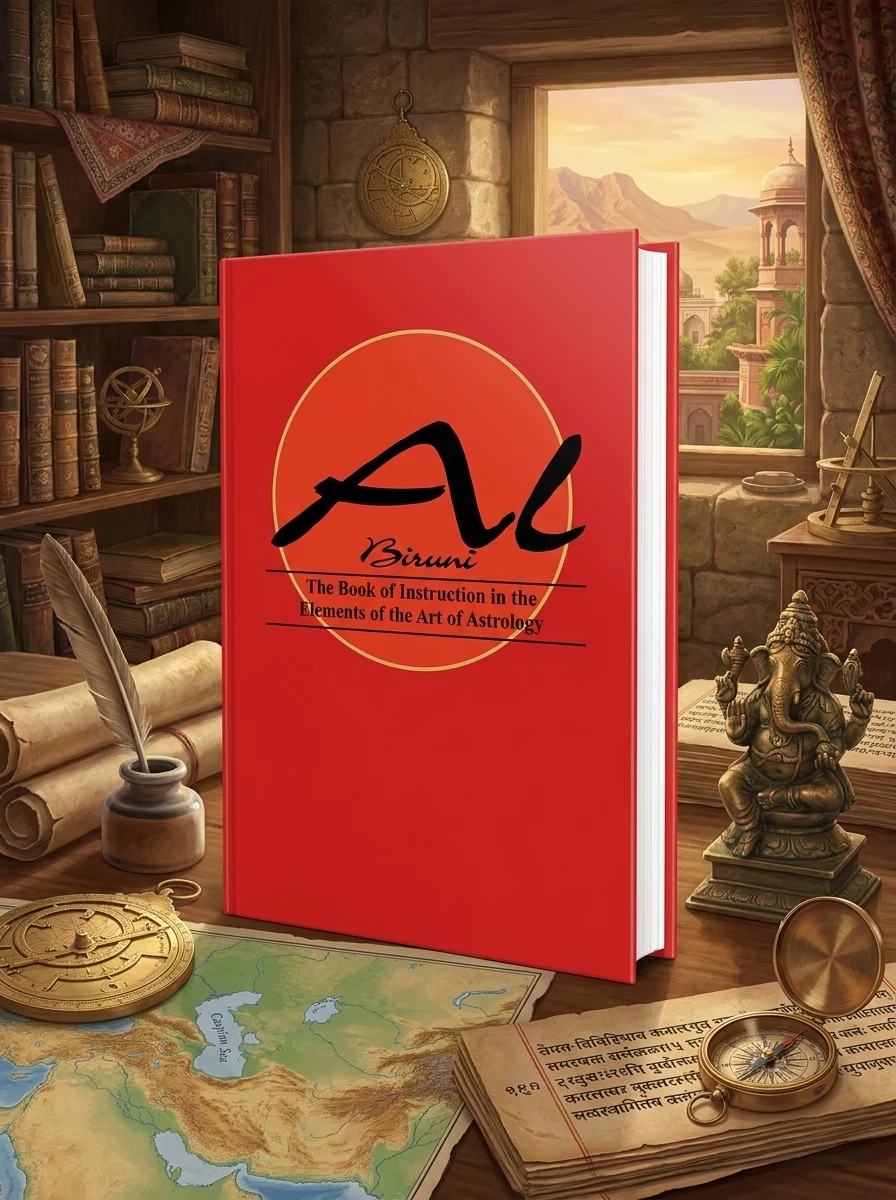
Book of Instructions in the Elements of the Art of Astrology
Stock reported in the catalog; fulfillment is confirmed with your request.
Unlock the universe's ancient code with this foundational astrological primer from a medieval master.
Al-Biruni, a celebrated polymath of the Islamic Golden Age, penned this essential guide to celestial interpretation for Lady Rayhanah. Serving as an illuminating primer, it lays out the fundamental principles of astrology and 11th-century scientific understanding. Readers will discover comprehensive details on planetary positions relative to the sun, intricate aspects, and the profound concept of over 150 "Lots," alongside detailed rulerships. More than a mere astrological manual, it offers a rare window into the holistic scientific worldview of a millennium ago, meticulously translated for modern seekers.
This text originates from the Islamic Golden Age, reflecting the era's sophisticated synthesis of astronomy and astrology through the lens of Al-Biruni's scientific worldview. It stands as a critical link between classical celestial interpretation methods and modern esoteric studies.


📝 Description: Book of Instructions in the Elements of the Art of Astrology
💎 Expert review
📖 Why choose it
Why this book is worth reading
This volume is an indispensable resource for serious students of astrological history and practitioners seeking to understand the foundational mechanics of celestial interpretation. It offers a unique window into the holistic scientific worldview of the Islamic Golden Age, detailing complex planetary positions, aspects, and over 150 Lots with meticulous precision. Readers who appreciate the intellectual rigor of medieval polymaths will find profound value in Al-Biruni's systematic approach. The translation makes these ancient insights accessible to modern seekers, bridging the gap between historical scholarship and contemporary esoteric practice for those dedicated to mastering the art's roots.
⭐ Reader reviews
Reader rating
Al-Biruni’s guide is a scholarly triumph, offering rigorous detail on planetary rulerships and Lots that appeals to the historically minded astrologer. However, it is explicitly not suitable for casual hobbyists or those seeking quick, simplified horoscope readings. The text demands patience and a willingness to engage with dense, 11th-century scientific frameworks rather than modern psychological interpretations. Readers looking for accessible entry-level material may find the depth overwhelming. It is best reserved for those ready to delve into the technical intricacies of celestial mechanics as understood by a medieval master, rather than general readers seeking light entertainment or basic astrological advice.
❓ Frequently asked questions
📖 Who should read this
For the serious student of astrology, the history of science, or medieval thought, this foundational text is indispensable. If you seek to understand the intellectual roots of celestial divination and 11th-century scientific methodology, prepare for an enlightening journey.
🎯 Key themes and symbolism
Foundations of Astrological Art
This text meticulously introduces core astrological concepts, from planetary placements relative to the sun to the intricate dance of aspects and houses. It clarifies the often-complex system of "rulerships," providing a structured framework for understanding celestial influences, making it an invaluable starting point for serious students of the craft and its historical evolution.
Medieval Scientific Worldview
Beyond its astrological instruction, the book offers a rare glimpse into the scientific methodologies and cosmological understanding prevalent in the 11th century. Translator R. Ramsay Wright rightly noted its role as a scientific primer, showcasing how astronomy, mathematics, and terrestrial observation were integrated into a coherent pre-modern intellectual tradition during the Islamic Golden Age.
Historical Astrological Practices
Delve into the specific techniques and calculations employed by astrologers a thousand years ago. The inclusion of over 150 "Lots" provides unique insight into the detailed predictive and interpretive tools of the era, differentiating it from modern approaches and offering a rich historical perspective on the evolution of astrological practice within its cultural context.
💬 Quotes from the book
“Know that the positions of the celestial bodies, when observed with diligence, reveal the subtle influences upon earthly affairs.”
“The benefic qualities of Venus are enhanced when she is found in her own domicile, or in trine to Jupiter, signifying harmony and fortune.”
📜 Historical context
📚 Glossary
- Lots
- Rulerships
- Aspects
📔 Questions to reflect on
- How does Al-Biruni's approach to astrology reflect the scientific understanding of his time, and what parallels or divergences do you see with modern scientific thought?
- Consider the inclusion of over 150 'Lots.' What does this emphasis on specific calculated points reveal about the predictive and interpretive goals of medieval astrology?
- If astrology is a 'science' as implied, what responsibilities does this place on the astrologer, and how might Al-Biruni have viewed ethical practice?
🏛 Books from this publisher Astrology Classics
All books from this publisher →

 80
80



You might also like
See more →
 90
90


 88
88