
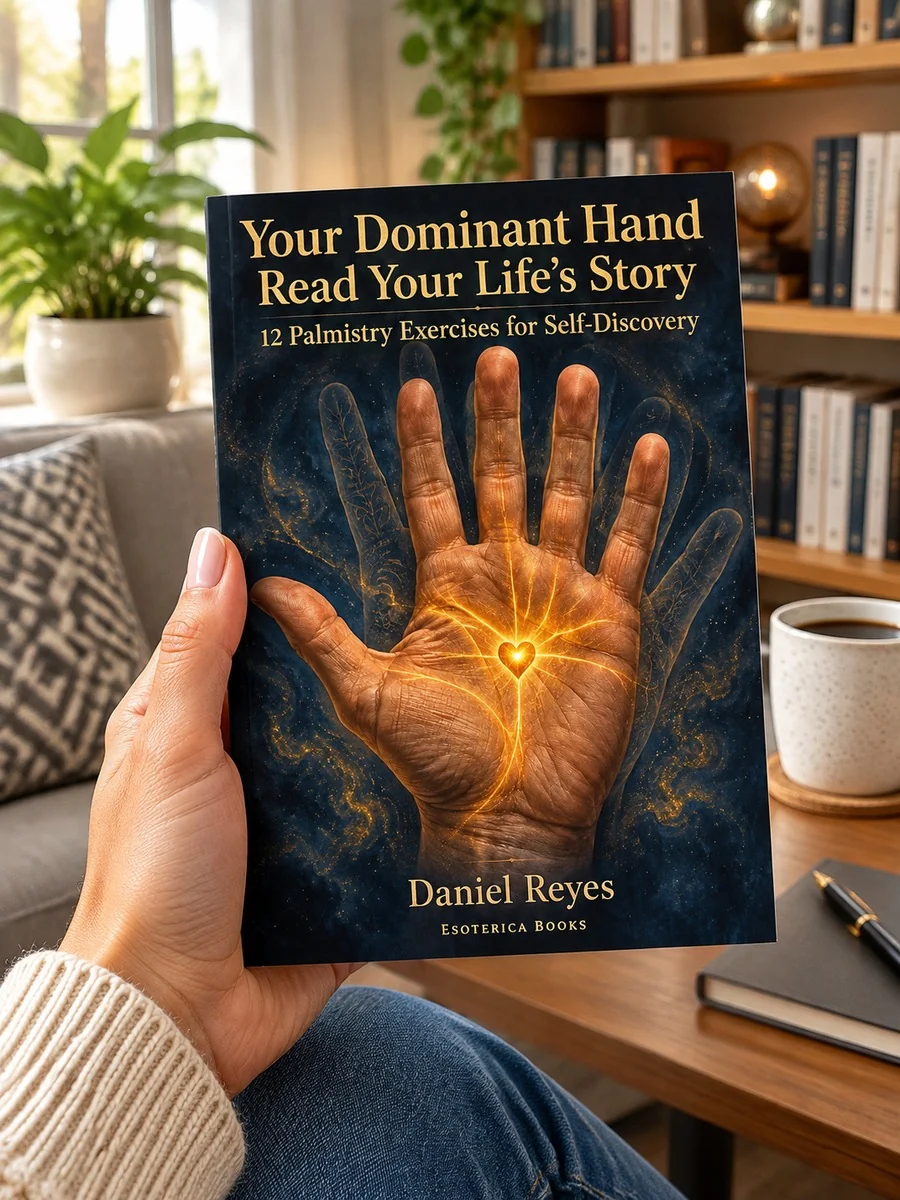

Your Dominant Hand: Read Your Life's Story
Discover what your dominant hand traditionally represents and learn to read both palms through 12 guided exercises.
What does your dominant hand mean in palmistry, and why does it sometimes look different from your other hand? Traditionally, the dominant hand represents conscious choices, present development, and the life you actively shape, while the non-dominant hand symbolizes inherited tendencies and underlying potential. Using the four-step Hand-to-Heart Method, you will explore these interpretations through 12 practical exercises. Learn to identify the four major palm lines, recognize seven planetary mounts, examine distinctive markings, compare both hands, and record your discoveries in a personal palmistry journal.
Palmistry is a traditional interpretive practice that examines the shape of the hand, its lines, fingers, mounts, and markings. Different schools approach the relationship between dominant and non-dominant hands differently, so interpretations are best understood within their particular traditions.


📝 Description: Your Dominant Hand: Read Your Life's Story
📖 Why choose it
Why this book is worth reading
The most useful starting point is also the simplest: identify the hand you naturally use and look at it carefully. From there, the Hand-to-Heart Method gives you an orderly way to explore four major lines, seven planetary mounts, finger characteristics, and distinctive markings. The 12 exercises turn abstract symbolism into practical observation, while dated sketches and journal prompts help you revisit your interpretations. You will also learn why reading both hands together offers a fuller picture than concentrating on just one.
⭐ Reader reviews
Reader rating
The strongest feature here is the Hand-to-Heart Method, which gives beginners a sensible sequence for approaching palmistry: observe, trace, compare, and reflect. The opening exercise is particularly practical, asking you to identify your dominant hand through familiar everyday activities before recording its visible characteristics. The contents also provide a useful progression from the four major lines to planetary mounts, finger symbolism, distinctive markings, and two-hand comparisons. Importantly, the distinction between the two hands is presented as a traditional interpretation rather than a universal rule. One limitation: experienced palmists looking for advanced interpretive systems or extensive comparisons between different palmistry schools may find the introductory approach too basic. For newcomers, however, the structure is clear and accessible.
❓ Frequently asked questions
📖 Who should read this
Ideal if you are curious about the traditional meaning of your dominant hand, want an approachable introduction to palmistry, or would like a structured way to explore the symbolism of both palms. Particularly suitable if you enjoy hands-on exercises, personal reflection, and keeping a journal of your observations.
🎯 Key themes and symbolism
Dominant Hand Symbolism
Major Palm Lines
Planetary Mounts
Two-Hand Comparison
📜 Historical context
📚 Glossary
- Dominant Hand
- Non-dominant Hand
- Major Lines
- Planetary Mounts
- Markings
- Palmistry Journal
📔 Questions to reflect on
- Which qualities do you associate with the way you use your dominant hand in everyday life, and how might traditional palmistry symbolism encourage you to reflect on your conscious choices?
- What differences do you notice when you place your dominant and non-dominant palms side by side, particularly in their major lines, mounts, and finger proportions?
- If you created a dated palmistry journal today, which three visible features would you record first, and what personal experiences would you connect with your observations?
📖 Read on the blog
✍️ More books by this author Daniel Reyes










🏛 Books from this publisher Esoterica Books
All books from this publisher →






You might also like
See more →

Have a question about this item?
Ask about the edition, condition, delivery or anything else — we reply by email or phone, usually within a day.
