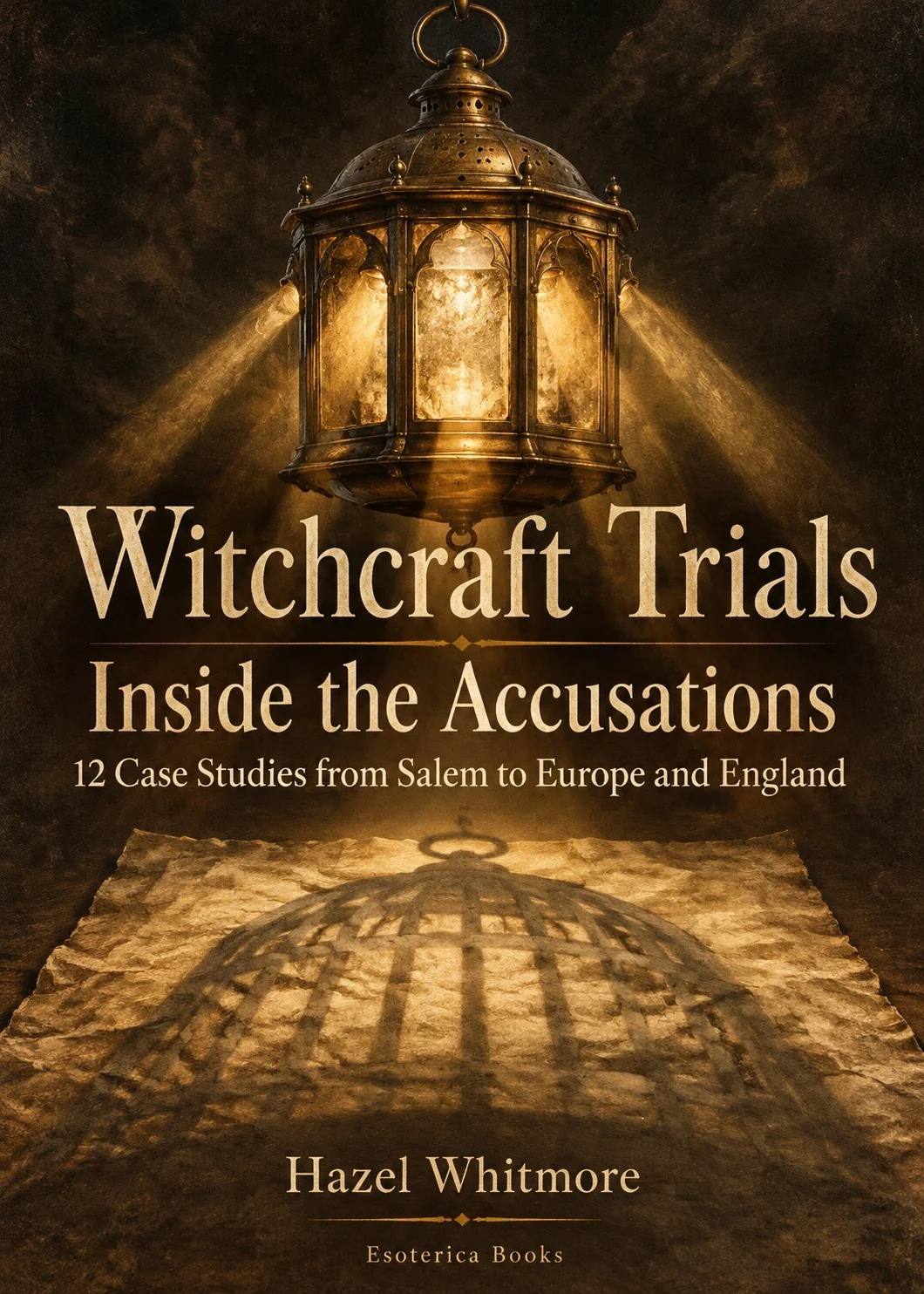
Witchcraft Trials: Inside the Accusations
Discover how witchcraft accusations became court cases, and investigate the historical records behind Salem and beyond.
Why did accusations of witchcraft become formal prosecutions, and what happened to the people caught in them? Hazel Whitmore introduces a practical five-part investigative method, the Case Lantern, for examining the setting, accusations, evidence, judgments, and later memory of historical witchcraft trials. Across twelve chapters, readers explore Salem, European persecutions, and English and Scottish proceedings. They learn to distinguish depositions from confessions, accusations from convictions, and contemporary records from popular retellings, building the skills to investigate historical cases with clarity and confidence.
Witchcraft accusations developed within particular religious beliefs, neighborhood relationships, community tensions, and legal systems. The book places Salem alongside English, Scottish, and European proceedings, showing how local circumstances shaped both accusations and their lasting cultural memory.


📝 Description: Witchcraft Trials: Inside the Accusations
📖 Why choose it
Why this book is worth reading
The real strength of this book is its investigative approach. Instead of simply retelling familiar witch-trial stories, it teaches you how to take them apart: identify the original accusation, examine the testimony, follow the courtroom decisions, and compare the historical record with later accounts. The Case Lantern gives beginners a repeatable method they can use beyond Salem. If you have ever wondered how to tell documented history from dramatic embellishment, these twelve chapters provide a practical starting point.
⭐ Reader reviews
Reader rating
Hazel Whitmore's strongest editorial choice is the Case Lantern: a clear five-part framework that gives readers a practical way to investigate witchcraft prosecutions without confusing allegations with documented events. The Salem material establishes the importance of distinguishing convictions from executions, while the planned comparisons with England, Scotland, and Europe give the twelve-chapter structure a useful historical breadth. The notebook exercises, evidence worksheets, and chronological case maps make the approach accessible to beginners. The main limitation of the preview is that it explains the investigative method more fully than it demonstrates a complete, detailed case study. Readers seeking extensive archival transcriptions or specialist legal analysis may want greater depth.
❓ Frequently asked questions
📖 Who should read this
Ideal for readers interested in the Salem witch trials, European witchcraft persecutions, British legal history, and the historical origins of familiar witch-trial stories. Beginners who enjoy working with timelines, historical documents, and investigative questions will find the practical framework particularly useful.
🎯 Key themes and symbolism
Historical Witchcraft Trials
Salem Court Proceedings
Evidence and Testimony
Historical Records and Memory
📜 Historical context
📚 Glossary
- The Case Lantern
- Spectral Evidence
- Deposition
- Confession
- Acquittal
- Conviction
📔 Questions to reflect on
- What familiar story about the Salem witch trials would you most like to investigate using contemporary historical records?
- How might neighborhood relationships, personal disputes, and community tensions influence the way an accusation develops?
- When a historical document records an accusation or confession, what additional questions would help you understand what actually happened?
📖 Read on the blog
✍️ More books by this author Hazel Whitmore


🏛 Books from this publisher Esoterica Books
All books from this publisher →




You might also like
See more →
Have a question about this item?
Ask about the edition, condition, delivery or anything else — we reply by email or phone, usually within a day.
