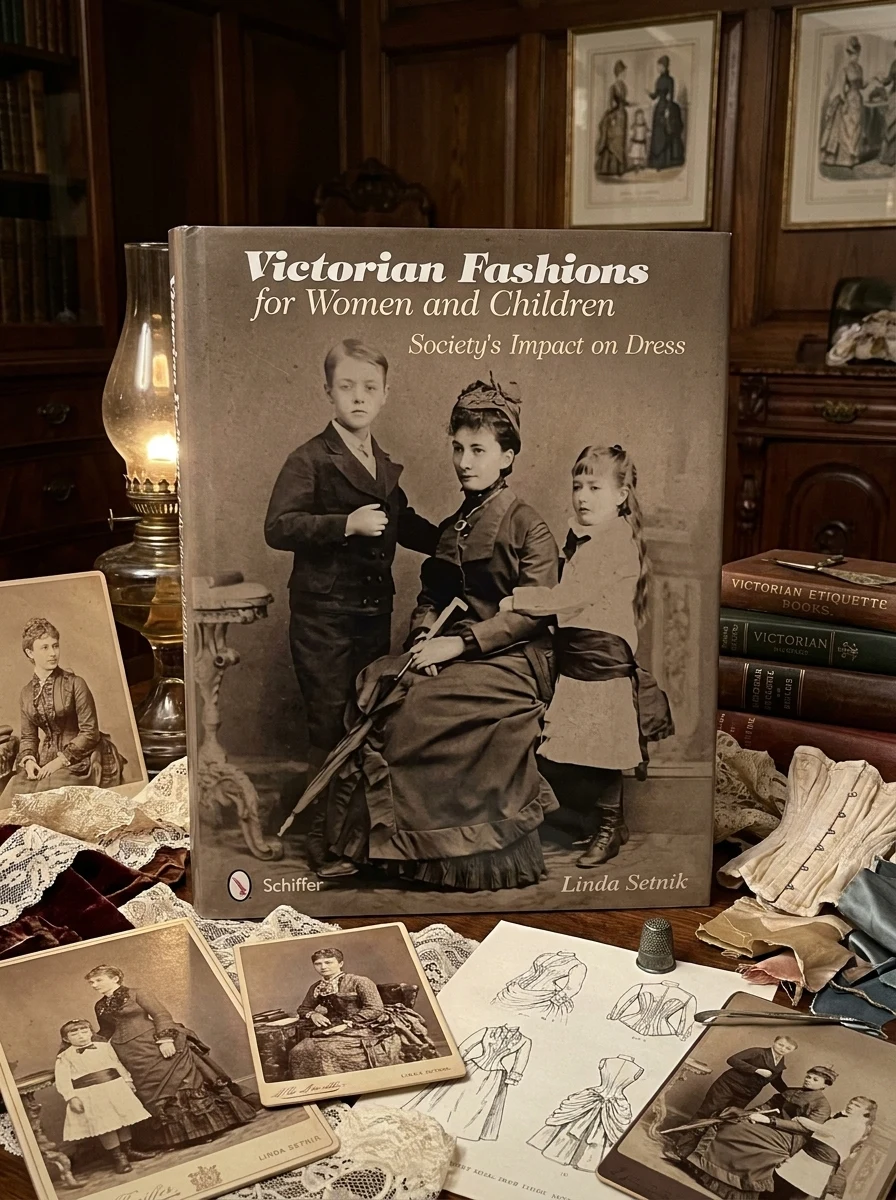
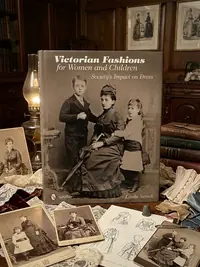
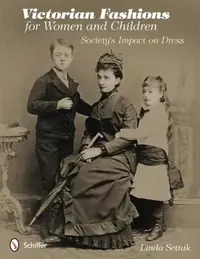
Victorian Fashions for Women and Children: Society's Impact on Dress
This edition can be ordered. No arrival date is confirmed.
Victorian dress was a cage of silk and corsetry, binding women's bodies and spirits alike.
Linda Setnik’s meticulously researched volume dissects the sartorial world of women and children between 1860 and 1900. Through over two hundred twenty-five archival photographs and surviving textile fragments, the book exposes the rigid social mechanics behind fashion. It moves beyond mere aesthetics to analyze how medical advice, etiquette manuals, and societal expectations compelled females to endure physical pain and health risks. The text illuminates why women accepted these constraints, linking childhood conditioning to adult compliance, offering a visceral look at the anatomy of Victorian conformity and the hidden costs of elegance.
This work sits within the scholarly tradition of fashion history and social analysis, examining how sartorial choices reflect broader societal mechanics in the late nineteenth century.


📝 Description: Victorian Fashions for Women and Children: Society's Impact on Dress
💎 Expert review
📖 Why choose it
Why this book is worth reading
Readers who are fascinated by the intersection of gender, power, and material culture will find immense value in this meticulously researched volume. Linda Setnik offers more than just a visual catalog; she provides a visceral exploration of how Victorian women’s bodies were disciplined through clothing. By utilizing archival photographs and textile fragments, the book illuminates the rigid social mechanics that compelled females to endure physical pain for the sake of elegance. It is particularly rewarding for those interested in understanding the psychological conditioning of childhood that led to adult compliance with societal expectations. If you seek to understand the hidden costs of Victorian conformity and the anatomy of a 'cage of silk,' this text provides the necessary historical depth and critical insight.
⭐ Reader reviews
Reader rating
Perfect companion for my morning study sessions. It rewards patience more than any book I've bought this year. Will be gifting a copy to a friend.
I keep coming back to this one. Plenty of passages worth underlining; my copy is already full of margin notes. I appreciated how the argument builds steadily from first principles. Already eyeing my next order.
While Setnik’s analysis of medical advice and etiquette manuals is compelling, this book may not suit readers seeking purely aesthetic appreciation or light-hearted costume drama. It is a serious academic study that demands attention to the social constraints and health risks inherent in Victorian dress. Those looking for simple pattern replication or romanticized narratives of high society will likely find the focus on 'rigid social mechanics' and physical endurance too dry or heavy. However, for those willing to engage with the darker realities behind the elegance, it serves as an essential, evidence-based critique of nineteenth-century gender norms and the punitive nature of fashionable attire.
❓ Frequently asked questions
📖 Who should read this
Readers interested in the intersection of gender politics, textile history, and social control will find this essential. It appeals to those who wish to understand how clothing functions as a mechanism of power, rather than just a marker of aesthetic trends.
🎯 Key themes and symbolism
The Architecture of Constraint
This section explores how structural elements like corsets and heavy skirts physically limited movement, serving as tangible metaphors for the restricted roles women occupied in Victorian society. It analyzes how these garments functioned as both armor and prison, dictating posture and behavior through their sheer physical weight and tightness.
Medical Justifications for Suffering
The book examines how contemporary medical literature was twisted to validate harmful fashion trends. It details how doctors and health experts paradoxically promoted restrictive clothing as beneficial for moral and physical hygiene, creating a dangerous feedback loop where pain was reframed as propriety and virtue.
Childhood Conditioning and Compliance
Setnik investigates the early socialization of girls, showing how restrictive childhood garments prepared young minds for adult subjugation. By analyzing period advice literature, the text reveals how obedience to nonsensical dress codes was taught early, ensuring women internalized societal control as natural law rather than oppression.
💬 Quotes from the book
“The body was not merely dressed; it was engineered to conform.”
“Health was sacrificed at the altar of propriety.”
📜 Historical context
📚 Glossary
- Sartorial Subjugation
- Period Construction
- Etiquette Literature
📔 Questions to reflect on
- How do modern fashion trends restrict your movement or define your social identity in ways similar to Victorian constraints?
- What 'rules' of appearance do you follow without questioning, and who benefits from your compliance?
- In what ways is your body 'engineered' by the clothing you choose to wear daily?
🏛 Books from this publisher Schiffer Publishing
All books from this publisher →
 89
89




You might also like
See more → 91
91

 91
91
 91
91
 91
91