US shipping Secure card payment Occult and esoteric books

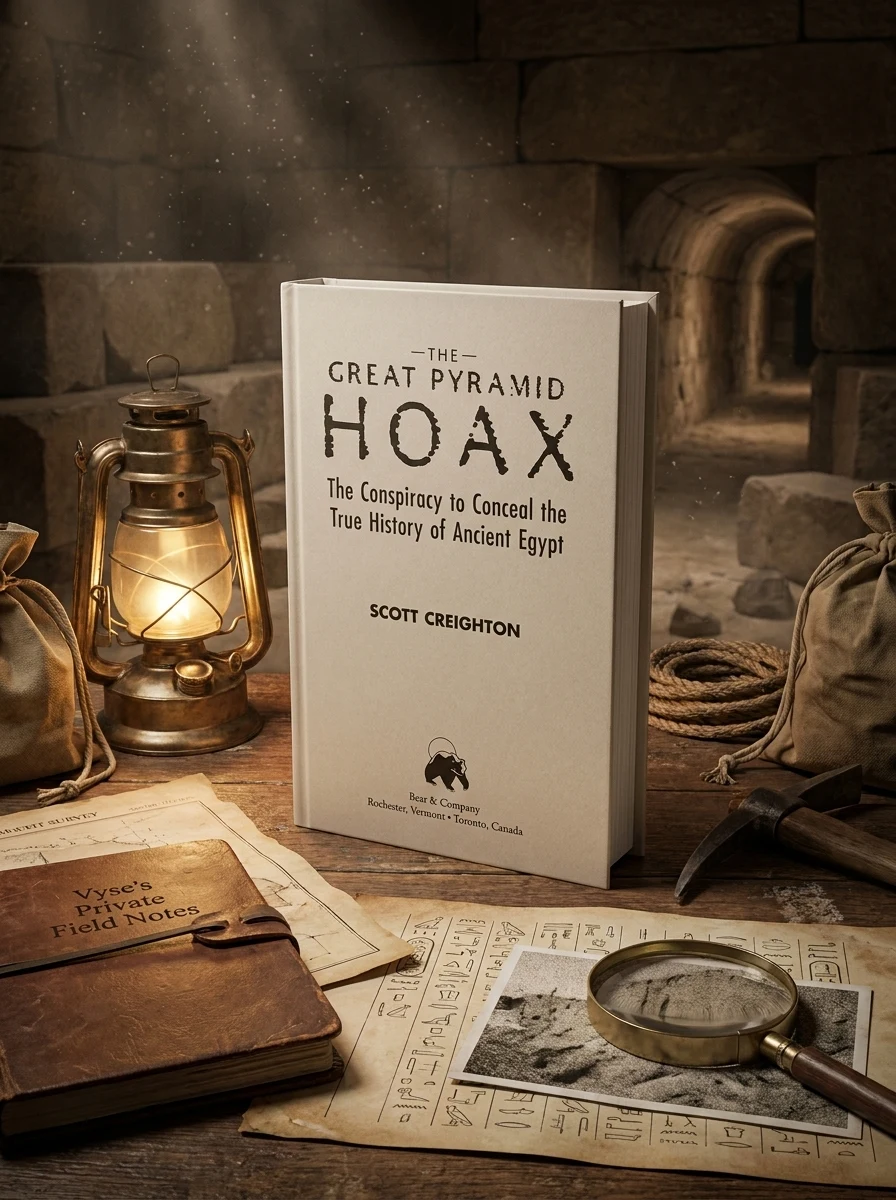
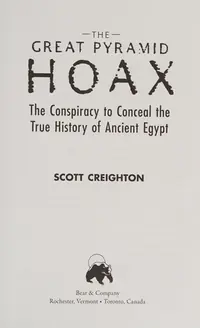
The Great Pyramid Hoax: The Conspiracy to Conceal the True History of Ancient Egypt

Creighton, Scott
Reader rating
4.4
(3 reviews) 71 sold
Availability to be confirmed

This edition can be ordered. No arrival date is confirmed.

📚 ABOUT THE BOOK

Colonel Vyse forged the pyramid’s only dating evidence to claim glory for himself.

Scott Creighton dismantles the foundational myth of Giza by exposing the fraudulent quarry marks that anchor the pyramid’s timeline. Using Vyse’s own private notes, survey data, and high-resolution imaging, the author demonstrates how the Khufu cartouche was artificially created in 1837. This is not merely a debunking but a psychological profile of a man desperate for immortality through deceit. The book challenges the entire archaeological consensus built upon this single, compromised piece of evidence.

Key themes
Archaeological fraud Historical revisionism Colonial ambition
Historical context

This work sits firmly within the tradition of alternative Egyptology and revisionist history, challenging established archaeological narratives through esoteric inquiry. It appeals to readers interested in spiritualism and the hidden mechanisms behind historical consensus.


Difficulty
●● Moderate
Fans will love it
Erich von Däniken · Graham Hancock · John Anthony West · The Chariots of the Gods?
🕊️ Spiritualism
🏛 Bear & Company 📖 224 pages 📔 Paperback 📐 Paperback ISBN: 9781591437895
Fun fact
Creighton delivers a meticulous forensic audit of a historical lie. He excels at juxtaposing Vyse’s public boasts against his private doubts, creating a compelling narrative of deceit. However, conventional Egyptologists will find this dismissive and lacking in broader contextual evidence. It sits firmly in the realm of critical inquiry, offering a necessary counterpoint to the uncritical acceptance of 19th-century findings. A vital read for those questioning the foundations of their history.
📚 This book appears in Esoterica Books

📝 Description: The Great Pyramid Hoax: The Conspiracy to Conceal the True History of Ancient Egypt

Reveals how the only hard evidence that dates the Great Pyramid--the quarry marks discovered by Colonel Vyse in 1837--was forged - Includes evidence from the time of the discovery of the marks: Vyse's private field notes, surveys, facsimile drawings, and eye-witness testimony - Explains why Vyse was driven to perpetrate a fraud inside the Great Pyramid - Examines recent chemical analysis of the marks and high-definition photos to reveal errors and other anomalies within the forged Khufu cartouche Despite millennia of fame, the origins of the Great Pyramid of Giza are shrouded in mystery. Believed to be the tomb of an Egyptian king, even though no remains have ever been found, its construction date of roughly 2550 BCE is tied to only one piece of evidence: the crudely painted marks within the pyramid's hidden chambers that refer to the 4th Dynasty king Khufu, discovered in 1837 by Colonel Howard Vyse and his team. Using evidence from the time of the discovery of these "quarry marks"--including surveys, facsimile drawings and Vyse's private field notes--along with high definition photos of the actual marks, Scott Creighton reveals how and why the marks were faked. He investigates the anomalous and contradictory orthography of the quarry marks through more than 75 photos and illustrations, showing how they radically depart from the established canon of quarry marks from this period. He explains how the orientation of the Khufu cartouche contradicts ancient Egyptian writing convention and how one of the signs is from a later period. Analyzing Vyse's private diary, he reveals Vyse's forgery instructions to his two assistants, Raven and Hill, and what the anachronistic sign should have been. He examines recent chemical analysis of the marks along with the eye-witness testimony of Humphries Brewer, who worked with Vyse at Giza in 1837 and saw forgery take place. Exploring Vyse's background, including his electoral fraud to become a member of the British Parliament, he explains why he was driven to perpetrate a fraud inside the Great Pyramid. Proving Zecharia Sitchin's claim that the quarry marks are forgeries and removing the only physical evidence that dates the Great Pyramid's construction to the reign of Khufu, Creighton's study strikes down one of the most fundamental assertions of orthodox Egyptologists and reopens long-standing questions about the Great Pyramid's true age, who really built it, and why.

💎 Expert review

💎
Esoterica Books editorial team
Occult literature desk
Creighton presents a provocative argument that may alienate traditionalists but will resonate strongly with skeptics of mainstream Egyptology. The focus on psychological profiling adds depth, though the reliance on a single compromised piece of evidence might frustrate readers seeking broader archaeological consensus. It is not suited for those who prefer uncritical acceptance of established historical timelines or who find conspiracy theories tedious. However, for readers open to alternative perspectives and detailed forensic analysis of historical claims, it serves as a stimulating, if polarizing, addition to the spiritualism shelf.
✓ EDITOR'S REVIEW

📖 Why choose it

📖

Why this book is worth reading

Readers fascinated by the intersection of archaeology, conspiracy theory, and psychological profiling will find this book deeply engaging. Scott Creighton offers a compelling narrative that goes beyond simple debunking to explore the human desire for immortality through deceit. If you enjoy having foundational historical myths dismantled with rigorous, albeit controversial, evidence, this text provides a satisfying intellectual challenge. It is ideal for those who question official narratives and appreciate detailed investigations into how history is constructed, fabricated, or concealed by powerful figures seeking glory.

⭐ Reader reviews

The starting rating comes from the team Esoterica Books —
⭐ Esoterica editorial review Editorial rating 4.7/5
★★★★
Readers skeptical of mainstream Egyptology who crave primary source analysis over accepted dogma. If you enjoy investigative journalism that peels back the layers of historical lies, this text will satisfy your curiosity about the pyramid's true origins.

Reader rating

4.4
Based on 3 reviews
5
0
4
3
3
0
2
0
1
0
D
David W. ✓ Verified purchase
April 10, 2026
Solid edition

Ordered this after seeing it referenced in another book I was studying. Solid binding, decent paper — holds up to heavy use. A few pages arrived with light corner wear, though nothing serious. Happy enough with the purchase.

S
Steven R. ✓ Verified purchase
April 30, 2025
Good addition to the shelf

Not my usual area but wanted to branch out. It's become a regular reference in my practice. A few pages arrived with light corner wear, though nothing serious. Still worth having on the shelf.

E
Esoterica Books editorial team

Creighton presents a provocative argument that may alienate traditionalists but will resonate strongly with skeptics of mainstream Egyptology. The focus on psychological profiling adds depth, though the reliance on a single compromised piece of evidence might frustrate readers seeking broader archaeological consensus. It is not suited for those who prefer uncritical acceptance of established historical timelines or who find conspiracy theories tedious. However, for readers open to alternative perspectives and detailed forensic analysis of historical claims, it serves as a stimulating, if polarizing, addition to the spiritualism shelf.

❓ Frequently asked questions

No, it specifically targets the validity of the 2550 BCE date derived from Vyse's forged marks, arguing that without this evidence, the timeline is unproven.
Yes, he utilizes high-definition photography and chemical analysis alongside Vyse’s own contradictory field notes to demonstrate the artificial nature of the cartouche.

📖 Who should read this

Readers skeptical of mainstream Egyptology who crave primary source analysis over accepted dogma. If you enjoy investigative journalism that peels back the layers of historical lies, this text will satisfy your curiosity about the pyramid's true origins.

🎯 Key themes and symbolism

Archaeological fraud

Historical revisionism

Colonial ambition

💬 Quotes from the book

“The marks were not ancient graffiti but a modern fabrication designed to secure Vyse's place in history.”

“Vyse’s private notes reveal a mind unraveling under the pressure of fabrication.”

📜 Historical context

Placed within the 19th-century tradition of Egyptomania, where wealthy amateurs like Vyse raced to claim discoveries for British prestige. This work intersects with modern alternative history movements that question the official timeline of ancient civilizations, challenging the Victorian-era narrative that still dominates academic Egyptology today.

📚 Glossary

Quarry Marks
Khufu Cartouche
Relieving Chambers

📔 Questions to reflect on

  1. How does the desire for personal legacy influence our interpretation of historical evidence?
  2. What other widely accepted historical facts might rest on a single, unverified piece of evidence?
  3. Consider the role of colonial narratives in shaping our understanding of ancient civilizations.

🏛 Books from this publisher Bear & Company

All books from this publisher →
You might also like

See more →