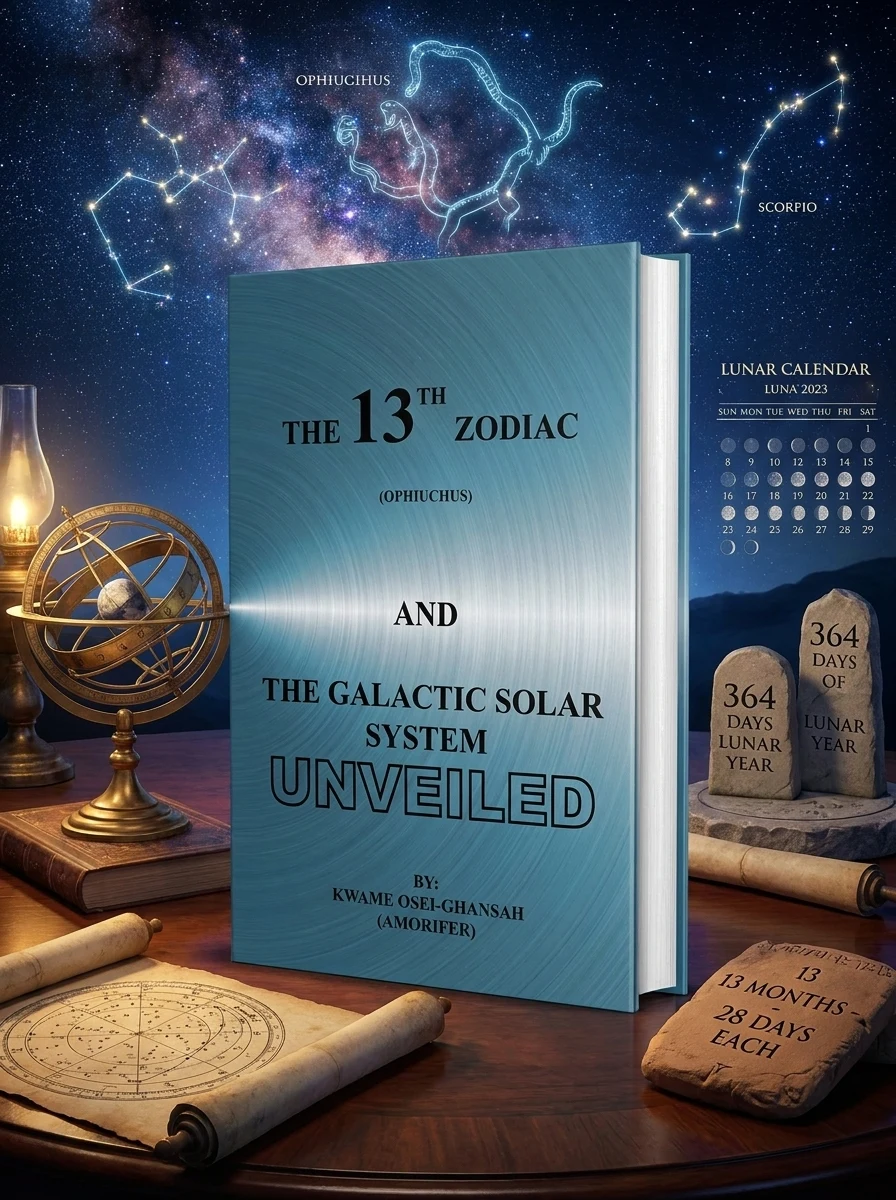
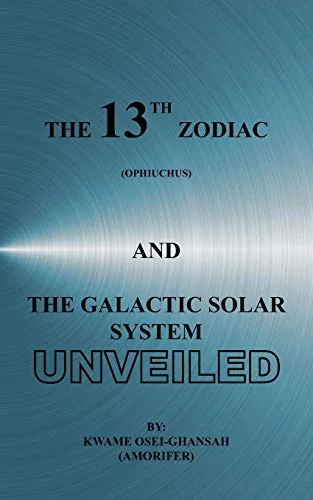
The 13th Zodiac (Ophiuchus and the Galactic Solar System Unveiled
A text introducing Ophiuchus and proposing a thirteen-month, 28-day lunar calendar system.
Kwame Osei-Ghansah outlines an alternative astronomical model focused on Ophiuchus, the serpent holder positioning between Scorpio and Sagittarius. The book re-evaluates modern calendars by examining 28-day lunar months, 364-day years, and the history behind month names such as September and October. It connects planetary movements to a 26,000-year galactic orbit and discusses the shift from the Age of Pisces to the Age of Aquarius. Additionally, the text critiques Genesis chapter one using observations about galactic light compactness and systemic galaxy structures.
This work sits within contemporary astrological and cosmographical revisionism. Published by Authorhouse UK, the text draws directly on critiques of the Gregorian calendar, biblical creation stories in Genesis, and the astronomical shift from the Age of Pisces into the Age of Aquarius.


📝 Description: The 13th Zodiac (Ophiuchus and the Galactic Solar System Unveiled
💎 Expert review
📖 Why choose it
Why this book is worth reading
Readers fascinated by the intersection of astronomy, history, and spiritual cosmology will find this book a compelling invitation to rethink their understanding of time and celestial mechanics. If you have ever felt that the standard twelve-sign zodiac or the irregular Gregorian calendar lacked intuitive harmony, Osei-Ghansah offers a rigorous alternative framework. This text is ideal for those willing to engage with dense arguments about lunar cycles and galactic structures. It appeals to seekers of unified cosmic theories who desire a deeper, more interconnected view of the universe beyond conventional solar system models. By embracing the 13-month year and Ophiuchus, readers gain access to a reimagined cosmic conspiracy that promises to unveil the true structure of existence through a meticulously argued, albeit radical, perspective.
⭐ Reader reviews
Reader rating
Osei-Ghansah presents a bold, controversial thesis that demands careful scrutiny rather than passive consumption. While the exploration of Ophiuchus and lunar cycles offers fresh perspectives for open-minded esotericists, this book is not suited for those adhering strictly to conventional astronomical data or traditional Western astrological frameworks. Readers seeking empirical scientific validation or simple, accessible guides will likely find the dense arguments and fundamental challenges to established systems frustrating. It is best approached as a speculative philosophical inquiry rather than factual science. Those unable to suspend disbelief regarding the 'false construct' of current calendars may feel alienated by the author's assertive tone and radical reinterpretations of cosmic history.
❓ Frequently asked questions
📖 Who should read this
If you question conventional wisdom, are drawn to hidden knowledge, and seek a radical re-evaluation of time, astrology, and our place in the cosmos, this book is your guide to a startling new reality. Prepare to have your most fundamental assumptions challenged.
🎯 Key themes and symbolism
The Thirteenth Zodiac
This book unveils the existence of Ophiuchus, the Serpent Bearer, as the true thirteenth zodiac sign, previously omitted from conventional astrology. It contends that the constellations forming the backdrop to each lunar month dictate our astrological placements, fundamentally altering the understanding of one's birth sign and cosmic influences.
Calendar Rectification
Osei-Ghansah systematically dismantles the Gregorian calendar, arguing that a natural lunar cycle dictates a 28-day month and a 13-month year. He questions the arbitrary nature of 30- and 31-day months and the concept of leap years, suggesting our current timekeeping is a deeply flawed, man-made construct that disconnects us from cosmic rhythm.
Unified Cosmic Structure
Beyond calendar and zodiac, the author presents a radical cosmology where the idea of a separate 'solar system' is obsolete. He asserts that only 'Galactic Suns' and 'Planetary Galaxies' exist as fundamental units, distinguished by the compactness of their light, implying an interconnected universe far grander than previously conceived.
📜 Historical context
📚 Glossary
- Ophiuchus
- Lunar Calendar
- Galactic Sun
📔 Questions to reflect on
- How would a 13-month, 28-day lunar calendar change your daily rhythms and perceptions of time?
- If your birth chart shifted due to a 13-sign zodiac, what new aspects of your personality or destiny might emerge?
- Consider the author's assertion that there is no separate 'solar system.' How does this unified galactic view alter your understanding of humanity's place in the cosmos?
📖 Read on the blog
🏛 Books from this publisher Authorhouse UK
All books from this publisher →






You might also like
See more →


Have a question about this item?
Ask about the edition, condition, delivery or anything else — we reply by email or phone, usually within a day.
