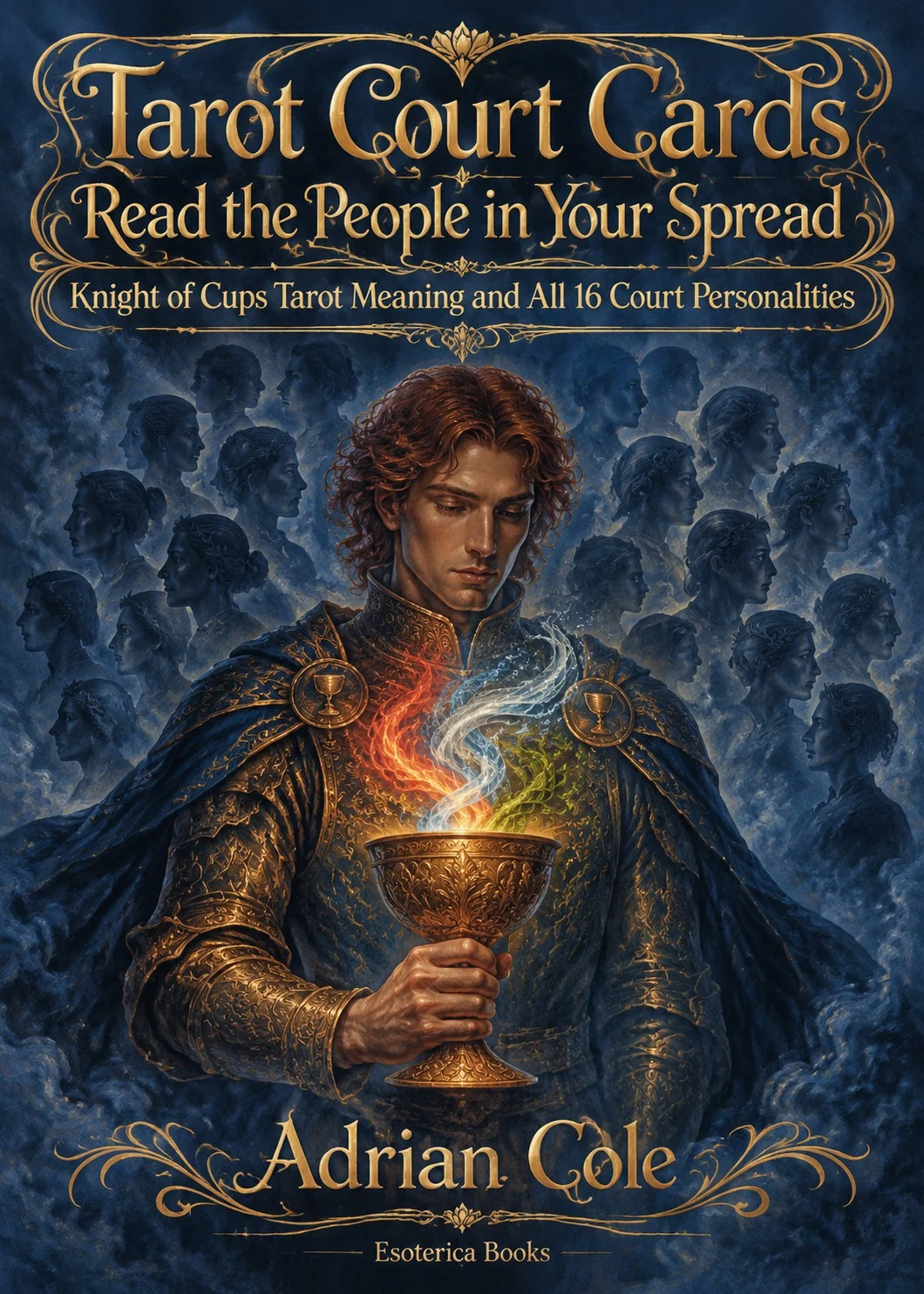
Tarot Court Cards: Read the People in Your Spread
Meet all 16 tarot court personalities and learn who—or what—they represent in your readings.
Tarot court cards can be challenging to interpret, especially when you're unsure whether a Page, Knight, Queen, or King represents a person, an aspect of yourself, or an energy influencing a situation. This practical guide introduces all 16 personalities through the F.A.C.E. Method: Find, Assess, Connect, Explore. Discover the four ranks, elemental associations, astrological connections, upright and reversed meanings, and the relationships between multiple court cards. Build a clear, contextual approach to interpreting the people and personalities in your spreads.
Tarot court cards belong to the Minor Arcana and combine four traditional ranks with four elemental suits. Their interpretation draws on symbolic associations, personality archetypes, and the reader's chosen tarot tradition, with astrological correspondences varying between systems.


📝 Description: Tarot Court Cards: Read the People in Your Spread
📖 Why choose it
Why this book is worth reading
Court cards can make an otherwise straightforward tarot reading surprisingly complicated. Memorizing sixteen individual descriptions isn't enough when the same card might represent another person, your own behavior, or the approach a situation calls for. The F.A.C.E. Method offers a repeatable way to bring these possibilities together. By combining rank, suit, personality, spread position, and surrounding cards, you'll have a practical framework for interpreting unfamiliar combinations instead of relying on isolated card definitions.
⭐ Reader reviews
Reader rating
Adrian Cole's guide tackles one of the most persistent challenges for beginning tarot readers: understanding what court cards actually represent in a spread. Its strongest feature is the F.A.C.E. Method, which organizes interpretation into four manageable questions rather than treating sixteen personalities as disconnected definitions. The chapter sequence is sensible, moving from basic recognition through individual ranks, suits, reversals, and multiple-card combinations. The attention to context and the distinction between personality, role, and energy are particularly useful. One limitation: the preview introduces the framework but does not provide a complete worked interpretation of an entire spread. Readers seeking immediate depth will want the detailed card-by-card chapters. Overall, a clearly organized introduction to a frequently confusing part of tarot.
❓ Frequently asked questions
📖 Who should read this
This book is for tarot beginners who understand the basic structure of a deck but struggle to interpret Pages, Knights, Queens, and Kings. It's also suitable for readers who want a more consistent method for interpreting court cards as people, personal qualities, or energies within a situation.
🎯 Key themes and symbolism
Sixteen Court Personalities
Elemental Correspondences
Upright and Reversed
Contextual Card Interpretation
📜 Historical context
📚 Glossary
- Court Cards
- F.A.C.E. Method
- Elemental Correspondence
- Upright
- Reversed
- Minor Arcana
📔 Questions to reflect on
- Which of the sixteen court personalities do you recognize most strongly in yourself, and which qualities of that card stand out in your everyday decisions?
- When a court card appears in a reading, what clues in the question, spread position, and neighboring cards help you decide whether it represents a person, an aspect of yourself, or an energy?
- How do the four elemental personalities—Fire, Water, Air, and Earth—change your understanding of the same court rank across the four suits?
📖 Read on the blog
✍️ More books by this author Adrian Cole




🏛 Books from this publisher Esoterica Books
All books from this publisher →




You might also like
See more →

Have a question about this item?
Ask about the edition, condition, delivery or anything else — we reply by email or phone, usually within a day.
