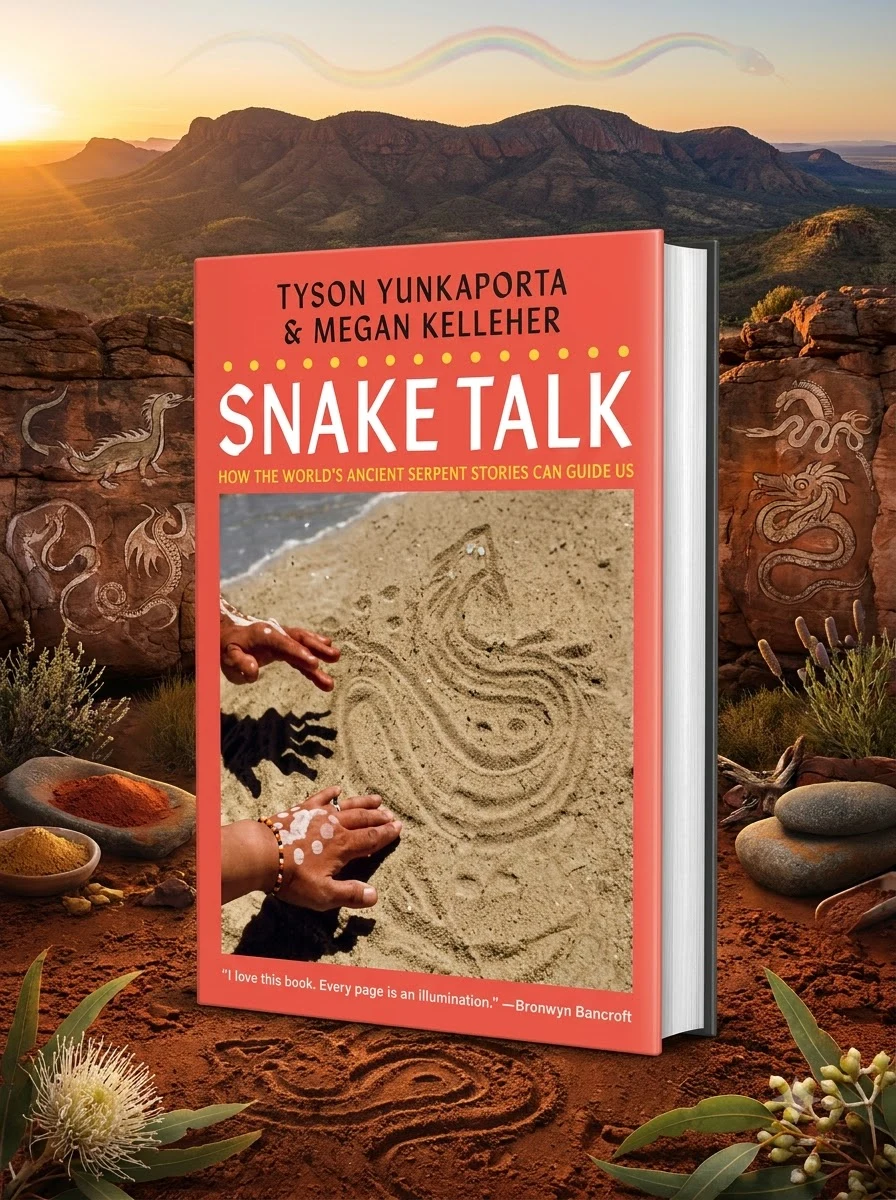
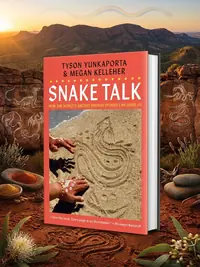
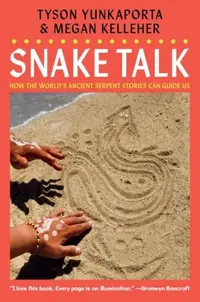
Snake Talk: How the World's Ancient Serpent Stories Can Guide Us


This edition can be ordered. No arrival date is confirmed.
Unearth the serpentine wisdom woven through creation, destruction, and global spiritual lore.
Delve into the profound symbolism of the serpent across Indigenous cultures worldwide. Tyson Yunkaporta and Megan Kelleher embark on an illuminating journey, revealing how ancient serpentine narratives from the Australian Dreaming to Mesoamerican myths offer vital guidance for our contemporary challenges. This work explores the serpent as a bridge between realms, a unifier, and a repository of essential knowledge, inviting readers to perceive the world through a lens of interconnected wisdom and pattern recognition rooted in deep ancestral understanding. It's a compelling exploration of universal truths.
This work resides within the realm of esoteric history and comparative mythology, specifically drawing upon Indigenous Australian traditions such as the Dreaming alongside Mesoamerican spiritual lore. It serves as a bridge between ancient ancestral narratives and contemporary spiritual understanding.


📝 Description: Snake Talk: How the World's Ancient Serpent Stories Can Guide Us
💎 Expert review
📖 Why choose it
Why this book is worth reading
Readers seeking a deeper connection to ancestral wisdom will find profound value in this exploration of serpentine symbolism. Those interested in how ancient stories guide modern challenges will appreciate the unifying perspective offered by Tyson Yunkaporta and Megan Kelleher. It is ideal for individuals drawn to interconnected worldviews who wish to understand the serpent as a repository of essential knowledge rather than merely a symbol of danger. By examining creation and destruction through global spiritual lore, this book offers vital guidance for navigating contemporary life with a lens of deep ancestral understanding.
⭐ Reader reviews
Reader rating
This text offers an illuminating journey into the profound symbolism of the serpent across diverse cultures, presenting it as a bridge between realms and a unifier of universal truths. However, readers expecting dry academic historiography or scientific zoology will find little appeal here, as the focus remains firmly on spiritual lore and pattern recognition rather than empirical data. Those who prefer linear, Eurocentric historical narratives may struggle with the non-linear approach rooted in Indigenous understanding. It is best suited for those open to esoteric interpretations and global spiritual connections, ensuring it does not suit skeptics of ancestral wisdom.
❓ Frequently asked questions
📖 Who should read this
If you are drawn to comparative mythology, Indigenous wisdom traditions, or seeking ancient solutions to modern dilemmas, this book is for you. It's an essential read for those eager to expand their understanding of global spiritual connections and the power of symbolic thought.
🎯 Key themes and symbolism
Universal Serpent Symbolism
The book meticulously traces the ubiquitous presence of serpent figures like the Basilisk, Naga, and Quetzalcoatl across diverse civilizations. It posits that these seemingly disparate myths share a foundational 'Lore,' suggesting a common wellspring of human understanding regarding creation, transformation, and our place within the cosmic order, transcending geographical and cultural boundaries.
Indigenous Knowledge Revival
Through the lens of Aboriginal Australian 'Lore,' the authors illuminate how Indigenous ways of knowing offer critical perspectives often overlooked by Western thought. It champions the reintegration of these ancient wisdom systems into modern discourse, presenting them not as relics of the past, but as dynamic, living frameworks for navigating contemporary societal, environmental, and personal crises with holistic insight.
Pattern Recognition & Connection
This work emphasizes the serpent's role as an intrinsic pattern within the fabric of existence—a force that both divides and unites. It encourages readers to develop a deeper sensitivity to these foundational patterns in nature and human interaction, advocating for a return to alignment with creation's rhythms. The serpent becomes a metaphor for recognizing the interconnectedness of all things.
💬 Quotes from the book
“The Great Dividing Range is the body of the Serpent, yet he does not separate us—he brings us together.”
“What if these ancient stories of the Basilisk, Wyvern, Naga, and Quetzalcoatl contain the knowledge we need in this moment of crisis?”
📜 Historical context
📚 Glossary
- Lore
- Dreaming
- Cultural Analysis
📔 Questions to reflect on
- Reflect on a 'serpent-like' pattern or recurring theme in your own life or community. How might understanding its cyclical nature offer new insights?
- Consider a crisis facing the world today. How might a perspective rooted in ancient, interconnected wisdom (like 'Lore') shift your approach to it?
- Identify a symbol from your own cultural heritage. How might a 'deep cultural analysis' reveal hidden meanings or connections to universal truths?
🏛 Books from this publisher HarperOne
All books from this publisher →
You might also like
See more →