US shipping Secure card payment Occult and esoteric books

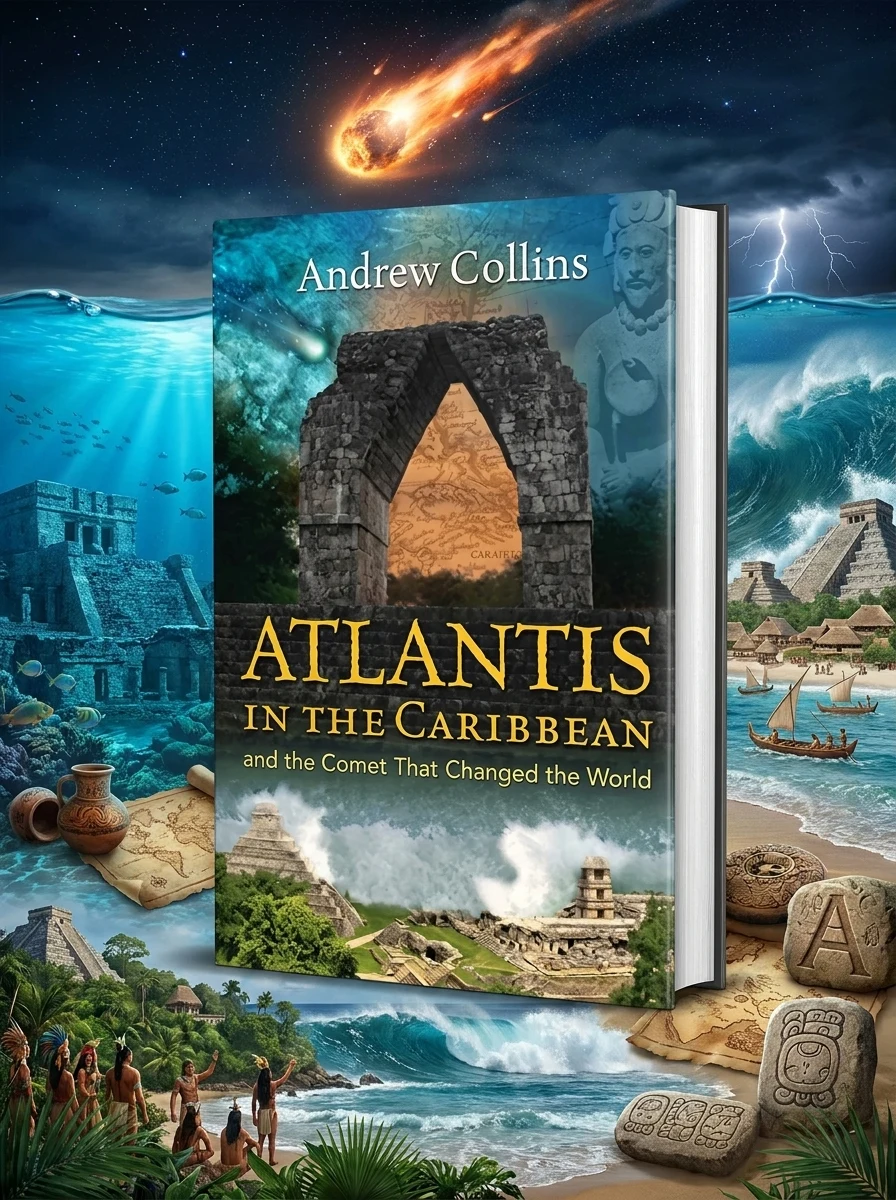
Atlantis in the Caribbean: And the Comet That Changed the World

Collins, Andrew
Reader rating
4.7
(1 reviews) 86 sold
Availability to be confirmed

This edition can be ordered. No arrival date is confirmed.

📚 ABOUT THE BOOK

Did a comet shatter Atlantis, hiding its ruins beneath Caribbean waves?

Andrew Collins boldly redefines the Atlantis narrative, proposing its true location within the Bahamian and Cuban waters. He meticulously compiles archaeological, geological, and mythological evidence to suggest a cataclysmic comet impact around 13,000 years ago, coinciding with the end of the last Ice Age. This celestial event, he argues, not only destroyed the advanced civilization Plato described but also shaped the mysterious Carolina Bays. Collins draws compelling parallels between Plato's account and ancient indigenous legends from the Americas, offering a fresh, interdisciplinary perspective on this enduring enigma.

Key themes
Cometary Cataclysm Theory Ancient Lore & Plato
Historical context

This work sits firmly within the tradition of alternative archaeology and esoteric history, challenging mainstream academic consensus by blending geological theory with ancient mythology. It aligns with speculative historical narratives that seek to uncover hidden truths about human civilization's origins through interdisciplinary evidence.


Difficulty
●● Moderate
Fans will love it
Erich von Däniken · Graham Hancock · Zecharia Sitchin
🕯️ Occult Philosophy
🏛 Bear & Company 📅 2016 📖 528 pages 📔 Paperback 📐 Paperback ISBN: 9781591432654
Fun fact
Andrew Collins's "Atlantis in the Caribbean" offers a fascinating and meticulously argued new theory, deftly weaving together disparate fields of study. It excels in presenting a coherent, compelling narrative for a Bahamian Atlantis destroyed by a comet, drawing extensively from both geology and ancient myth. Readers seeking purely conventional archaeological consensus will be disappointed, but those open to paradigm-shifting interpretations of history will find a treasure trove. This book firmly establishes itself as a significant, provocative contribution to the literature of ancient mysteries and unexplained phenomena.

📝 Description: Atlantis in the Caribbean: And the Comet That Changed the World

An in-depth investigation of the mounting evidence that Atlantis was located in the Bahamas and Caribbean, near Cuba in particular - Explains how Atlantis was destroyed by a comet, the same comet that formed the mysterious Carolina Bays - Reveals evidence of complex urban ruins off the coasts of Cuba and the Bahamas - Shows how pre-Columbian mariners visited the Caribbean and brought back stories of Atlantis's destruction - Compares Plato's account with ancient legends from the indigenous people of North and South America, such as the Maya, the Quiché, and the Yuchi of Oklahoma The legend of Atlantis is one of the most intriguing mysteries of all time. Disproving many well-known Atlantis theories and providing a new hypothesis, the evidence for which continues to build, Andrew Collins shows that what Plato recounts is the memory of a major cataclysm at the end of the last Ice Age 13,000 years ago, when a comet devastated the island of Cuba and submerged part of the Bahaman landmass in the Caribbean. He parallels Plato's account with corroborating ancient myths and legends from the indigenous people of North and South America, such as the Maya of Mesoamerica, the Quiché of Peru, the Yuchi of Oklahoma, the islanders of the Antilles, and the native peoples of Brazil. The author explains how the comet that destroyed Atlantis in the Caribbean was the same comet that formed the mysterious and numerous elliptical depressions, known as the Carolina Bays, found across the mid-Atlantic United States. He reveals evidence of sunken ruins off the coasts of both Cuba and the Bahamas, ancient complexes spanning more than 10 acres that clearly suggest urban development and meticulously planned road systems. Revealing the identity of Plato's "opposite continent" as ancient America, Collins argues that Plato's story was first carried back to the Mediterranean world by trans-Atlantic mariners, such as the Phoenicians and Carthaginians, as early as the first millennium BC. He offers additional ancient trans-Atlantis trade evidence from Egyptian mummies, Roman shipwrecks in the Western Atlantic, and the African features of giant stone heads in Mexico. Piecing together the final days of Atlantis and the wildfires, earthquakes, tsunamis, days of darkness, and advancement of ice sheets that followed the ancient comet's impact, Collins establishes not only that Atlantis did indeed exist but also that remnants of it survive today, most obviously in Cuba, Atlantis's original central island.

💎 Expert review

💎
Esoterica Books editorial team
Occult literature desk
This book presents a bold, well-researched hypothesis that will satisfy those eager for alternative historical explanations. Collins effectively synthesizes geological and mythological sources to argue for a Caribbean Atlantis destroyed by a comet impact. However, skeptics or strict adherents to conventional archaeological timelines may find the speculative leaps unconvincing or overly reliant on circumstantial evidence. It is not suitable for readers seeking definitive, peer-reviewed academic consensus or those who prefer strictly factual historical records without esoteric interpretation. The narrative is engaging but demands a willingness to entertain unconventional theories about ancient catastrophes and lost civilizations.
✓ EDITOR'S REVIEW

📖 Why choose it

📖

Why this book is worth reading

Readers fascinated by the intersection of geology, mythology, and ancient history will find this book deeply engaging. Andrew Collins offers a compelling alternative to Plato’s Atlantis narrative, grounding his theory in specific archaeological and geological data from the Caribbean. If you enjoy speculative non-fiction that challenges established timelines and proposes dramatic celestial events as catalysts for cultural shifts, this text provides a rich, detailed exploration. It is particularly suited for those who appreciate interdisciplinary approaches, weaving together indigenous legends with scientific findings to reconstruct a lost world. The narrative invites active participation in piecing together evidence, rewarding the curious mind with a fresh perspective on one of history’s most enduring mysteries.

⭐ Reader reviews

The starting rating comes from the team Esoterica Books —
⭐ Esoterica editorial review Editorial rating 4.7/5
★★★★
If you are captivated by ancient mysteries, enjoy challenging established historical narratives, or seek to understand the profound impact of cosmic events on human civilization, this book is for you. Dive deep into a compelling alternative theory of Atlantis that is both rigorously researched and…

Reader rating

4.7
Based on 1 reviews
5
0
4
1
3
0
2
0
1
0
E
Esoterica Books editorial team

This book presents a bold, well-researched hypothesis that will satisfy those eager for alternative historical explanations. Collins effectively synthesizes geological and mythological sources to argue for a Caribbean Atlantis destroyed by a comet impact. However, skeptics or strict adherents to conventional archaeological timelines may find the speculative leaps unconvincing or overly reliant on circumstantial evidence. It is not suitable for readers seeking definitive, peer-reviewed academic consensus or those who prefer strictly factual historical records without esoteric interpretation. The narrative is engaging but demands a willingness to entertain unconventional theories about ancient catastrophes and lost civilizations.

❓ Frequently asked questions

Unlike many theories, this book posits Atlantis's location specifically in the Caribbean, near Cuba and the Bahamas, and attributes its destruction to a comet impact at the close of the last Ice Age, an event supported by geological markers like the Carolina Bays.
No, it integrates a multidisciplinary approach, combining Plato's account with archaeological findings, geological evidence of cosmic impacts, and corroborating ancient legends from indigenous North and South American cultures, offering a holistic perspective.

📖 Who should read this

If you are captivated by ancient mysteries, enjoy challenging established historical narratives, or seek to understand the profound impact of cosmic events on human civilization, this book is for you. Dive deep into a compelling alternative theory of Atlantis that is both rigorously researched and imaginatively presented.

🎯 Key themes and symbolism

Cometary Cataclysm Theory

The book meticulously details the theory that a devastating comet impact 13,000 years ago was the true cause of Atlantis's demise. It explores the geological traces left by such an event, including the formation of the Carolina Bays, and links this ancient celestial catastrophe directly to the civilization's sudden disappearance, offering a scientific explanation for the legend.

Ancient Lore & Plato

Collins masterfully weaves together Plato's classical account of Atlantis with the rich tapestry of indigenous myths from cultures like the Maya, Quiché, and Yuchi. By finding corroborating narratives of great floods and celestial destruction across North and South America, the author suggests these oral traditions preserve a collective memory of the same catastrophic event that befell Atlantis.

💬 Quotes from the book

“The submerged structures off Cuba are not mere geological anomalies; their patterns suggest a deliberate, ancient construction, hinting at a sophisticated civilization now lost to the depths.”

“The fingerprint of a cometary impact 13,000 years ago is etched into the very landscape of the Americas, a cosmic scar that aligns precisely with the timeline of Atlantis's fabled destruction.”

📜 Historical context

This work stands within a long tradition of seeking Atlantis, yet it diverges significantly from previous theories by marrying Plato's narrative with modern geological evidence and indigenous American lore. It contributes to the growing field of impact event studies, pushing the boundaries of how we interpret ancient cataclysms and their potential role in shaping early human history and mythology.

📚 Glossary

Carolina Bays
Quiché
Plato's Atlantis

📔 Questions to reflect on

  1. How might our understanding of prehistory change if catastrophic cosmic events are proven to be major shapers of ancient civilizations and their myths?
  2. Reflect on the power of indigenous oral traditions to preserve historical truths across millennia, especially concerning events of great magnitude.
  3. Consider the implications of a 'lost' advanced civilization existing in the Caribbean for our perception of ancient global interconnectedness and technological development.

🏛 Books from this publisher Bear & Company

All books from this publisher →
You might also like

See more →