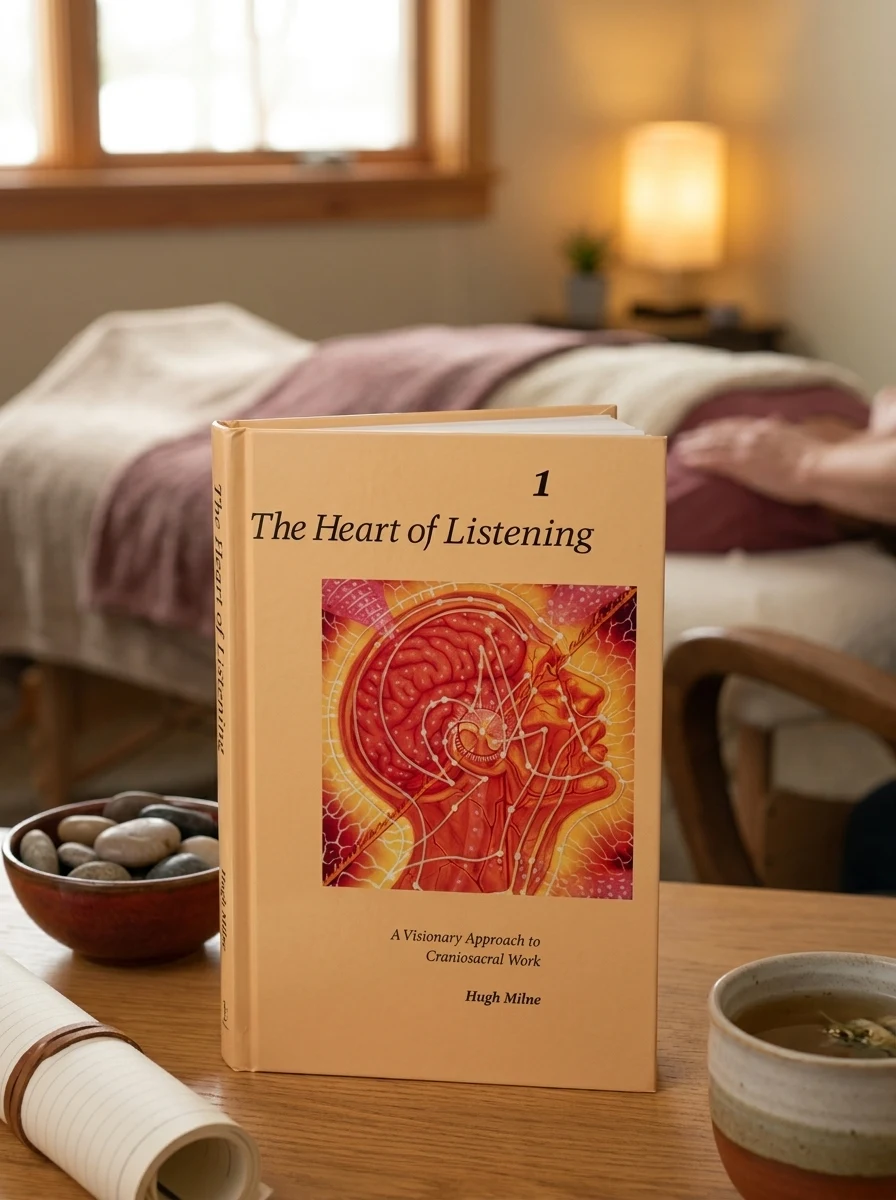


The Heart of Listening, Volume 1: A Visionary Approach to Craniosacral Work (Second)
Milne, Hugh

Stock reported in the catalog; fulfillment is confirmed with your request.
Discover the silent dialogue between healer and healed in this visionary guide to craniosacral artistry.
Hugh Milne invites practitioners and curious laypeople alike to view craniosacral therapy not as a mechanical procedure, but as a profound collaborative art. This volume prioritizes the initial encounter, teaching readers to listen deeply to the client’s subtle bodily narratives. Milne argues that true healing emerges from this mutual dialogue, where understanding the person precedes treating the pathology. Through evocative case studies and timeless wisdom, he demonstrates how to approach the body with reverence, transforming routine sessions into sacred exchanges of presence and attention.
This text situates itself within the contemporary esoteric healing movement, bridging traditional craniosacral therapy with visionary spiritual practices. It reflects a period where physical manipulation is increasingly viewed through a lens of sacred artistry and metaphysical dialogue rather than purely clinical mechanics.


📝 Description: The Heart of Listening, Volume 1: A Visionary Approach to Craniosacral Work (Second)
💎 Expert review
📖 Why choose it
Why this book is worth reading
This book is ideal for therapists seeking to deepen their intuitive connection with clients, as well as curious laypeople interested in the spiritual dimensions of healing. Readers who value presence over procedure will find profound guidance in shifting from mechanical treatment to collaborative artistry. It offers a transformative perspective on how subtle bodily narratives communicate essential truths. Those weary of rigid clinical protocols will appreciate the emphasis on reverence and mutual dialogue. The text provides timeless wisdom for anyone wishing to view healing sessions as sacred exchanges. It is particularly beneficial for practitioners ready to prioritize understanding the person before addressing pathology, fostering a more humane and attentive approach to craniosacral work.
⭐ Reader reviews
Reader rating
Came across this title in a footnote and had to track it down. I appreciated how the argument builds steadily from first principles. A few pages arrived with light corner wear, though nothing serious. Still worth having on the shelf.
Needed this for my research. It reads better in small doses — a chapter at a time with notes. Shipping was quick too.
This edition finally does the material justice. Not a light read, but far more accessible than I feared. The text itself is dense but rewarding — you get out what you put in. My only quibble is the cover feels thinner than expected. Recommended with reservations.
This has been on my wishlist for months. The ideas are old but land with surprising force today. Great value for what you get.
Bought this as a gift for my sister and ended up ordering a second copy for myself. Solid binding, decent paper — holds up to heavy use. It connects ideas I'd only seen treated separately elsewhere. Deserves a place on any esoteric bookshelf.
This exceeded my expectations. The material is presented clearly and the structure makes it easy to revisit key passages. There's real depth here that reveals itself on a second reading. Definitely recommend.
Milne’s vision offers a refreshing, albeit abstract, departure from standard technical manuals. It succeeds beautifully in elevating craniosacral therapy to a spiritual practice, emphasizing the healer’s inner state and the client’s subtle narratives. However, this approach may frustrate readers seeking concrete anatomical techniques or step-by-step procedural instructions. Those preferring evidence-based, mechanistic models of bodywork might find the emphasis on 'sacred exchanges' overly esoteric. The text assumes a readiness for metaphysical interpretation that not all practitioners possess. It is best suited for those already inclined toward holistic and visionary frameworks, rather than skeptics or strictly clinical professionals.
❓ Frequently asked questions
📖 Who should read this
If you seek to deepen your tactile sensitivity or wish to understand the spiritual dimensions of touch, this book bridges the gap between clinical practice and intuitive artistry for both students and seasoned practitioners.
🎯 Key themes and symbolism
Somatic dialogue
Collaborative healing
Presence over technique
💬 Quotes from the book
“The body speaks a language of its own, waiting for a listener who knows how to be still.”
“To heal is not to fix, but to witness the body’s innate intelligence returning to balance.”
📜 Historical context
📚 Glossary
- Craniosacral Rhythm
- Somatic Listening
- Collaborative Caregiving
📔 Questions to reflect on
- When was the last time you listened to your body without trying to change anything? What did it say?
- How might your current interactions change if you approached them as a collaborative dialogue rather than a transaction?
- In what ways do you rush to 'fix' problems instead of allowing space for them to reveal their own resolution?
✍️ More books by this author Milne, Hugh
All books by this author →
🏛 Books from this publisher North Atlantic Books
All books from this publisher →






You might also like
See more →