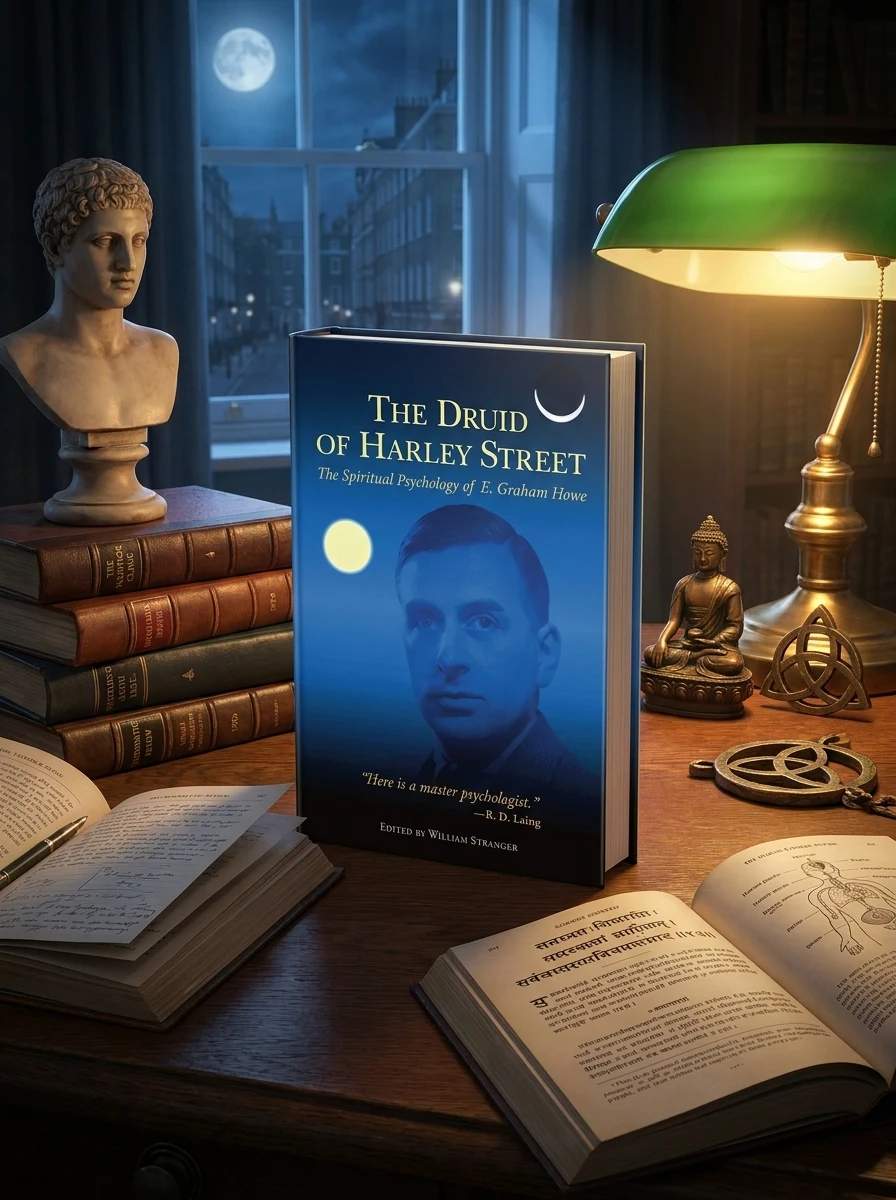

The Druid of Harley Street: The Spiritual Psychology of E. Graham Howe
This edition can be ordered. No arrival date is confirmed.
Where clinical psychiatry meets ancient wisdom, E. Graham Howe bridges the soul and the clinic.
This volume gathers the finest essays of E. Graham Howe, a pioneering figure who helped establish the Tavistock Clinic while simultaneously challenging the rigid boundaries of early psychoanalysis. Howe argued that true healing requires integrating spiritual experience with psychological insight, a stance that earned him both admiration and fierce opposition from the scientific establishment. By weaving together existential phenomenology and Eastern contemplative traditions, he offered a holistic map of the mind. This collection captures his lucid prose and profound influence on later thinkers like R.D. Laing, demonstrating that the psyche cannot be fully understood without acknowledging the sacred dimensions of human experience.
This work emerges from the mid-20th century intersection of clinical psychiatry and esoteric spirituality, reflecting a period when pioneers sought to reconcile scientific psychology with ancient wisdom traditions. It sits within the broader occult and esoteric tradition that challenges rigid materialist boundaries by integrating Eastern contemplative practices with Western psychoanalysis.


📝 Description: The Druid of Harley Street: The Spiritual Psychology of E. Graham Howe
💎 Expert review
📖 Why choose it
Why this book is worth reading
Readers seeking a profound synthesis of clinical insight and spiritual depth will find immense value in this collection. E. Graham Howe offers a vital alternative to rigid early psychoanalysis, appealing to those who feel the psyche demands recognition of its sacred dimensions. It is essential for practitioners and scholars interested in how existential phenomenology and Eastern traditions can heal the modern mind. Those frustrated by purely materialist approaches to mental health will appreciate Howe’s courageous stance against scientific establishment opposition. This book provides a holistic map for understanding human experience, bridging the gap between the Tavistock Clinic’s clinical rigor and the Druid’s spiritual wisdom, ultimately empowering readers to view psychological healing as a deeply spiritual journey.
⭐ Reader reviews
Reader rating
As someone who reads a lot in this field, I can be picky. The print is clean and easy on the eyes for long sessions. You can tell why this work has endured. Still worth having on the shelf.
Finally got around to ordering this. The historical context alone makes it worth the price. I found myself reading passages aloud just to sit with them. I'd have loved an index, but that's on the original text.
Arrived faster than expected and well packaged. It rewards patience more than any book I've bought this year. The symbolism is layered and generous to patient readers. Some archaic spellings slow things down. Recommended with reservations.
My book club chose this last month. The symbolism is layered and generous to patient readers. The historical context alone makes it worth the price. Highly recommend to serious students.
Came across this title in a footnote and had to track it down. Every rereading turns up something I missed. A keeper.
This volume is a compelling yet demanding read for those willing to explore the fringes of established psychiatry. Howe’s integration of spiritual experience with psychological insight is both lucid and provocative, challenging readers to abandon comfortable dualisms. However, it does not suit skeptics who demand purely empirical data or readers seeking straightforward self-help advice. Those uncomfortable with the tension between clinical authority and esoteric belief may find his fierce opposition from the scientific establishment alienating rather than inspiring. The text requires patience for its philosophical density and historical context. It is best appreciated by those already familiar with R.D. Laing’s work or Eastern contemplative traditions, as it assumes a comfort with abstract concepts that might overwhelm casual readers seeking simple diagnostic frameworks.
❓ Frequently asked questions
📖 Who should read this
Readers seeking to understand the roots of transpersonal psychology, Jungian analysts, and those interested in the historical tension between clinical science and spiritual practice. Ideal for practitioners of somatic therapy and meditation who value historical depth.
🎯 Key themes and symbolism
Psycho-spiritual integration
Critique of scientific psychiatry
Existential phenomenology
💬 Quotes from the book
“The psyche is not a machine to be repaired, but a mystery to be inhabited.”
“Healing occurs when the patient remembers their connection to the eternal within the temporal.”
📜 Historical context
📚 Glossary
- Tavistock Clinic
- Existential Phenomenology
- Transpersonal Psychology
📔 Questions to reflect on
- Where do you see the boundary between your psychological struggles and your spiritual life?
- How might your understanding of 'health' change if you viewed it as a sacred integration rather than a clinical fix?
- What aspects of your inner experience have been dismissed by 'scientific' or 'rational' frameworks that you feel need reclaiming?
🏛 Books from this publisher North Atlantic Books
All books from this publisher →
You might also like
See more →


 91
91