
US shipping Secure card payment Occult and esoteric books

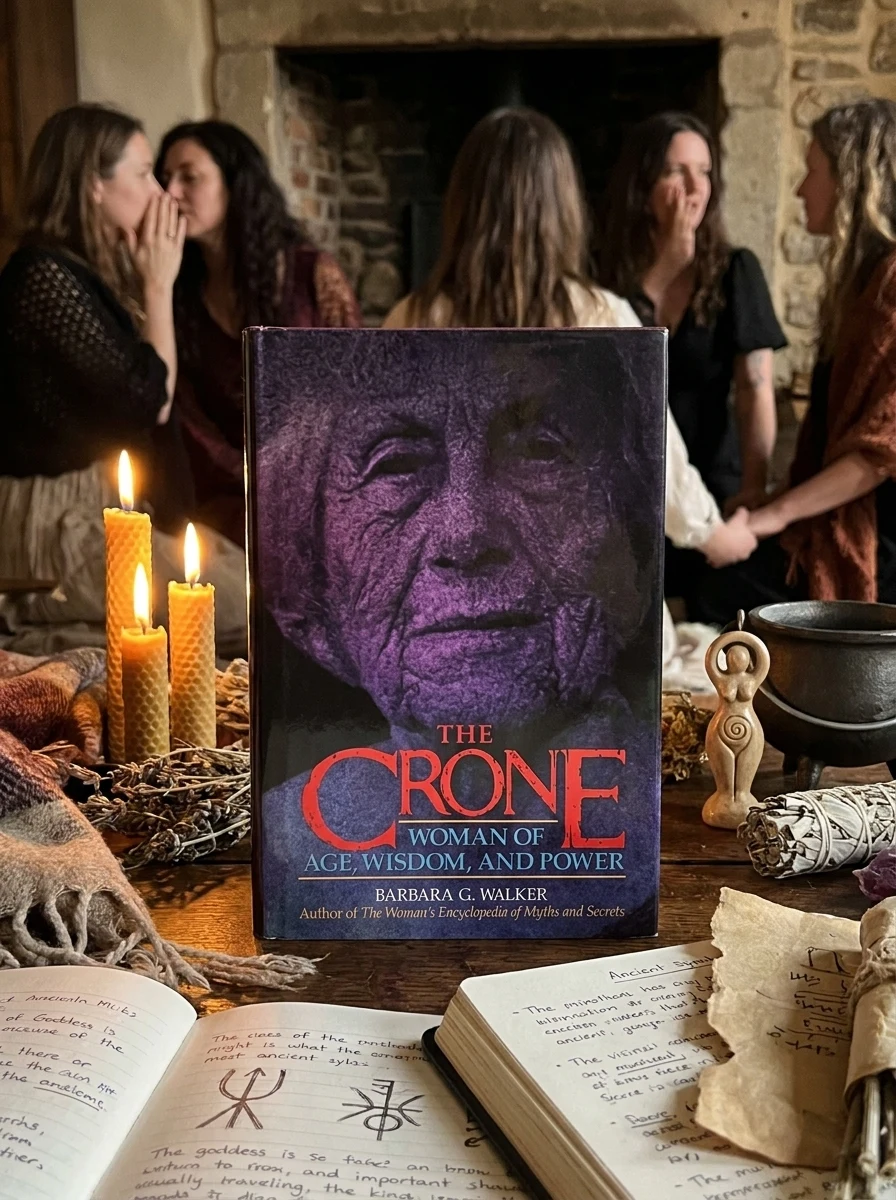
The Crone: Woman of Age, Wisdom, and Power

Walker, Barbara G
Reader rating
4.8
(1 reviews) 128 sold
In stock

Stock reported in the catalog; fulfillment is confirmed with your request.

📚 ABOUT THE BOOK

Reclaim the Crone: embrace ancient female power, wisdom, and spiritual rebirth.

This seminal work explores the burgeoning women's spirituality movement, examining women's growing disillusionment with traditional patriarchal religions. It delves into the rediscovery of ancient Goddess worship and the profound significance of the Crone archetype as a source of wisdom, power, and liberation. The text highlights the transformative impact of communal gatherings, where women find empowerment, mutual support, and a deeper connection to their spiritual selves, fostering a renewed sense of identity beyond conventional structures and societal expectations.

Key themes
Women's Spiritual Awakening Rediscovering the Crone Archetype Community and Empowerment
Historical context

This text is a seminal work within the burgeoning women's spirituality movement of the late twentieth century, serving as a foundational exploration of Goddess worship and the reclamation of female archetypes. It sits firmly within the tradition of second-wave feminist theology and modern Witchcraft literature that seeks to dismantle patriarchal religious structures.


Difficulty
●● Moderate
Fans will love it
Starhawk · Ramona Karp · Zsuzsanna Budapest · Dion Fortune
🌙 Witchcraft & Wicca
🏛 HarperOne 📅 1988 📖 208 pages 🌐 en 📐 Paperback ISBN: 9780062509345
Fun fact
Barbara G. Walker's "The Crone" is a foundational text that brilliantly articulates the spiritual yearning of women in the late 20th century. It excels at identifying the nascent women's spirituality movement and the reclaiming of ancient archetypes. While it might disappoint readers seeking practical ritual instructions, its strength lies in its sociological and theological analysis. This book remains an essential primer for understanding the resurgence of the Divine Feminine in contemporary occult and esoteric thought.

📝 Description: The Crone: Woman of Age, Wisdom, and Power

Chapter OneCreationAll over the modern world, a new social phenomenon is gradually taking shape. Women, the traditional pillars of Judeo-Christian religion, are turning against this faith. Many women prefer to gather in small grass-roots groups in each other's homes, where they discuss recent studies of prepatriarchal Goddess worship and engage in rituals aimed at recreating some feeling for those ancient faiths. Because of its private nature, the phenomenon is almost invisible to the public eye. Occasionally, the popular press takes a passing interest in it, giving it the label witchcraft, which is understood to be mildly newsworthy. Under another one of its labels, the women's spirituality movement, the phenomenon is hardly defined or even definable in this man's world. The women's spirituality movement has given many women better feelings about themselves, in consequence of joining together with other women in groups, gatherings, circles, covens, or conferences. Women touch, embrace, communicate. They share food, feelings, thoughts, and ideas. They praise each other's accomplishments. They support each other in trouble. They provide sympathy for hurts, advice for problems, many kinds of mutual education. They laugh or cry together, love or quarrel, lend things, give gifts, do favors. Some find in women's groups the closest relationships of their lives, closer than their bonds with husbands, children, or parents. Others drop out after a time, but with changed attitudes. Women have always banded together along the underside of male-dominated social structures. Aside from obvious natural bonds among female family members, women have always joined all-female groups that in some wayserved the mutual support functions listed above, whenever they could. Old-fashioned sewing circles and quilting bees gave their members more than needlework expertise. Grandma's Saturday afternoon teas or Sunday luncheons held more rewards for Grandma and her friends than men ever noticed. Volunteer groups, community services, neighborhood committees, social clubs, church and charity organizations, even bridge clubs or the PTA gave women opportunities to meet and work with one another, to communicate, cooperate, and widen their circles of friends. Women working together on almost any kind of project have inevitably formed mutually supportive relationships out of their common needs and shared life experiences. When a woman has faced any of life's common crises -- birth, bereavement, illness, sudden misfortune, troubles with love or work -- there have usually been other women there to help. Male-dominated society still exploits women's natural propensity to care, to nurture, to take responsibility for the comfort of others. Unfortunately, feminists still allow this to happen. Nothing much has been changed so far by women talking together of the Goddess's blessings instead of the annual fund-raising party, or of the archetypal power of femaleness instead of their children's grades. As far as most men are concerned, women's talk is still women's talk, having little to do with the real world -- that is, the world where money is made. Men with power in that world seldom pay attention to what women say among themselves. They even pride themselves on their ignorance of it. They still believe women's groups perform busywork, the only real purpose of which is to keep women off the streets andaway from the seats of genuine power. Because Goddess worshipers use the term power much more loosely, they need to understand that, to men, it means the capacity to threaten or destroy. Like it or not, the fate of all women, their children, and their earth lies in the untrustworthy hands of men corrupted by their lifelong craving for that real power which also corrupts women in ways so numerous and so subtle that it takes a very high degree of consciousness-raising to name and avoid even a fraction of them. Patriarchal society has always found ways to exploit women's need for what is called busywork. Done in solitude, such work has been thought to provide a harmless outlet for frustrated female creativity that will never become commercially viable (the only raison d'e tre recognizable by the patriarchy), Done in company, such work has been thought to provide harmless ways for women to help one another support male-headed institutions: family, government, church. A prime example of such exploitation is the churches' canny enlistment of women to work without pay for their cause: promoting the patriarchal God and his ever-acquisitive priesthoods, after the latter spent centuries demolishing women's own religions. A human analogy is found in the Bible: Yahweh directed his warriors to take heathen girl children as their household slaves and concubines, after raping and killing the girls' mothers (Num. 31:17-18; judges 21:10-12). If a few women today talk of resurrecting the long-since raped and killed Divine Mother, many churchmen believe they can be ignored as too few, and usually too poor, to matter. Churches go on enjoying the faithful service of their unpaid ladies' auxiliaries andmaintain the conventional idea that women who recognize no church, or who call themselves witches and Goddess worshipers, are only lunatic-fringe cultists, misled by some diabolical power into making fools of themselves. In one sense, women may again play into patriarchal hands when they leave conventional religion behind and begin to study, work, and play with the older matriarchal concepts. Most Goddess worshipers emphasize such traits as human warmth, love, sensitivity, generosity, and nonjudgmental acceptance. Lo and behold, the same traits were always urged upon Christian women too. Through the course of European history, by the golden rule standard, women were the only true Christians. Their men may have talked fine rhetoric about loving their enemies and giving away all their worldly goods; but in practice, Christian men slaughtered their enemies in un

💎 Expert review

💎
Esoterica Books editorial team
Occult literature desk
Walker delivers a passionate defense of the Crone archetype, effectively articulating the shift from patriarchal dogma to Goddess-centered spirituality. While the text succeeds in fostering a sense of communal empowerment and validating the wisdom of age, it may feel abstract or overly ideological to readers who prefer historical rigor over spiritual advocacy. Those seeking strictly academic anthropological studies on ancient religions might find the tone too prescriptive or emotionally charged. However, for its intended audience within the modern Pagan community, it remains a powerful, if somewhat singular in perspective, manifesto on reclaiming female power and rejecting societal expectations of aging.
✓ EDITOR'S REVIEW

📖 Why choose it

📖

Why this book is worth reading

Readers seeking a deep, spiritual reconnection with the feminine divine will find profound value in this empowering exploration of the Crone archetype. It is ideal for women feeling disillusioned by traditional patriarchal religious institutions who are searching for alternative sources of wisdom and power. Those interested in the psychological and spiritual significance of aging as a time of liberation rather than decline will appreciate its transformative perspective. The book offers a vital framework for understanding communal gatherings as spaces for mutual support and identity renewal, making it essential for anyone wishing to embrace their own inner authority and spiritual rebirth through ancient female wisdom.

⭐ Reader reviews

The starting rating comes from the team Esoterica Books —
⭐ Esoterica editorial review Editorial rating 4.8/5
★★★★
If you're seeking to understand the roots of contemporary women's spirituality, or yearning for a deeper connection to ancient female wisdom and communal support, this profound work offers invaluable insights. It’s perfect for those ready to embrace the power of the Crone within themselves.

Reader rating

4.8
Based on 1 reviews
5
0
4
1
3
0
2
0
1
0
E
Esoterica Books editorial team

Walker delivers a passionate defense of the Crone archetype, effectively articulating the shift from patriarchal dogma to Goddess-centered spirituality. While the text succeeds in fostering a sense of communal empowerment and validating the wisdom of age, it may feel abstract or overly ideological to readers who prefer historical rigor over spiritual advocacy. Those seeking strictly academic anthropological studies on ancient religions might find the tone too prescriptive or emotionally charged. However, for its intended audience within the modern Pagan community, it remains a powerful, if somewhat singular in perspective, manifesto on reclaiming female power and rejecting societal expectations of aging.

❓ Frequently asked questions

It refers to a burgeoning trend where women increasingly reject traditional patriarchal religious structures. Instead, they form private, grassroots groups to explore ancient Goddess worship and engage in rituals that foster self-empowerment and communal spiritual connection.
While the popular press might label aspects of the movement as "witchcraft," the book describes a broader phenomenon. It focuses on women seeking spiritual alternatives, rediscovering prepatriarchal faiths, and forming supportive communities, rather than specifically endorsing a particular magical practice.

📖 Who should read this

If you're seeking to understand the roots of contemporary women's spirituality, or yearning for a deeper connection to ancient female wisdom and communal support, this profound work offers invaluable insights. It’s perfect for those ready to embrace the power of the Crone within themselves.

🎯 Key themes and symbolism

Women's Spiritual Awakening

This book chronicles the growing trend of women disengaging from established patriarchal religions. It explores their journey towards alternative spiritual paths, particularly those rooted in ancient Goddess traditions, seeking a more inclusive and empowering framework for their beliefs and practices, often within intimate, community-focused settings.

Rediscovering the Crone Archetype

The text champions the Crone as a potent symbol of mature female power, wisdom, and liberation, challenging negative societal connotations. It delves into her historical and mythological significance, offering a framework for women to embrace their later years with spiritual authority and self-possession, moving beyond youth-centric paradigms.

Community and Empowerment

Highlighting the vital role of grassroots gatherings, the book illustrates how women's circles, covens, and conferences foster profound connections. These spaces provide environments for shared experiences, mutual support, emotional healing, and collective spiritual exploration, ultimately empowering participants to reclaim their voices and inherent value.

💬 Quotes from the book

“A quiet but profound social shift is occurring, as women, long the bedrock of established faiths, begin to seek spiritual paths beyond their traditional confines.”

“Within these communal spaces—circles, gatherings, and covens—women discover mutual support, empathy, and a shared journey towards self-affirmation, fostering deep bonds and personal growth.”

📜 Historical context

Emerging during a period of significant feminist scholarship and spiritual awakening, this book contributes to the broader discourse of Goddess theology and women's studies. It aligns with works that critically re-examine religious history through a female lens, contributing to the re-evaluation of suppressed matriarchal narratives and the reclaiming of feminine divine principles.

📚 Glossary

Crone
Prepatriarchal Goddess worship
Women's Spirituality Movement

📔 Questions to reflect on

  1. How do traditional religious narratives align or conflict with your personal sense of feminine power and wisdom?
  2. In what ways could embracing the Crone archetype enhance your perception of aging, experience, and spiritual authority?
  3. Reflect on the importance of community in your spiritual journey. What kind of supportive environment would foster your deepest growth?

🏛 Books from this publisher HarperOne

All books from this publisher →
You might also like

See more →