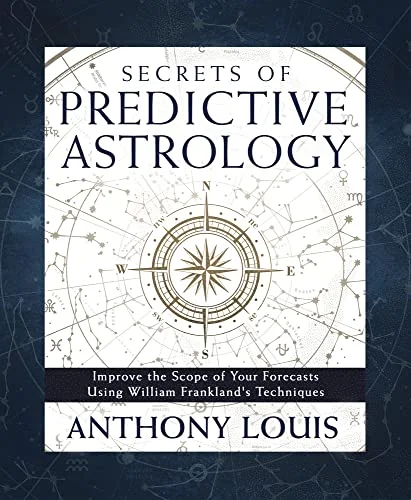
Secrets of Predictive Astrology: Improve the Scope of Your Forecasts Using William Frankland's Techniques
✍️ Louis, AnthonyThis essential guide resurrects William Frankland's revolutionary 1920s predictive astrology methods. Author Anthony Louis meticulously details Frankland's direct, birth-chart-centric techniques, which sidestepped complex mathematics for clear forecasting. Drawing from Frankland's original writings and historical influences like Ptolemy and Alan Leo, Louis presents over sixty illustrative charts. Learn to apply practical concepts such as age-related influences, midpoints, symbolic directions, and planetary periods, even when exact birth times are elusive, to significantly improve your astrological predictions.


📝 Description: Secrets of Predictive Astrology: Improve the Scope of Your Forecasts Using William Frankland's Techniques
📑 What's inside
- List of Charts...................................................................................... xi
- Foreword............................................................................................xv
- Introduction
- Chapter 1: An Overview of Frankland's Astrological Investigations
- Chapter 2: The Vocabulary of Directions and Progressions
- Chapter 3: Alan Leo's Zodiac Signs as Periods of Life
- Chapter 4: Planetary Periods and Ptolemy's Seven Ages of Man
- Chapter 5: Frankland's Point of Life Measure
- Chapter 6: Birth Numbers Identify Potentially Significant Years
- Chapter 7: Frankland on Methods of Prediction and Their Scope
- Chapter 8: Judging the Overall Tenor of the Chart
- Chapter 9: Age Along the Zodiac (Age Point)
- Chapter 10: Midpoints and Areas of Life
- Chapter 11: The 12 Houses
- Chapter 12: Combining Cusps of Houses to Produce Sensitive Points
- Chapter 13: Average Positions and Midpoints
- Chapter 14: Aspects and Orbs: The Knatchbull Twins
- Chapter 15: The 4/7° Age Point
- Chapter 16: Frankland's Measures with Unknown Birth Times
- Chapter 17: Frankland's Student L. Protheroe Smith
- Chapter 18: Forecasting Methods of Wynn and Adams
- Chapter 19: Atacirs (Symbolic Directions)
- Chapter 20: Found by the Aid of the Stars
- Epilogue
- Appendix A: The Point of Life
- Appendix B: The 4/7° Per Year Measure (4/7° Age Point)
- Appendix C: Ptolemy's Seven Ages of Man
- Appendix D: Alan Leo's Zodiac Signs Combined with Ptolemy's Seven Ages of Man
- Appendix E: Keywords for the Planets, Ascendant, and Midheaven
- Bibliography
- Index
💎 Expert review
📖 Why choose it
Why this book is worth reading
This book is an invaluable resource for astrologers seeking to refine their predictive accuracy without getting lost in overly complex mathematical calculations. It is specifically designed for practitioners who value direct, birth-chart-centric techniques that remain accessible even when precise birth times are unavailable. By resurrecting Frankland’s forgotten methods, the text empowers readers to utilize age-related influences, midpoints, and planetary periods with greater confidence. If you feel your current forecasting tools lack depth or clarity, this guide offers a structured path to improvement through historical wisdom. It serves those who wish to ground their insights in rigorous yet understandable frameworks, transforming vague intuitions into precise forecasts by leveraging the proven techniques of a recognized master.
⭐ Reader reviews
Reader rating
Anthony Louis provides a meticulous resurrection of William Frankland’s 1920s methods, offering over sixty illustrative charts that demonstrate practical application. The text successfully demystifies complex concepts like symbolic directions and planetary periods, making them approachable for dedicated students. However, this book does not suit beginners seeking introductory astrology basics or those who prefer modern psychological approaches over traditional predictive frameworks. Readers looking for quick, simplistic answers may find the required study of historical influences and specific techniques tedious. It is best reserved for intermediate practitioners ready to engage with substantive, historically rooted material that demands effort but rewards with enhanced forecasting scope and precision.
❓ Frequently asked questions
📖 Who should read this
If you're an astrologer seeking to refine your predictive skills with accessible, dependable methods, this book is for you. It's particularly valuable if you're looking to move beyond traditional complexities and embrace a more direct, birth-chart-focused approach to forecasting life events.
🎯 Key themes and symbolism
Frankland's Streamlined Prediction
Louis unveils William Frankland's revolutionary 1920s approach to predictive astrology, which prioritized the birth chart over intricate calculations. This section highlights how Frankland developed accessible, reliable methods that remain surprisingly relevant today for anyone seeking direct, practical forecasting insights without getting lost in overly complex mathematical systems.
Classical Roots, Modern Insight
Discover how Frankland built upon the wisdom of ancient astrologer Claudius Ptolemy's "seven ages of man" and Alan Leo's "twelve stages of life." This exploration reveals the historical foundations that underpin Frankland's nuanced understanding of age-related influences and life cycles, demonstrating a profound synthesis of classical knowledge with innovative technique.
Chart Interpretation Mastery
The book provides an extensive collection of over sixty real-world chart examples, demonstrating Frankland's techniques in action. Learn to apply concepts like midpoints, symbolic directions, and planetary periods to interpret birth charts effectively, even when precise birth times are unavailable, offering practical skills for immediate astrological application.
📜 Historical context
📚 Glossary
- Predictive Astrology
- Birth Chart (Natal Chart)
- Midpoints
📔 Questions to reflect on
- Reflect on a past significant life event. How might Frankland's methods of age-related influences or planetary periods shed new light on its timing or nature?
- Consider a current challenge. How would you approach its potential astrological timing using Frankland's birth-chart centric techniques, prioritizing direct interpretation over complex math?
- If you were to teach Frankland's core principle to another astrologer, what single concept would you emphasize as most revolutionary and why?