US shipping Secure card payment Occult and esoteric books

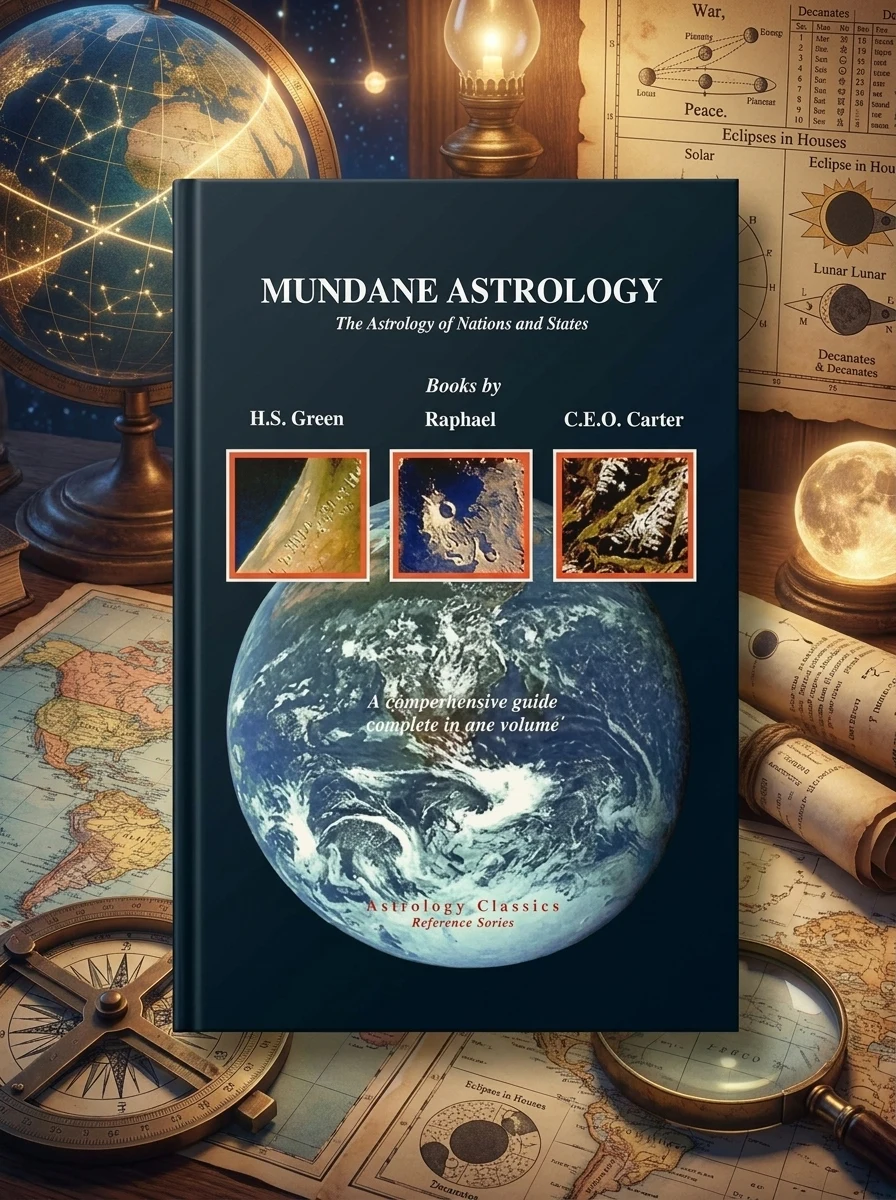
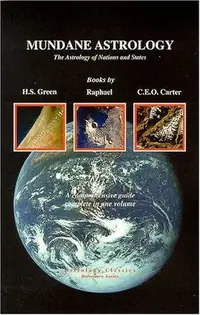
Mundane Astrology: The Astrology of Nations and States

Green, H S
Reader rating
4.5
(2 reviews) 155 sold
In stock

Stock reported in the catalog; fulfillment is confirmed with your request.

📚 ABOUT THE BOOK

Unlock the celestial mechanics governing global conflicts and national destinies in this essential triple anthology.

This volume unites three foundational texts on mundane astrology, offering a comprehensive guide to interpreting planetary influences on world events. Green provides a systematic planetary breakdown across the twelve houses, while Raphael structures his analysis by house placement, detailing how mundane sectors interact with celestial bodies. Both authors explore the ominous impacts of solar and lunar eclipses, with Green focusing on house effects and Raphael utilizing decanic divisions. The collection concludes with Carter’s post-WWII critique, examining the astrological failures to anticipate global conflict and advocating for more rigorous data collection. Together, these works establish the core methodologies for studying the astrology of nations.

Key themes
Geopolitical Forecasting Eclipse Interpretation Historical Astrological Critique
Historical context

This volume sits at the intersection of traditional astrological practice and geopolitical analysis, bridging historical foundational texts with post-war critical reflection on the discipline's predictive limitations.


Difficulty
●●● Demanding
Fans will love it
Raphael · Carter · Mundane Astrology practitioners · Historical esotericism
🪐 Astrology
🏛 Astrology Classics 📖 320 pages 📔 Paperback 📐 Paperback ISBN: 9781933303116
Fun fact
This anthology excels as a rigorous comparative study, offering readers multiple lenses through which to view geopolitical astrology. It is indispensable for those committed to deep scholarly inquiry but may frustrate casual readers seeking simple, immediate predictions. The collection sits firmly as a historical cornerstone, bridging classical tradition with mid-20th-century analytical rigor, though its Eurocentric bias reflects its time.
📚 This book appears in Esoterica Books

📝 Description: Mundane Astrology: The Astrology of Nations and States

Will there be peace? Will there be war? Find out with Mundane Astrology. Here, in one volume, are three classic books on the astrology of nations and states, by H. S. Green, Raphael, and C. E. O. Carter: H. S. Green organizes his book planet-by- planet. He tells what each planet will do in the 12 houses. Raphael organizes the topic by house. He tells how mundane houses work when planets are in them. In addition, both authors deal with solar and lunar eclipses, and earthquakes. Green shows the effects of eclipses in the houses, while Raphael describes them by decanate (100 sections of the zodiac). Both mention the effects of comets, although little about these mysterious bodies is known astrologically. Charles Carter, writing after WWII, discusses why astrologers failed to predict the war and what that means for mundane astrology. His plea for better data has largely been met, but the need for more study remains. All three authors give astrological rulerships for countries and cities. These are centuries old and are weighted to England and Europe. Carter's rulers are the most up-to-date. These are the essential texts for serious study of mundane astrology. About the Authors H. S. Green was an astrologer associated with Alan Leo's astrological revival back in the first decade of the 20th century. His various books are highly regarded (all but this one out of print, sadly), but biographical details are sketchy. Raphael was the pen-name of one Robert Cross, 1850-1923. He was the sixth in a series of astrological writers who used the name "Raphael" & remains the best known of them all. He wrote books on virtually all astrological topics. His book on mundane astrology dates from 1910. Charles E. O. Carter, 1887-1968, was one of the outstanding British astrologers of the 20th century. He succeeded Alan Leo as head of the Astrological Lodge of the Theosophical Society, a post he held from 1920 to 1952. He was editor of Astrology, The Astrologer's Quarterly, from 1926 to 1959. Carter's persistent genius reestablished astrology as a serious discipline in England, after two centuries of decline. He wrote his book on Mundane Astrology in reaction to the failure of astrologers to forecast WWII. In 1939, astrologers in London knew there was a full-scale war on in China, they knew the situation with Germany was tense, but they had studied the charts for the year, they knew the fuss would blow over. And they were wrong. Carter set out to discover why, his book was the result.

💎 Expert review

💎
Esoterica Books editorial team
Occult literature desk
While this compilation is a vital resource for serious Mundane Astrology students, it is not suitable for casual hobbyists or those seeking simple horoscope interpretations. The text demands patience, as it requires navigating dense theoretical frameworks and comparative methodologies from three distinct authors across different eras. Readers expecting straightforward predictive formulas may find Green’s house effects and Raphael’s decanic divisions overly technical or abstract without a strong foundational background in traditional astrology. Furthermore, Carter’s critical stance might disappoint those looking for uncritical validation of astrological power. It is strictly for the dedicated researcher willing to engage with complex systemic analysis rather than quick answers.
✓ EDITOR'S REVIEW

📖 Why choose it

📖

Why this book is worth reading

Scholars and serious astrologers seeking to understand the macro-level applications of celestial mechanics will find this triple anthology indispensable. It offers a rare convergence of foundational methodologies, allowing readers to compare Green’s systematic planetary breakdowns against Raphael’s house-based structural analysis. By including Carter’s critical post-WWII perspective, the collection provides not just technique but necessary historical context regarding the field's predictive failures. This comprehensive approach empowers students of national destiny to grasp how eclipses, decanic divisions, and house effects interact on a global scale, making it essential for anyone dedicated to rigorous data collection in the astrology of nations.

⭐ Reader reviews

The starting rating comes from the team Esoterica Books —
⭐ Esoterica editorial review Editorial rating 4.4/5
★★★★
For serious students of astrology seeking to understand macro-level trends, historians interested in esoteric perspectives on war and peace, and practitioners aiming to refine their predictive techniques for international affairs.

Reader rating

4.5
Based on 2 reviews
5
1
4
1
3
0
2
0
1
0
H
Henry V.
May 4, 2026
Essential reading

Exactly what I was looking for. Not a light read, but far more accessible than I feared. The material is presented clearly and the structure makes it easy to revisit key passages. Definitely recommend.

E
Esoterica Books editorial team

While this compilation is a vital resource for serious Mundane Astrology students, it is not suitable for casual hobbyists or those seeking simple horoscope interpretations. The text demands patience, as it requires navigating dense theoretical frameworks and comparative methodologies from three distinct authors across different eras. Readers expecting straightforward predictive formulas may find Green’s house effects and Raphael’s decanic divisions overly technical or abstract without a strong foundational background in traditional astrology. Furthermore, Carter’s critical stance might disappoint those looking for uncritical validation of astrological power. It is strictly for the dedicated researcher willing to engage with complex systemic analysis rather than quick answers.

❓ Frequently asked questions

No, this text requires a solid foundation in basic astrological principles, house systems, and planetary rulerships before engaging with its complex geopolitical applications.
Each author offers a distinct methodological approach: Green focuses on planetary placement, Raphael on house dynamics, and Carter provides a critical historical analysis of the field's limitations.

📖 Who should read this

For serious students of astrology seeking to understand macro-level trends, historians interested in esoteric perspectives on war and peace, and practitioners aiming to refine their predictive techniques for international affairs.

🎯 Key themes and symbolism

Geopolitical Forecasting

Eclipse Interpretation

Historical Astrological Critique

💬 Quotes from the book

“His plea for better data has largely been met, but the need for more study remains.”

“All three authors give astrological rulerships for countries and cities.”

📜 Historical context

Emerging from the fertile ground of early 20th-century esotericism, this compilation bridges classical tradition and modern statistical concerns. It reflects the era’s intense interest in applying ancient celestial knowledge to the chaotic political landscape of the 20th century, particularly the trauma of World War II which spurred Carter’s critical reevaluation of the discipline’s predictive capabilities.

📚 Glossary

Mundane Astrology
Decanate
Rulerships

📔 Questions to reflect on

  1. How do the differing methodologies of Green and Raphael complement each other in understanding a single planetary transit?
  2. In what ways might Carter’s post-war critique influence your approach to predicting current global conflicts?
  3. Which planetary rulership for your home country resonates most with its historical narrative, and why?

You might also like

See more →