

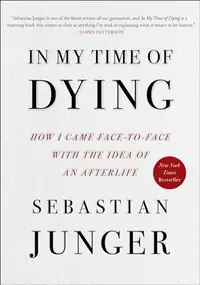
In My Time of Dying: How I Came Face to Face with the Idea of an Afterlife
Stock reported in the catalog; fulfillment is confirmed with your request.
A near-fatal brush with death transforms an atheist's worldview on the afterlife.
Pulitzer-winning journalist Sebastian Junger, known for his work in war zones, found himself closer to death during a quiet afternoon at home. A ruptured aneurysm led to a vivid near-death experience, including an encounter with his deceased father. This profound event challenged Junger's lifelong atheism and scientific upbringing. His book chronicles his deeply personal, yet rigorously intellectual, journey to reconcile this inexplicable experience with his empirical worldview, exploring mortality, consciousness, and the possibility of what lies beyond.
This work sits at the intersection of modern journalistic non-fiction and contemporary spiritual inquiry, reflecting the growing cultural trend of empirically-minded individuals exploring near-death experiences. It bridges the gap between hard-nosed reportage and personal metaphysical exploration in the post-pandemic era of heightened mortality awareness.


📝 Description: In My Time of Dying: How I Came Face to Face with the Idea of an Afterlife
💎 Expert review
📖 Why choose it
Why this book is worth reading
Readers who have grappled with the tension between scientific rationalism and spiritual wonder will find profound resonance in this narrative. It is particularly suited for skeptics, atheists, or those raised in strictly empirical households who are curious about consciousness beyond biological death. Those who have lost loved ones and seek a nuanced, non-dogmatic perspective on the afterlife will also appreciate Junger’s honest reckoning with grief and existence. The book offers a rare, grounded look at how a life-altering event can shift one's foundational worldview without abandoning intellectual rigor. It serves as a gentle invitation to consider the unknown not with fear, but with open-minded curiosity.
⭐ Reader reviews
Reader rating
Junger delivers a compelling, introspective account that avoids mystical clichés by grounding his experience in journalistic discipline. However, readers seeking dense theological debate or definitive proof of an afterlife will likely feel disappointed, as the text remains deeply personal rather than universally conclusive. It may also frustrate those who prefer absolute secular dismissal of such phenomena, as Junger openly admits his atheism was challenged. The narrative prioritizes emotional truth over metaphysical argumentation, making it more suitable for spiritual seekers than academic philosophers or hardline materialists who demand empirical evidence beyond subjective experience.
❓ Frequently asked questions
📖 Who should read this
If you're drawn to profound personal journeys that merge rigorous inquiry with the mysteries of existence, or if you've ever pondered life's ultimate question from a non-dogmatic perspective, this book offers a compelling, thought-provoking exploration you won't want to miss.
🎯 Key themes and symbolism
The NDE Phenomenon
Junger's incredibly personal and vivid near-death experience serves as the book's catalyst. He recounts slipping into unconsciousness, encountering his late father, and feeling an undeniable sense of peace, forcing him to confront phenomena often dismissed by secular thought. The narrative offers a powerful first-hand account of this mysterious state.
Science Meets Spirit
Raised by a physicist, Junger’s mind is steeped in empiricism and rational inquiry. This book details his struggle to reconcile a profoundly spiritual and inexplicable personal experience with his scientific skepticism. It’s a compelling exploration of the tension between verifiable fact and subjective reality, questioning the limits of scientific explanation.
Exploring Human Mortality
The core of Junger's inquiry delves into humanity's oldest questions: What is death? What happens next? His near-death experience compels him to undertake a broad examination of mortality, the nature of consciousness, and the diverse cultural and philosophical understandings of an afterlife, moving beyond conventional religious dogma.
💬 Quotes from the book
“"It's okay. There's nothing to be scared of. I'll take care of you."”
“"How could a mind, trained in the empirical, reconcile a vision so undeniably real yet scientifically inexplicable?"”
📜 Historical context
📚 Glossary
- Near-Death Experience (NDE)
- Eschatology
- Empirical
📔 Questions to reflect on
- How might a profound, inexplicable personal experience challenge your deepest-held beliefs about the nature of reality or spirituality?
- What role do scientific inquiry and personal faith (or lack thereof) play in your current understanding of mortality and what might lie beyond?
- If confronted with an experience similar to Junger's, how would you begin to process the possibility of an afterlife, and how might it alter your life's priorities?
🏛 Books from this publisher Simon & Schuster
All books from this publisher →
 81
81
 83
83


You might also like
See more →