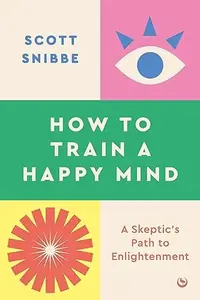
How to Train a Happy Mind: A Skeptic's Path to Enlightenment


Stock reported in the catalog; fulfillment is confirmed with your request.
Cultivate deep contentment and genuine connection, even for the most analytical mind.
This compelling guide offers a practical, eight-step system for fostering enduring happiness and profound connection, crafted by a self-proclaimed skeptic. It skillfully merges timeless Buddhist wisdom with contemporary scientific understanding, introducing analytical meditation as a powerful tool. Far exceeding simple mindfulness, this method employs narrative visualization, akin to cognitive behavioral therapy, to actively reshape mental patterns. Presented in an accessible style with relatable examples, the book empowers readers to transform their inner landscape, recognizing the mind's dual capacity for both challenge and liberation.
This work sits at the intersection of contemporary secular spirituality and traditional Tibetan Buddhism, reflecting a modern trend of integrating ancient contemplative practices with Western psychological frameworks. It appeals to readers interested in the synthesis of scientific skepticism and Eastern philosophical wisdom.


📝 Description: How to Train a Happy Mind: A Skeptic's Path to Enlightenment
💎 Expert review
📖 Why choose it
Why this book is worth reading
This book is ideal for analytical minds and self-proclaimed skeptics who seek spiritual fulfillment but feel alienated by traditional religious dogma or purely abstract meditation techniques. Scott Snibbe, drawing on his experience as a Buddhist monk and scientist, provides a practical eight-step system that bridges the gap between empirical inquiry and inner peace. Readers will benefit from the accessible style and relatable examples, which demystify complex concepts like analytical meditation. It is particularly suitable for those who want to actively reshape their mental patterns through narrative visualization rather than passive mindfulness. By combining Buddhist wisdom with scientific understanding, it offers a robust path to enduring happiness and genuine connection, empowering individuals to transform their inner landscape with clarity and confidence.
⭐ Reader reviews
Reader rating
The book succeeds in making ancient Buddhist teachings accessible to the modern, analytical reader by framing them through the lens of cognitive behavioral therapy and scientific inquiry. The eight-step system is practical and grounded, avoiding esoteric jargon in favor of actionable advice. However, it may not suit readers seeking mystical experiences or those uninterested in the intersection of science and spirituality. It also might feel too structured for those who prefer intuitive, non-linear spiritual journeys. While the tone is warm and inviting, the heavy reliance on 'skeptic' framing might alienate traditionalists. Ultimately, it is a valuable resource for pragmatists but lacks depth for advanced practitioners seeking profound philosophical debate.
❓ Frequently asked questions
📖 Who should read this
If you're a discerning individual seeking a pragmatic, science-informed approach to inner peace, this book is for you. It's especially suited for those who appreciate intellectual rigor alongside spiritual exploration, and who are ready to actively engage with their own mental architecture.
🎯 Key themes and symbolism
Skeptic's Path to Peace
This book uniquely bridges the gap between ancient spiritual practices and a questioning, scientific mindset. It validates a path to inner peace for those wary of unverified claims, demonstrating how profound personal growth can be achieved through rigorous, evidence-based introspection rather than blind faith.
Mastering Analytical Meditation
Moving beyond mere awareness, this text delves into analytical meditation, a structured approach to mental training. It teaches readers to actively engage with their thoughts and emotions through guided visualization, effectively rewiring neural pathways for greater well-being, much like a cognitive workout for the soul.
Modern Buddhist Wisdom
This work translates complex Buddhist principles into a practical, secular framework for contemporary life. It distills ancient wisdom into an actionable eight-step program, allowing readers to integrate profound insights into their daily routines without requiring adherence to traditional religious dogma, focusing on practical transformation.
💬 Quotes from the book
“Think of your mind not as a static entity, but as a garden. You wouldn't expect roses to grow by simply observing the weeds; you'd actively tend to the soil, plant seeds, and prune what doesn't serve. Our inner world demands similar cultivation.”
“For centuries, ancient wisdom traditions understood what neuroscience is only now beginning to confirm: our thoughts are not mere ephemera, but architects of our reality. This book offers the blueprint.”
📜 Historical context
📚 Glossary
- Analytical Meditation
- Cognitive Behavioral Therapy (CBT)
- Enlightenment (Secular Context)
📔 Questions to reflect on
- Consider a persistent negative thought pattern you experience. How might viewing it as a "trainable habit" rather than an inherent flaw change your approach to it?
- Reflect on a situation where simply "observing" your thoughts wasn't enough. How might a more active, narrative visualization technique have altered your emotional response or subsequent actions?
- If you were to design one small, positive mental habit to cultivate daily, what would it be, and what is the first step you could take to integrate it into your routine?
🏛 Books from this publisher Watkins Publishing
All books from this publisher →




![Pregnancy Health Yoga: Your Essential Guide for Bump, Birth and Beyond [With DVD]](/img/pregnancy-health-yoga-your-essential-guide-for-bump-birth-and-beyond-with-dvd.webp)
You might also like
See more →