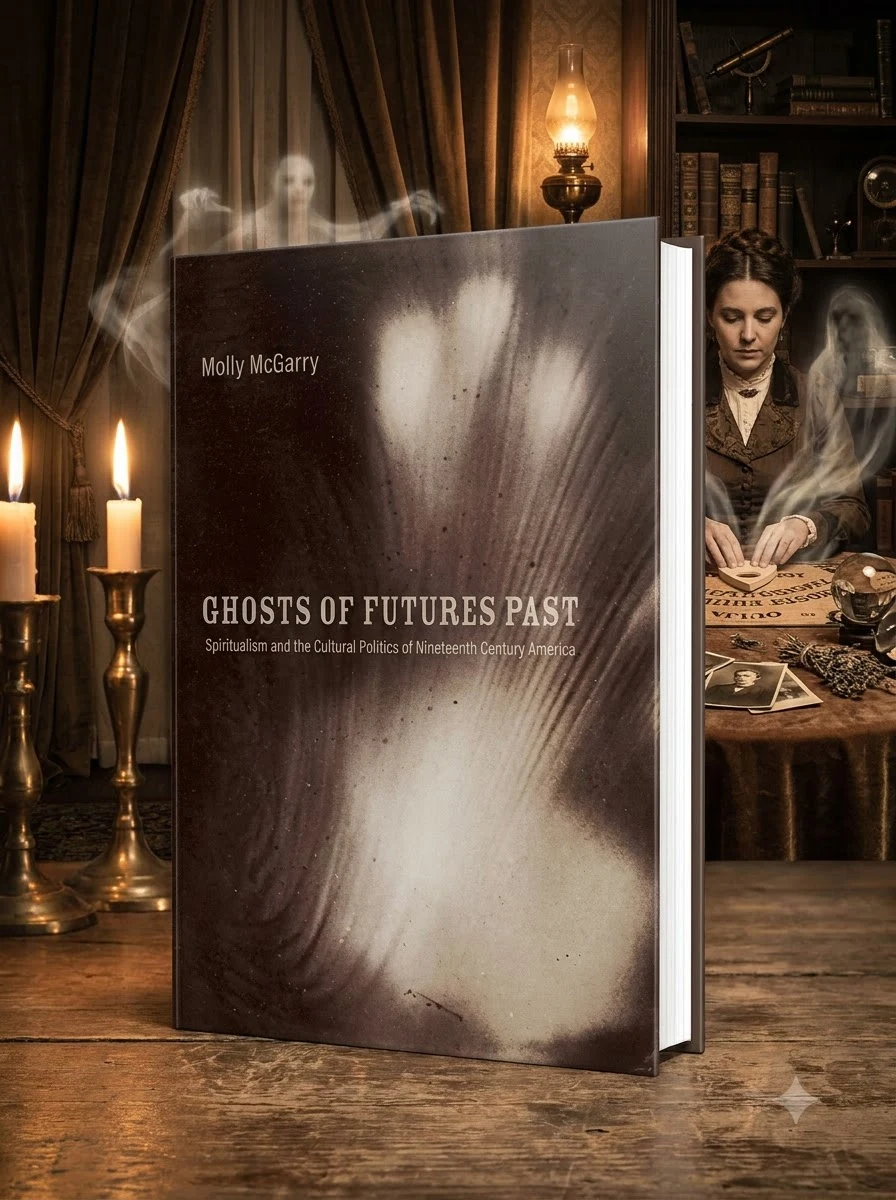
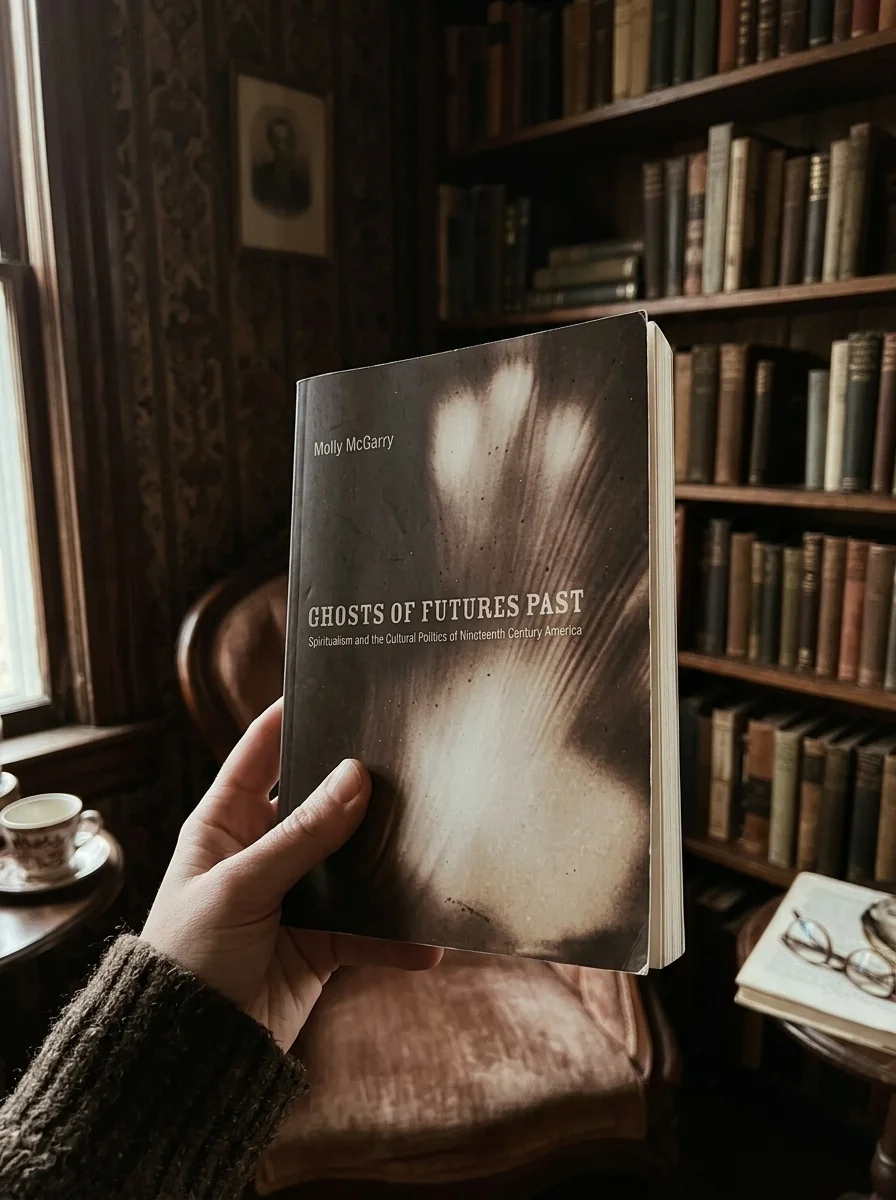
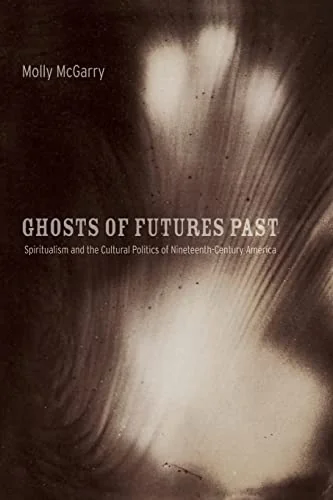
Ghosts of Futures Past: Spiritualism and the Cultural Politics of Nineteenth-Century America
A scholarly analysis of nineteenth-century American spiritualism and its political impact.
McGarry connects spiritualist practices to broader historical shifts in gender, sexuality, and law. She argues that channeling voices from beyond the grave was a method for negotiating identity and power in a changing nation. The text reveals how these beliefs intersected with scientific discourse and legal frameworks regarding obscenity. By tracing a queer genealogy of sexualities, the author shows how spiritualism provided a space for alternative social structures. The work relies on historical analysis to demonstrate that the movement was central to understanding mid-century American culture.
The book focuses on nineteenth-century America, specifically the mid-nineteenth century. It examines how spiritualism functioned as a new religion that linked the present with the past. The context includes the cultural politics of conjuring the dead and the intersection of belief with scientific doubt in United States society.


Praise for this book
“Ghosts of Futures Past offers a fresh and important perspective on significant issues in mid-nineteenth-century cultural history.”
📝 Description: Ghosts of Futures Past: Spiritualism and the Cultural Politics of Nineteenth-Century America
📑 What's inside
- List of Illustrations
- Acknowledgments
- Introduction
- 1. Mourning, Media, and the Cultural Politics of Conjuring the Dead
- 2. Indian Guides: Haunted Subjects and the Politics of Vanishing
- 3. Spectral Sexualities: Free Love, Moral Panic, and the Making of U.S. Obscenity Law
- 4. Mediomania: The Spirit of Science in a Culture of Belief and Doubt
- 5. Secular Spirits: A Queer Genealogy of Untimely Sexualities
- Notes
- Select Bibliography
- Index
💎 Expert review
📖 Why choose it
Why this book is worth reading
Readers fascinated by the intersection of history, religion, and politics will find this book indispensable. It moves beyond the sensationalism of séances to reveal how Spiritualism actively reshaped American identity through debates on memory and society. Those interested in how marginalized voices or spiritual practices influence broader cultural narratives will appreciate McGarry’s meticulous analysis. It offers a deep understanding of how past interactions with the departed forged unexpected links to contemporary issues, making it essential for scholars and enthusiasts of nineteenth-century American culture seeking depth over superficial intrigue.
⭐ Reader reviews
Reader rating
McGarry delivers a rigorous academic study that challenges the perception of Spiritualism as a fleeting fad, positioning it instead as a robust religious movement. While intellectually stimulating for those interested in cultural politics and historical memory, this text is not suited for casual readers seeking entertaining ghost stories or simple biographical accounts. It demands attention to complex societal debates and may feel dense to those preferring narrative-driven history over analytical examination of ideological shifts within nineteenth-century America.
❓ Frequently asked questions
📖 Who should read this
If you're fascinated by the intersection of esoteric practices, American history, and social movements, this book is for you. Dive in to understand how communicating with the dead was once a vibrant, challenging force in a rapidly changing nation.
🎯 Key themes and symbolism
Spiritualism as Social Power
This work meticulously unpacks how Spiritualism transcended its supernatural claims to become a potent social and political force. McGarry illustrates how its practices, such as channeling and séances, provided platforms for marginalized voices, particularly women, to challenge established norms and engage in public discourse in unprecedented ways, influencing abolition, suffrage, and other reform movements.
Bridging Past and Present
Explore how the spectral communication central to Spiritualism served as a unique conduit for historical reflection and future projection. The book demonstrates that by 'channeling' the deceased, adherents actively engaged with collective memory and historical narratives, using the wisdom of the dead to comment on and shape their present-day circumstances, bridging temporal divides in profound ways.
Cultural & Political Impact
McGarry delves into the profound cultural and political ramifications of Spiritualism in 19th-century America. She reveals how this movement, with its radical ideas about agency, authority, and the afterlife, directly influenced public opinion, social reform, and even national identity, making it an indispensable lens through which to understand the era's complex ideological shifts.
📜 Historical context
📚 Glossary
- Spiritualism
- Channeling
- Occult
📔 Questions to reflect on
- Consider how contemporary spiritual or esoteric movements might be reflecting or shaping current social and political anxieties, much like 19th-century Spiritualism did.
- Reflect on the role of 'voices from the past' in your own understanding of history or personal identity. How do we, consciously or unconsciously, 'channel' the past?
- If you could communicate with a historical figure to gain insight into a modern problem, who would it be and what question would you ask, and why?
📖 Read on the blog
🏛 Books from this publisher University of California Press
All books from this publisher →





You might also like
See more →





Have a question about this item?
Ask about the edition, condition, delivery or anything else — we reply by email or phone, usually within a day.
