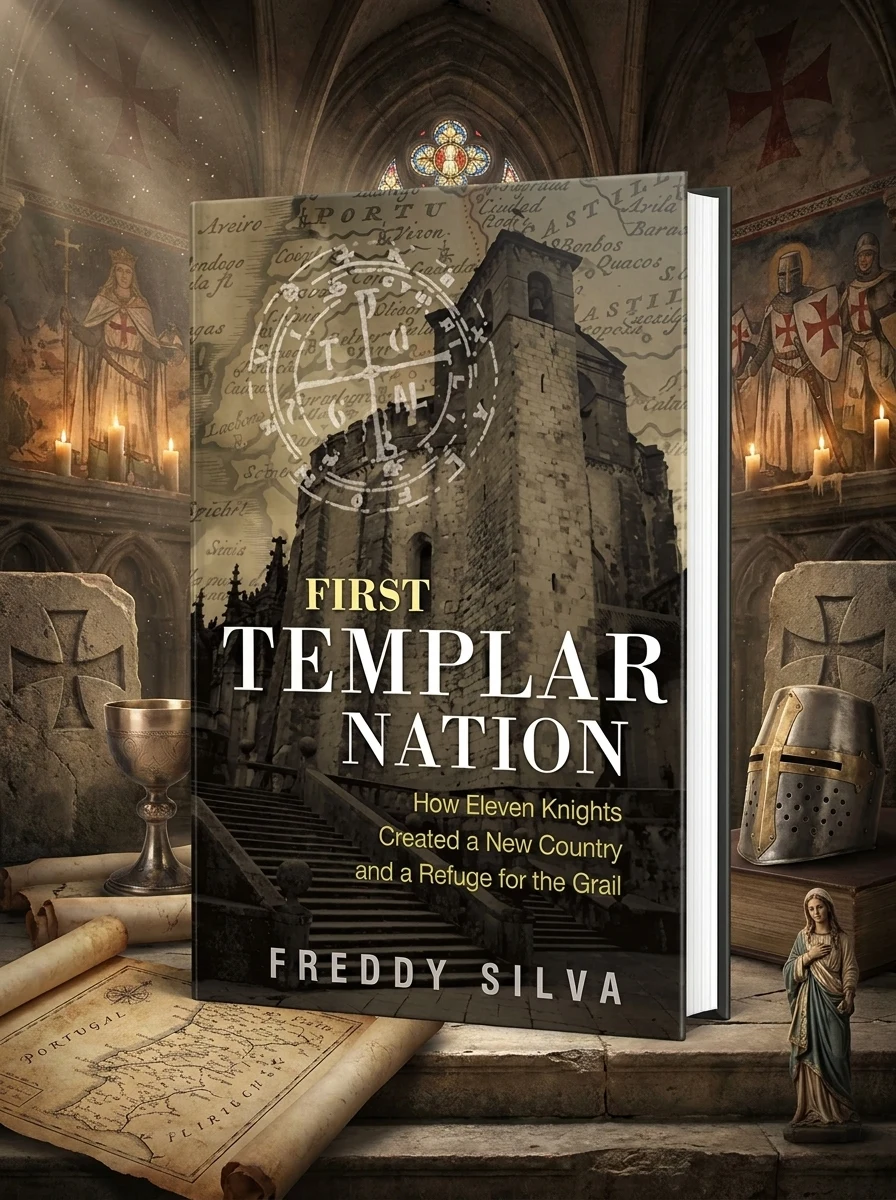
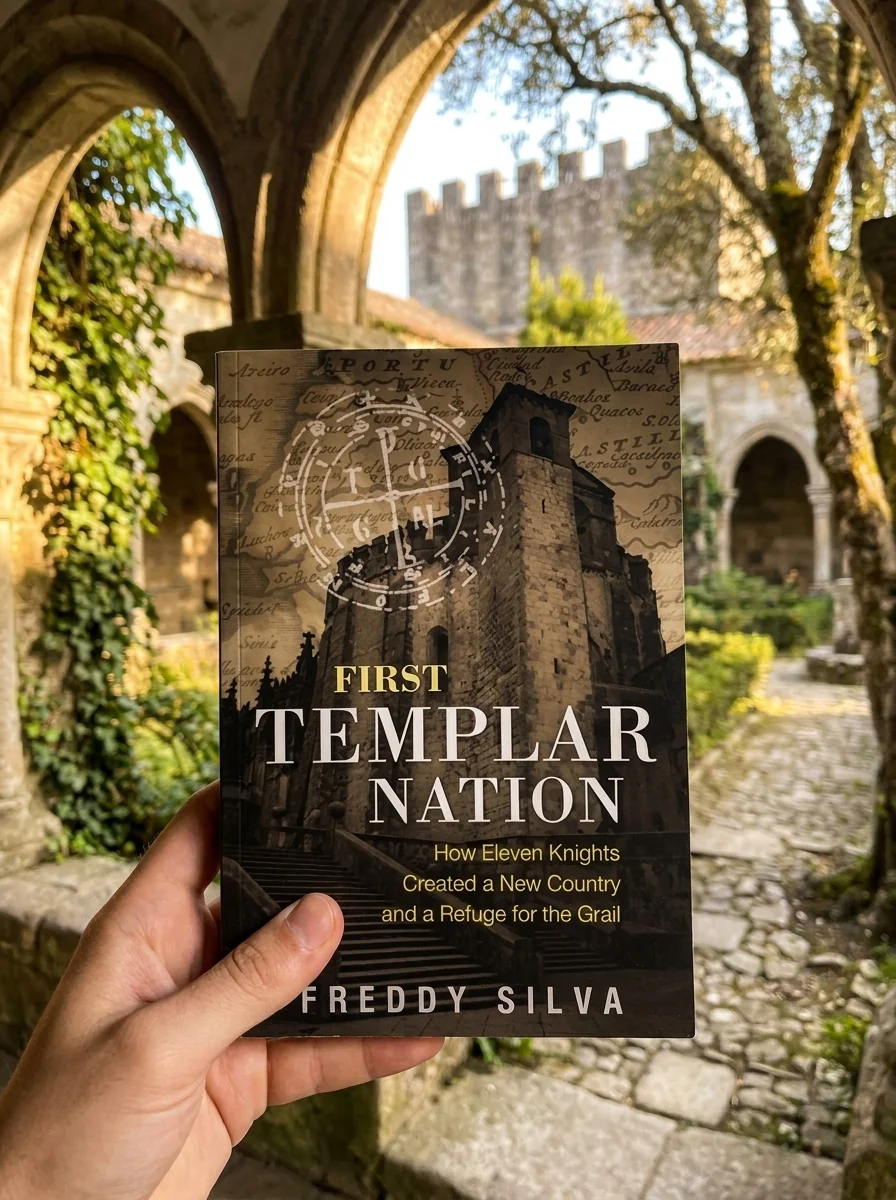
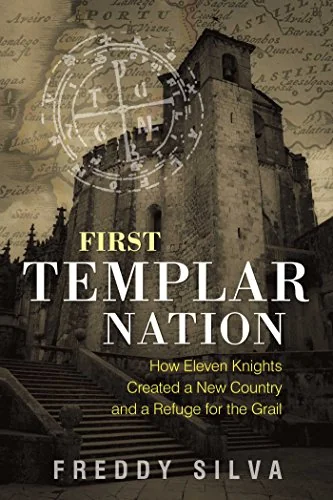
First Templar Nation: How Eleven Knights Created a New Country and a Refuge for the Grail (Edition, New)
✍️ Silva, FreddyA revisionist history showing how eleven Templar knights founded Portugal as a secret Grail refuge.
This study shifts the origin of the Templar Order from 1118 Jerusalem to early twelfth-century western Iberia. Silva examines how eleven knights aligned with Cistercian monks and the Order of Sion to establish Portugal, placing a secret Templar on the throne to escape papal control. Drawing from over 700 references, the narrative highlights the knights' veneration of John the Baptist and Mary Magdalene, their protection of the Grail, and their performance of hidden resurrection rituals. It tracks key historical milestones from central France to the battlefield of Guimarães.
The text examines medieval Europe between 1095 and 1139, spanning central France, Constantinople, Jerusalem, and Iberia. It focuses on the political and religious friction between early Templar knights, Cistercian abbeys, the Roman Church, and the Moorish battles that shaped the founding of Portugal.


Praise for this book
“In this well-told story, author Freddy Silva has filled a long-standing need for a real understanding of the Templars' early history, their search for treasure in the Temple of Solomon, and the creation of an independent Portugal with a Templar knight as king. First Templar Nation is a fascinating contribution to the body of knowledge of the Order.”
📝 Description: First Templar Nation: How Eleven Knights Created a New Country and a Refuge for the Grail (Edition, New)
📑 What's inside
- 1 1125. An oak table in a large hall in a small county named Portugale
- 2 1095. November. In the Auvergne, a mountainous region in central France
- 3 1096. August. Constantinople, capital of the Holy Roman empire
- 4 1096. August. With the northern army, preparing to depart
- 5 1098. On the desert road near Antioch
- 6 140 BC. In a land in western Iberia called Lusitania
- 7 1099. June. Outside the gates of Jerusalem
- 8 Thirty years earlier. Orval. A town downriver from Bouillon
- 9 1114. Braga. A very old city in Portugale
- 10 1100. Jerusalem. In the palace of the new king
- 11 1100. Braga. Hearing foreign voices
- 12 1117. Bethlehem. At a ceremony
- 13 1117. Guimarães. In the court of Countess Tareja
- 14 1126. Clairvaux. A very, very, very modest abbey in Champagne
- 15 Seven Years Earlier. Clairvaux. A special moment on June 24
- 16 1125. Late Autumn. Porto. Disembarking after a long sea voyage
- 17 1127. Autumn. Aboard a galley in the Mediterranean
- 18 1128. April. Braga. An office where lots of documents are signed
- 19 1128. January. A major gathering at Troyes, a town in Champagne
- 20 1128. Back in Clairvaux. Upon the conclusion of the conclave
- 21 1128. April. A chamber in the royal residence of Guimarães
- 22 1128. Meanwhile in Champagne
- 23 1128. June 24 A battlefield outside Guimarães
- 24 1129. March. Afonso reveals himself
- 25 1139. Ourique. Preparing to battle the Moors
- 26 1139. Clairvaux. Early dawn, outside the chapel
- INTERMEZZO
- 27 1867. Jaffa. A mule train heading toward Jerusalem
- 28 1146. Coimbra. At home with Afonso and his new bride
- 29 1147. April. Braga. The mysterious Prior Arnaldo in his new abode
- 30 1119. Temple Mount. A tunnel, eighty feet beneath
- 31 1147. Braga. Gualdino Paes also moves into his new domicile
- 32 1121. Saint-Omer. In the home of a cryptographer named Lambert
- 33 1947. Qumran. Two goatherds, in a cave, by the Dead Sea
- 34 1159. Ceras. A pile of rubble near a dilapidated town
- 35 68 AD. Mount Sion. Men in white, hiding scrolls and other important things
- 36 1159. Coimbra. The king of Portugal's desk, part I
- 37 1159. Coimbra. The king of Portugal's desk, part II
- 38 1159. Coimbra. The king of Portugal's desk, part III
- 39 1160. March 1. A dawn ceremony on the promontory above Thamar
- 40 Present Era. April. Inside the rotunda of Tomar
- 41 1865. The Vatican. Pope Pius IX gets all steamed up
- 42 Present Era. April. By the rotunda, amid the secrets of the beehive
- 43 Present Era. April. Musing outside the beehive
- 44 1165. Monsanto. Peculiar behavior on an unusual hill
- 45 Present Era. Monsanto. And other places for musing
- 46 1147. Sintra. A funny thing happens on the way to the castle
- 47 Present Era. Sintra. In the Forest of Angels
- 48 Present Era. April. In the shadow of a statue in Tomar
- 49 1153. Gossip in the alleyways of Jerusalem
- 50 1312. Southern Portugal. The templars enjoy a six-year vacation
- 51 Present Era. Aksum. A feast day when the Tabotat are seen in daylight
- 52 Present Era. Tomar. Staring at the rotunda
- 53 Present Era. A circular hall in a small country named Portugal
- EPILOGUE
- Lusitania. Where knowledge is stored, guarded by a goddess whose symbol is a triangle
- Notes Bibliography Image Credits Index About the Author
💎 Expert review
📖 Why choose it
Why this book is worth reading
Readers fascinated by the intersection of medieval history, secret societies, and spiritual mythology will find this book deeply engaging. Freddy Silva offers a compelling alternative narrative that recontextualizes the Knights Templar not merely as warriors, but as architects of a new political and spiritual identity. Those interested in the symbolic significance of Mary Magdalene and John the Baptist, or those seeking to understand the purported esoteric foundations of Portugal, will appreciate the meticulous research into holy sites. It is an ideal read for individuals who enjoy uncovering hidden connections between religious orders and nation-building, providing a fresh perspective on the Grail quest and its geographical implications.
⭐ Reader reviews
Reader rating
Silva presents a bold thesis that may appeal to enthusiasts of esoteric history but will likely frustrate academic historians seeking conventional evidence. The book is best suited for readers who enjoy speculative non-fiction and symbolic interpretation over strict factual chronology. It does not suit those who prefer mainstream historical accounts or who are skeptical of alternative theories regarding the Templars' origins. While the exploration of Portuguese holy sites and hidden chambers is intriguing, the argument relies heavily on reinterpretation rather than undeniable proof. Readers expecting rigorous academic citation may find the narrative too speculative, but fans of mystical history will enjoy the imaginative reconstruction of the Grail's legacy.
❓ Frequently asked questions
📖 Who should read this
If you're fascinated by secret societies, ancient mysteries, and alternative historical narratives, this book is for you. Readers who question established accounts of the Knights Templar, the Holy Grail, or the origins of European nations will find its revelations both challenging and captivating.
🎯 Key themes and symbolism
Templar Origins Reimagined
This book radically redefines the Knights Templar's genesis, placing their true beginnings in Portugal a decade before their conventionally accepted formation in Jerusalem. It argues their initial purpose was not merely pilgrim protection, but a far more ambitious, strategic endeavor linked to nation-building and esoteric spiritual pursuits, challenging centuries of historical understanding.
Portugal's Templar Foundations
Silva presents compelling evidence that the Knights Templar, in league with the mysterious Order of Sion, were the true architects behind the creation of Portugal as Europe's inaugural nation-state. The book details how Templar members ascended to kingship, demonstrating their deep-seated influence in shaping political landscapes and establishing a new European power.
Esoteric Devotions & The Grail
Beyond their martial reputation, the Templars' spiritual heart is explored, highlighting their veneration of Mary Magdalene and John the Baptist. The book delves into the true significance and precise geographical location of the Holy Grail, interpreting it not as a mere relic but as a profound esoteric secret integral to their spiritual and geopolitical mission.
📜 Historical context
📚 Glossary
- Knights Templar
- Order of Sion
- Holy Grail
📔 Questions to reflect on
- If the foundational history of a nation like Portugal was secretly orchestrated by a hidden order, how might this alter our understanding of other historical events?
- Consider the implications of a 'Grail' that is not a physical object, but a spiritual truth or lineage. How does this shift your perception of its power and significance?
- This book suggests a deep connection between ancient spiritual devotion (Mary Magdalene, John the Baptist) and geopolitical power. How might these two seemingly disparate forces intertwine today?
📖 Read on the blog
✍️ More books by this author Silva, Freddy
All books by this author →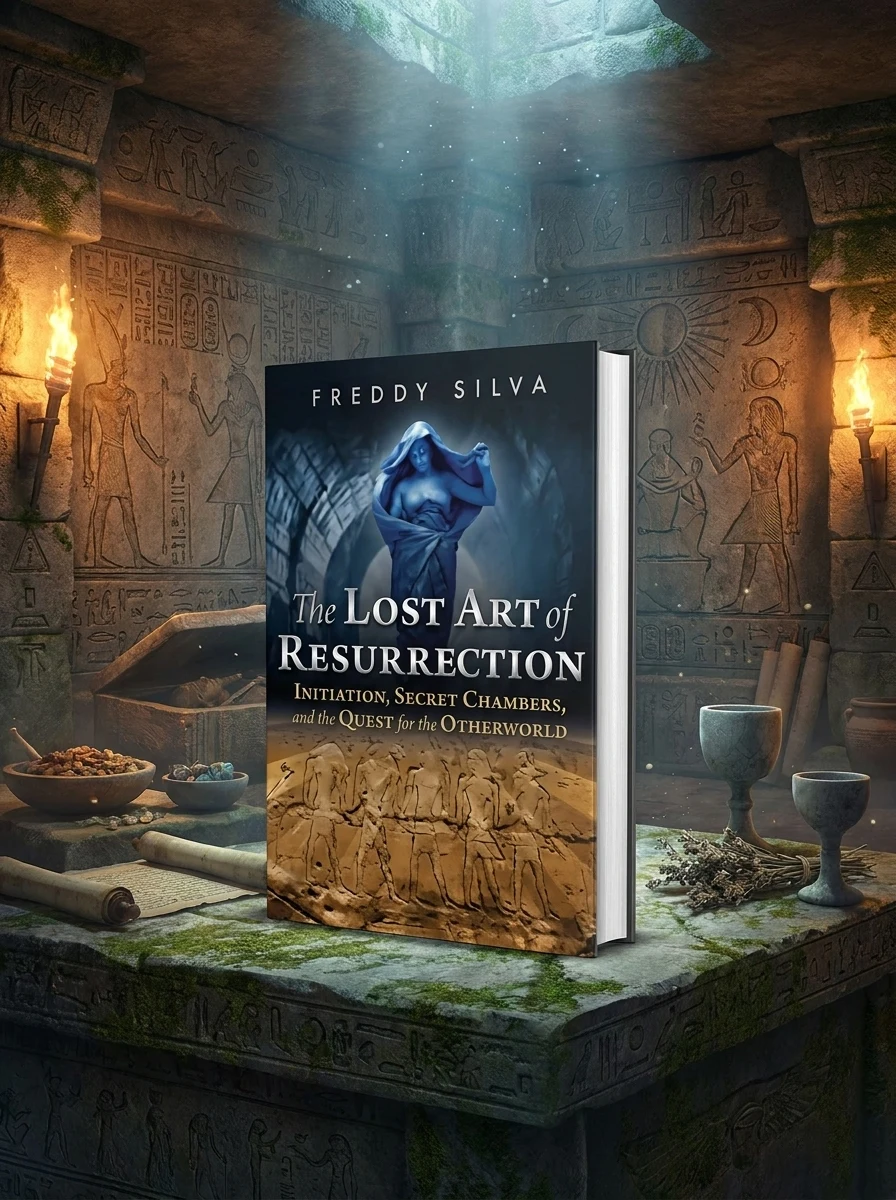


🏛 Books from this publisher Destiny Books
All books from this publisher →


You might also like
See more →


Have a question about this item?
Ask about the edition, condition, delivery or anything else — we reply by email or phone, usually within a day.
