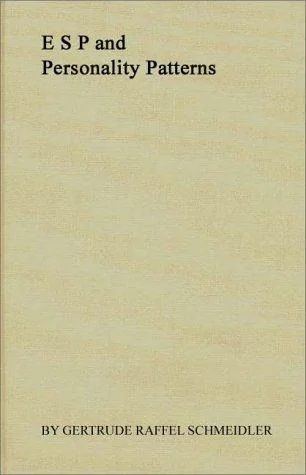
ESP and Personality Patterns (Revised)
A scientific analysis of how personality traits influence extrasensory perception abilities.
This work bridges psychology and physics to explore the measurable link between character types and psychic sensitivity. Schmeidler provides the psychological framework for understanding personality, while McConnell utilizes statistical methods to validate these patterns. The result is a text that treats ESP not as magic, but as a phenomenon subject to scientific scrutiny. Readers gain insight into how specific mental structures correlate with clairvoyant or telepathic potential, offering a grounded perspective on mystical subjects.
Published in October 1973 by Praeger, this volume reflects the era's interest in legitimizing occult studies through scientific rigor. It sits at the intersection of mid-twentieth century psychology and emerging paraps research, appealing to American readers seeking empirical frameworks for mystical concepts during a period of growing interest in mind-body-spirit integration.


📝 Description: ESP and Personality Patterns (Revised)
💎 Expert review
📖 Why choose it
Why this book is worth reading
Readers fascinated by the scientific underpinnings of the occult will find this text invaluable. It is ideal for those who suspect that their inner psychological landscape directly influences their ability to perceive beyond ordinary senses. If you are a researcher, psychologist, or serious enthusiast looking for data-driven insights rather than mystical anecdotes, this book offers a unique perspective. It provides a structured approach to understanding how personality traits might correlate with clairvoyance and telepathy. You will gain a deeper appreciation for the intersection of mind and matter, grounded in extensive data collection. This is not for casual readers seeking simple answers, but for those ready to engage with complex statistical analyses that challenge conventional views on psychic potential.
⭐ Reader reviews
Reader rating
While Schmeidler and McConnell provide a meticulous exploration of personality patterns and ESP, this book demands patience from its audience. It is strictly a scientific report, relying heavily on sophisticated statistical analysis rather than narrative engagement. Readers expecting a mystical journey or accessible anecdotes will likely find it dry and dense. The rigorous academic tone may alienate those seeking spiritual guidance or easy-to-digest theories. However, for those interested in the empirical side of parapsychology, it remains a significant resource. It does not suit readers who prefer intuitive or esoteric explanations over cold, hard data. The value lies in its methodological rigor, which may feel inaccessible to non-specialists unfamiliar with psychological testing frameworks.
❓ Frequently asked questions
📖 Who should read this
If you're a curious mind fascinated by the frontiers of consciousness, a student of psychology, or simply wonder about your own psychic inclinations, this book offers a grounded, evidence-based exploration. It's for those who appreciate a scientific approach to understanding the 'unseen.'
🎯 Key themes and symbolism
Psychic Predisposition
This book meticulously investigates how inherent personality traits may correlate with an individual's capacity for extrasensory perception. It moves beyond anecdotal evidence, seeking patterns and indicators within human psychological profiles that might suggest a natural inclination towards psychic abilities, providing a framework for understanding who might be more attuned.
Rigorous Inquiry
Delving into the often-skeptical realm of psychic phenomena, the authors employ a scientific lens. The work is built upon empirical data gathered through controlled psychological experiments, subsequently subjected to stringent statistical analysis, providing a methodological blueprint for parapsychological research and validating its findings through academic rigor.
Mind's Boundaries
By exploring the intricate interplay between the conscious and subconscious mind and its potential for perception beyond conventional senses, the text invites readers to reconsider the limits of human awareness. It probes whether our inner landscape directly influences our ability to grasp non-physical information, pushing the frontiers of psychological understanding.
📜 Historical context
📚 Glossary
- Extrasensory Perception (ESP)
- Parapsychology
- Clairvoyance
📔 Questions to reflect on
- Reflect on times you've had an 'intuitive hit' or 'gut feeling.' Do you notice any consistent personality traits or emotional states that accompany these experiences?
- Consider the ethical implications of scientifically validating psychic abilities. How might such acceptance change our understanding of human potential or societal structures?
- If personality truly influences psychic capacity, what does this suggest about personal development? Could fostering certain traits enhance our non-sensory perceptions?
📖 Read on the blog
🏛 Books from this publisher Praeger
All books from this publisher →



You might also like
See more →

Have a question about this item?
Ask about the edition, condition, delivery or anything else — we reply by email or phone, usually within a day.
