US shipping Secure card payment Occult and esoteric books

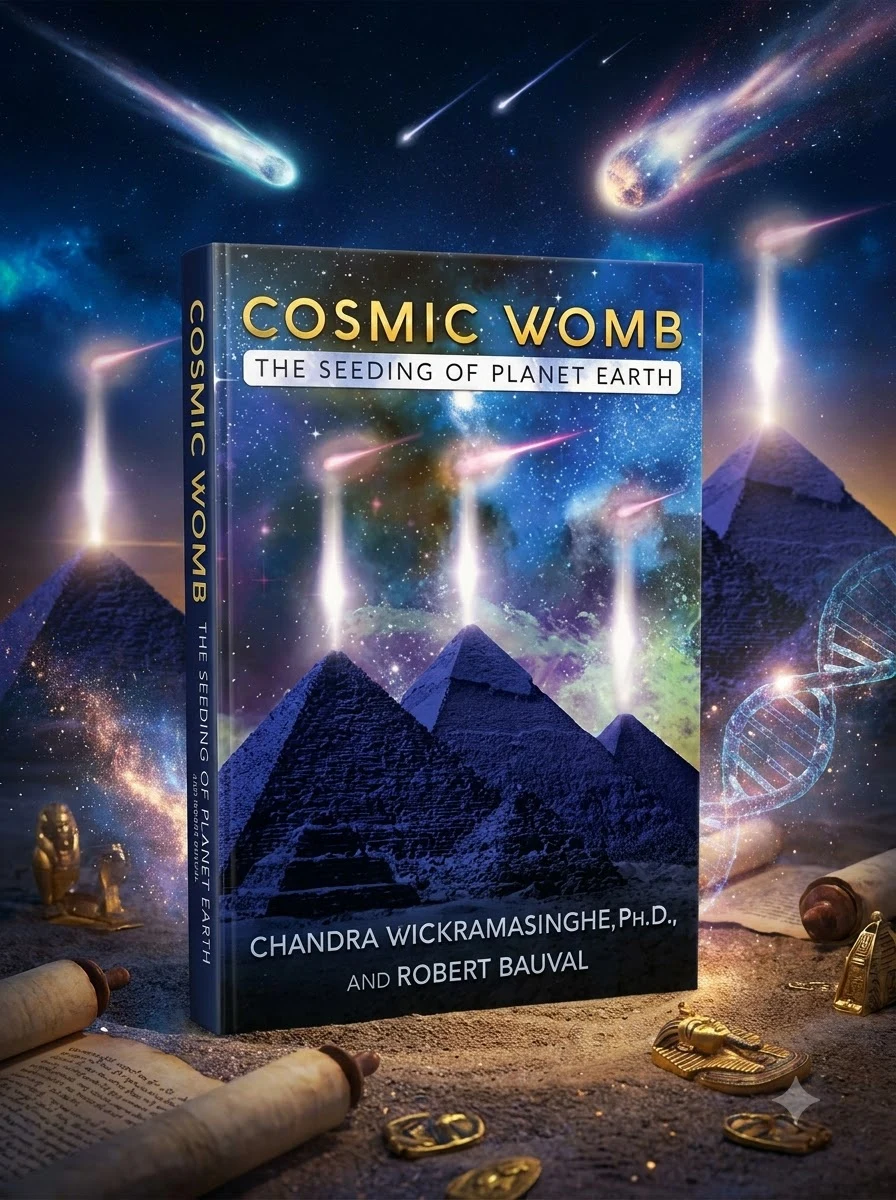
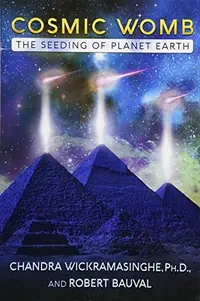
Cosmic Womb: The Seeding of Planet Earth

Wickramasinghe Ph D, Chandra; , Bauval, Robert
Reader rating
4.6
(1 reviews) 135 sold
In stock

Stock reported in the catalog; fulfillment is confirmed with your request.

📚 ABOUT THE BOOK

Unearth compelling evidence that humanity's origins are written in the stars, not just Earth's soil.

Chandra Wickramasinghe and Robert Bauval present a revolutionary thesis, suggesting that life, intelligence, and even the very blueprint for evolution on Earth were delivered from the cosmos. Expanding on the panspermia theory, this work delves into how interstellar dust and comets may have not only initiated life but also continually spurred its development. It provocatively explores the idea that ancient civilizations possessed knowledge of these extraterrestrial origins, perhaps even accessing universal wisdom embedded within human DNA, and uncovers new insights into monumental structures like the Great Pyramid.

Key themes
Cosmic Origin of Life DNA as Universal Archive Ancient Civilizations & Stars
Historical context

This volume sits firmly within the modern esoteric synthesis of science and spirituality, bridging the gap between hard astronomical data and metaphysical speculation about human origins. It aligns with the late twentieth-century surge in alternative history that reinterprets ancient myths through a lens of extraterrestrial influence.

Difficulty
●●● Demanding
Fans will love it
Erich von Däniken · Zecharia Sitchin · John Anthony West · The Sirius Mystery
🕯️ Occult Philosophy
🏛 Bear & Company 📅 2017 📖 408 pages 📔 Paperback 📐 Paperback ISBN: 9781591433071
Fun fact
Wickramasinghe and Bauval offer a compelling, if controversial, synthesis of astrobiology and ancient history. This book excels at presenting the scientific arguments for panspermia alongside the esoteric wisdom of antiquity, making a bold case for humanity's cosmic heritage. Readers seeking conventional explanations for life's origins or strictly materialistic views will likely find it challenging. However, for those open to profound paradigm shifts and interdisciplinary exploration, 'Cosmic Womb' stands as a fascinating and provocative entry into the literature of cosmic consciousness and ancient mysteries.

📝 Description: Cosmic Womb: The Seeding of Planet Earth

Compelling evidence that life, intelligence, and evolution on Earth were seeded by comets and cosmic intelligence - Explains how life first came from interstellar dust and comets and how later arrivals of cosmic dust and comets spurred evolution - Explores the possibility that universal knowledge may be stored in human DNA and how ancient cultures may have known a way to retrieve this knowledge - Reveals new discoveries about the dimensions of the Great Pyramid of Giza All ancient cultures link humanity's origins to the heavens. The Egyptians, for example, were adamant that their ancestors came from the stars of Orion and Sirius. Today, however, religion and science assert that life arose spontaneously here on Earth. Did the ancients know our true cosmic origins? Have they left us clues? Expanding on the panspermia theory developed with the celebrated astronomer Sir Fred Hoyle--namely that the building blocks of life were imported to Earth by comets in the distant past--Chandra Wickramasinghe and Robert Bauval explore the latest findings in support of a cosmic origin for humanity. They detail the astrobiological discoveries of organic molecules deep in space, how microbes are incredibly resistant to the harshest conditions of space--enabling the transfer of genes from one star system to another, and the recent recovery of microorganisms from comets still in space. They argue that the universe was "born" and preset with the blueprint of life and that the cosmos must be teeming with lifeforms far older and perhaps far more developed than us. They show how life arrived on our planet in the form of interstellar dust containing alien bacteria approximately 3.8 billion years ago and how later comets, meteoroids, and asteroids brought new bacterial and viral genetic material, which was vital for evolution. Using the latest advances in physics, cosmology, and neuroscience, the authors explore how universal knowledge may be stored in human DNA and cells, and they postulate that ancient cultures, such as the pyramid builders of Egypt and the temple builders of India, may have known a way to retrieve this knowledge. Sharing new discoveries from experienced architects, engineers, and mathematicians, they show how the Great Pyramid is a three-dimensional mathematical equation in stone, bearing a potent message for humanity across time and space about who we are and where we come from.

💎 Expert review

💎
Esoterica Books editorial team
Occult literature desk
While the thesis expands on panspermia with bold claims about extraterrestrial seeding of intelligence, it demands a suspension of conventional scientific skepticism. The authors weave together astronomical observations and architectural analysis to suggest ancient civilizations accessed universal wisdom via DNA. However, readers seeking rigorous, peer-reviewed academic proof may find the leaps in logic too speculative. It is best suited for those comfortable with fringe theories who view history as a record of cosmic contact rather than isolated terrestrial development. Do not expect straightforward scientific consensus; instead, prepare for a narrative that prioritizes metaphysical implication over empirical certainty.
✓ EDITOR'S REVIEW

📖 Why choose it

📖

Why this book is worth reading

Readers fascinated by the intersection of astrophysics and ancient mystery will find this book a compelling, if provocative, read. It appeals to those who feel that standard evolutionary narratives leave gaps regarding human consciousness and intelligence. If you are drawn to the idea that our DNA holds cosmic secrets or that monuments like the Great Pyramid encode stellar knowledge, this work offers a fresh, albeit controversial, perspective. It is for the open-minded seeker willing to explore how interstellar dust might have seeded not just life, but the very blueprint of evolution on Earth.

⭐ Reader reviews

The starting rating comes from the team Esoterica Books —
⭐ Esoterica editorial review Editorial rating 4.7/5
★★★★
If you're fascinated by ancient mysteries, the search for extraterrestrial life, and unconventional theories about human evolution, this book offers a thought-provoking journey. Prepare to have your perceptions of life's genesis and our place in the universe profoundly challenged.

Reader rating

4.6
Based on 1 reviews
5
0
4
1
3
0
2
0
1
0
E
Esoterica Books editorial team

While the thesis expands on panspermia with bold claims about extraterrestrial seeding of intelligence, it demands a suspension of conventional scientific skepticism. The authors weave together astronomical observations and architectural analysis to suggest ancient civilizations accessed universal wisdom via DNA. However, readers seeking rigorous, peer-reviewed academic proof may find the leaps in logic too speculative. It is best suited for those comfortable with fringe theories who view history as a record of cosmic contact rather than isolated terrestrial development. Do not expect straightforward scientific consensus; instead, prepare for a narrative that prioritizes metaphysical implication over empirical certainty.

❓ Frequently asked questions

Panspermia is the hypothesis that life exists throughout the universe, distributed by meteoroids, asteroids, comets, and planetoids. This book argues that Earth's life originated this way, brought by cosmic travelers.
The authors propose that ancient civilizations, particularly the Egyptians, retained knowledge of humanity's stellar origins. Their myths and monuments, like the Great Pyramid, may contain encoded clues to these cosmic truths and perhaps even a way to access 'universal knowledge' within our DNA.

📖 Who should read this

If you're fascinated by ancient mysteries, the search for extraterrestrial life, and unconventional theories about human evolution, this book offers a thought-provoking journey. Prepare to have your perceptions of life's genesis and our place in the universe profoundly challenged.

🎯 Key themes and symbolism

Cosmic Origin of Life

This book champions the panspermia theory, positing that life's building blocks, and even fully formed microbes, originated in space. It details how comets and cosmic dust acted as interstellar vessels, transporting the essential components of life across vast distances to seed our planet, profoundly influencing terrestrial evolution.

DNA as Universal Archive

The authors explore the radical concept that human DNA might function as a repository of universal knowledge, a cosmic hard drive containing information from across the galaxy. They suggest that ancient cultures, with their deep reverence for the heavens, may have understood how to unlock and interpret these inherent genetic memories.

Ancient Civilizations & Stars

Investigating the profound celestial connections in ancient societies, particularly Egyptian cosmology, the book argues that these cultures held a genuine understanding of humanity's cosmic heritage. It uncovers new findings related to the Great Pyramid of Giza, suggesting its dimensions encode profound astronomical and perhaps even panspermic truths.

💬 Quotes from the book

“Our very genesis, and indeed the evolutionary leaps that followed, appear to be etched in stardust, delivered by cosmic voyagers from beyond our terrestrial sphere.”

“Could the ancient whispers of stellar origins, passed down through forgotten ages, be echoes of a truth encoded deep within our own biological blueprint?”

📜 Historical context

The concept of panspermia, though ancient in its philosophical roots, gained modern scientific traction through the work of figures like Svante Arrhenius and later Sir Fred Hoyle. This book builds directly upon Hoyle's work with Wickramasinghe, extending the theory beyond mere biological seeding to encompass the origins of intelligence and ancient wisdom, positioning it firmly within the 'ancient astronaut' and 'cosmic connection' traditions.

📚 Glossary

Panspermia
Astrobiology
Cosmic Intelligence

📔 Questions to reflect on

  1. If our DNA truly holds universal knowledge, what implications does this have for human potential and our understanding of consciousness?
  2. Consider the difference between a spontaneous terrestrial origin of life and a cosmic seeding. How might each theory change your worldview?
  3. Reflect on ancient cultures' celestial links. What modern beliefs might be re-evaluated if their 'myths' held a core of scientific truth?

🏛 Books from this publisher Bear & Company

All books from this publisher →
You might also like

See more →