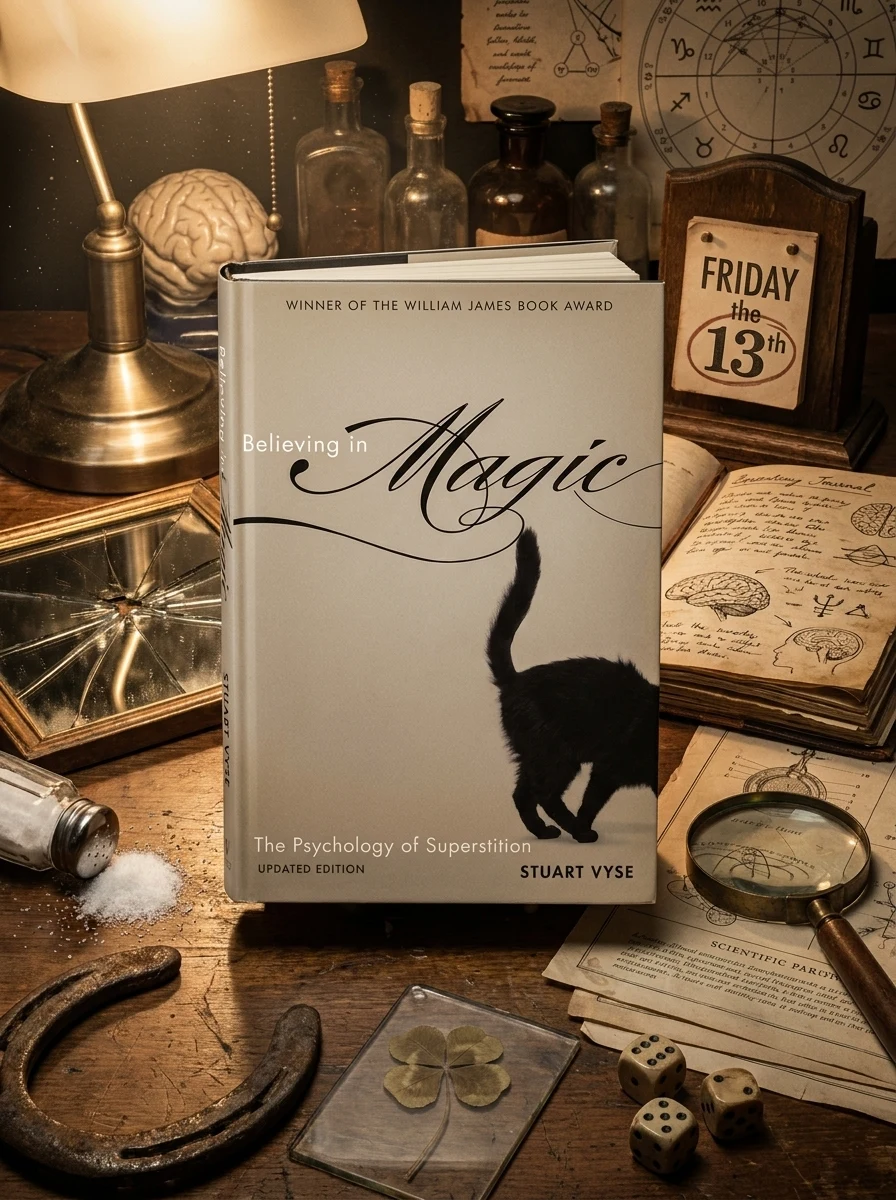
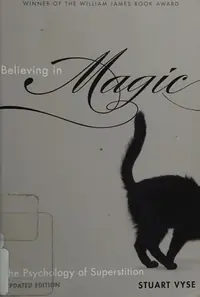
Believing in Magic: The Psychology of Superstition - Updated Edition (Updated)


Stock reported in the catalog; fulfillment is confirmed with your request.
Unravel the hidden psychological threads binding us to unseen forces and irrational hopes.
Stuart Vyse’s updated edition delves into the enduring presence of superstition across all societal strata, despite scientific advancements. This insightful work uncovers the deep-seated psychological mechanisms—like our sensitivity to coincidences, the comfort of ritual, and the primal need for control—that fuel these seemingly irrational beliefs. He carefully distinguishes superstition from religious and paranormal convictions, examining its surprising benefits, and ultimately offers a framework for understanding complex human behavior in a technologically advanced world.
This work sits at the intersection of modern cognitive psychology and the study of esoteric beliefs, offering a scientific lens on the persistence of superstition in contemporary society. It bridges the gap between academic inquiry into human behavior and the popular fascination with the occult.


📝 Description: Believing in Magic: The Psychology of Superstition - Updated Edition (Updated)
💎 Expert review
📖 Why choose it
Why this book is worth reading
Readers fascinated by the psychological underpinnings of occult practices will find this volume indispensable. It is ideal for those who wish to understand why even scientifically minded individuals cling to irrational hopes and rituals. Vyse provides a compassionate yet rigorous framework, revealing how our primal need for control and sensitivity to coincidence drive these behaviors. Whether you are a skeptic seeking to demystify the paranormal or a believer curious about the mind's role in faith, this book offers clarity without condescension.
⭐ Reader reviews
Reader rating
Vyse delivers a compelling dissection of superstition, distinguishing it clearly from religious conviction while acknowledging its surprising benefits. However, readers seeking definitive proof of supernatural phenomena will be disappointed by the strictly psychological explanations offered here. It is not for those who prefer dogmatic affirmations of magic over empirical analysis. Instead, it serves as a crucial tool for understanding the human condition in a technologically advanced world, challenging us to confront our own irrationalities with intellectual honesty and grace.
❓ Frequently asked questions
📖 Who should read this
For anyone intrigued by the pervasive nature of human belief, seekers of psychological insight, or those who wish to understand the subtle power of the mind over perceived reality. If you've ever crossed your fingers for luck, this book is for you.
🎯 Key themes and symbolism
Roots of Belief
This book meticulously dissects the core psychological processes that give rise to superstitious thinking. Vyse illuminates how our innate human wiring, such as our tendency to perceive patterns or our desire to alleviate anxiety through ritual, naturally leads to these pervasive beliefs, offering a scientific lens on a universal phenomenon.
Defining Superstition
Vyse provides crucial clarity, drawing sharp distinctions between superstition, paranormal phenomena, and established religious faith. He helps readers understand the specific characteristics that define superstitious behavior, offering a nuanced perspective that avoids conflating different systems of belief and practice.
Unexpected Benefits
Beyond simply labeling beliefs as irrational, the author explores the surprising adaptive functions superstition can serve for individuals. He discusses how these practices can offer a sense of control, reduce stress, and provide psychological comfort, revealing a more complex interplay between belief and well-being.
💬 Quotes from the book
“Even in an age saturated with scientific understanding, the human mind retains its profound capacity for beliefs that defy rational explanation.”
“Our innate sensitivity to patterns, coupled with an inherent desire for control, often lays the groundwork for what we come to label as superstition.”
📜 Historical context
📚 Glossary
- Superstition
- Paranormal Beliefs
- Ritual
📔 Questions to reflect on
- Reflect on a personal 'superstition' or ritual you observe, consciously or unconsciously. What psychological need might it be fulfilling for you?
- How does Vyse's distinction between superstition, religious belief, and paranormal belief shift your understanding of these categories?
- Consider a time when a seemingly irrational belief provided you or someone you know with comfort or a sense of control. What was the context and impact?
You might also like
See more →