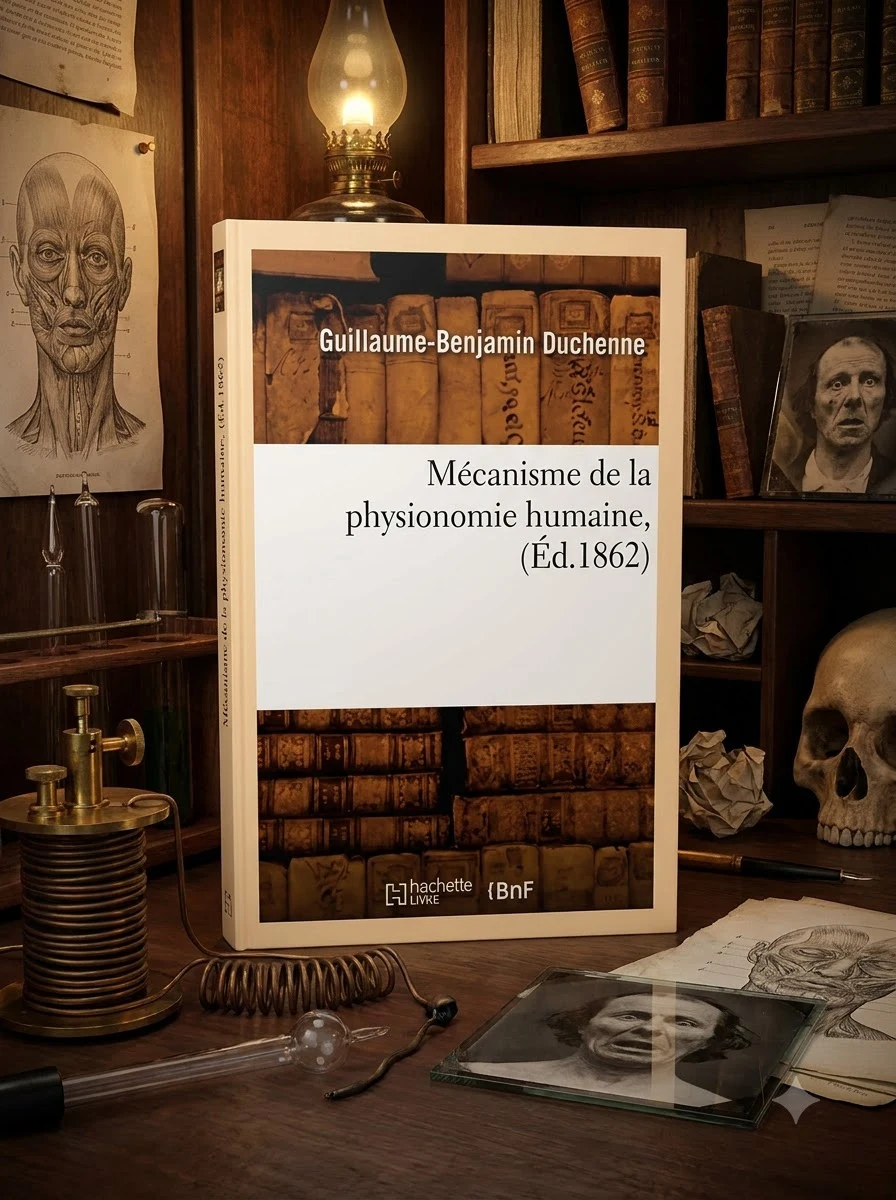


Mécanisme de la Physionomie Humaine, (Éd.1862) (1862) Collectif


Stock reported in the catalog; fulfillment is confirmed with your request.
Unmask the secrets etched upon the human face, revealing passions and hidden truths.
This fascinating reprint delves into the intricate science of human physiognomy, exploring how emotions manifest visually through facial expressions. Originally stemming from the pioneering electro-physiological research of Dr. G.B. Duchenne de Boulogne, this collective edition examines the muscular mechanisms that betray our inner states. It offers a detailed analysis of how passions are expressed, providing a historical lens into 19th-century attempts to categorize and understand human emotion. A crucial document for anyone interested in the physical embodiment of the psyche and the early roots of modern psychology.
This work emerges from the 19th-century intersection of empirical science and early psychology, reflecting the era's intense fascination with linking physical anatomy to psychological states through rigorous observation and photographic documentation.


📝 Description: Mécanisme de la Physionomie Humaine, (Éd.1862) (1862) Collectif
💎 Expert review
📖 Why choose it
Why this book is worth reading
Readers with a deep curiosity about the historical foundations of non-verbal communication and the physical basis of emotion will find this text invaluable. It serves as a vital resource for those studying the evolution of psychological theory, offering a unique glimpse into how 19th-century scholars attempted to quantify the human experience through muscular mechanics. Whether you are a historian of science, a student of facial expression analysis, or simply intrigued by the intersection of biology and behavior, this book provides essential context for understanding how we came to interpret the face as a mirror of the soul. It is not merely an aesthetic study but a foundational document in the quest to decode the invisible workings of the psyche through visible means.
⭐ Reader reviews
Reader rating
This volume stands as a significant historical artifact, meticulously documenting the electro-physiological research that underpinned early physiognomic studies. While its scientific methods may feel dated to modern eyes, its value lies in its raw documentation of emotional mechanics. However, it is not suited for casual readers seeking light entertainment or those with no interest in anatomy, psychology, or historical science. The dense focus on muscular mechanisms and the clinical tone may alienate readers looking for narrative flair or contemporary psychological insights. It is a specialized academic tool rather than a general interest read, best appreciated by those willing to engage with its rigorous, albeit archaic, approach to mapping human passion.
❓ Frequently asked questions
📖 Who should read this
If you're fascinated by the intersection of mind and body, the history of psychology, or the esoteric art of reading non-verbal cues, this volume is an essential acquisition. It appeals to students of early science and anyone seeking to understand the profound language of human emotion.
🎯 Key themes and symbolism
Decoding Facial Expressions
This volume meticulously dissects the mechanics behind human facial expressions, illustrating how specific muscle contractions correspond to various emotional states. It provides a detailed, almost anatomical, exploration of the face as a canvas for the soul's inner workings, attempting a scientific classification of human passions through their visible manifestations.
Early Electro-Physiology
The work showcases groundbreaking 19th-century investigations into the body's electrical responses. It highlights the pioneering use of electro-stimulation to isolate and understand the function of individual facial muscles, offering a rare glimpse into the nascent stages of bio-electrical research and its application to psychological inquiry.
Physiognomy's Legacy
Positioned within the long tradition of physiognomic study, this edition offers a significant historical perspective. It represents a pivotal moment when the ancient art of reading faces began to intersect with empirical scientific methods, laying groundwork for future studies in emotion, body language, and non-verbal communication.
💬 Quotes from the book
“Each muscle, when stimulated, reveals a specific, isolated expression, a fragment of human passion made visible through the galvanic current.”
“The precise contraction of the *corrugator supercilii* muscle, for instance, invariably produces an expression of intense suffering or deep reflection.”
📜 Historical context
📚 Glossary
- Physiognomy
- Electro-physiology
- BNF
📔 Questions to reflect on
- How do you consciously or unconsciously interpret the non-verbal cues and facial expressions of those around you in daily interactions?
- Considering the book's focus on universal expressions, what emotions do you personally find easiest or most challenging to truly conceal or express facially?
- If facial expressions are a 'mechanism' as explored here, how might a deeper, scientific understanding of their origins change your perception of human authenticity?
🏛 Books from this publisher Hachette Livre Bnf
All books from this publisher →





You might also like
See more →