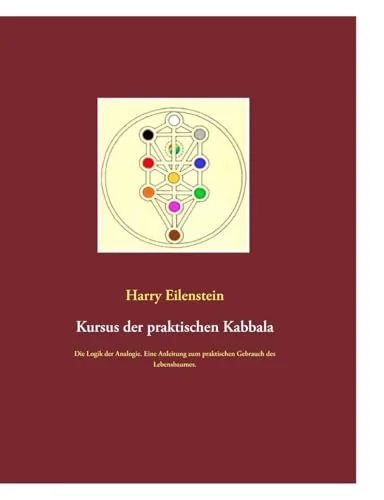
Kursus der praktischen Kabbala: Die Logik der Analogie. Eine Anleitung zum praktischen Gebrauch des Lebensbaumes. Eilenstein, Harry
✍️ Eilenstein, HarryHarry Eilenstein’s practical course illuminates the intricate architecture of the Kabbalistic Tree of Life. This foundational text introduces a revolutionary method for categorizing all phenomena, from the mundane to the mystical, using the Tree's inherent structure. It posits that a singular, universal blueprint underpins existence. By applying analogical logic, rather than traditional causal reasoning, readers can discern this pattern across diverse subjects. This approach cultivates a profound, unified worldview, helping individuals grasp their place within the cosmic design and satisfy a deep thirst for understanding without merely generating more questions.


📝 Description: Kursus der praktischen Kabbala: Die Logik der Analogie. Eine Anleitung zum praktischen Gebrauch des Lebensbaumes. Eilenstein, Harry
💎 Expert review
📖 Why choose it
Why this book is worth reading
This book is ideal for the intellectually curious occultist who feels that traditional mystical texts are too abstract or disjointed. If you possess a deep thirst for understanding the underlying unity of existence and crave a structured method to map the cosmos, this guide offers precisely that. It moves beyond mere theory, providing a practical course in analogical logic that helps readers discern patterns across diverse subjects. By illuminating the intricate architecture of the Tree of Life, it satisfies the desire to grasp one's place within the cosmic design. Readers seeking a unified worldview that connects the mundane to the mystical will find profound clarity here, transforming abstract concepts into a tangible blueprint for perceiving the hidden connections in everything.
⭐ Reader reviews
Reader rating
Eilenstein offers a systematic approach to Kabbalah that prioritizes logical categorization over emotional experience. While this structural rigor appeals to those who crave order in esoteric studies, it may alienate readers seeking spiritual depth or poetic mysticism. The text is dense with analogical reasoning, which can feel dry or overly academic to traditionalists. It does not suit those looking for immediate magical results or devotional practice. However, for the analytical mind fascinated by the 'blueprint' of reality, it provides a compelling, if somewhat rigid, framework. The emphasis on logic over intuition makes it a valuable reference for scholars, though it lacks the transformative fire often associated with practical occultism.
❓ Frequently asked questions
📖 Who should read this
If you seek a unifying framework for existence, this book is for you. Ideal for students of Kabbalah, esoteric philosophy, or anyone yearning to discover the fundamental interconnectedness of the universe through a practical, analogical lens, it promises profound insight.
🎯 Key themes and symbolism
The Universal Blueprint Revealed
Eilenstein posits that a single, unchanging architectural plan underpins all existence. Through the Tree of Life, readers discover how this fundamental design manifests across vastly different domains, from cellular biology to abstract mathematics. This consistent pattern, once recognized, offers a profound key to unlocking the underlying order of the cosmos, fostering deep insight.
Mastering Analogical Logic
Moving beyond conventional causal thinking, this work champions analogy as the primary tool for comprehension. The author demonstrates how connecting disparate elements through shared structural resemblances, rather than linear cause-and-effect, unveils deeper truths. This method allows for a holistic understanding, revealing the profound interconnectedness of all things.
Practical Kabbalistic Application
This isn't merely theoretical Kabbalah; it's a hands-on guide. Eilenstein provides a framework for actively applying the Tree of Life's principles to everyday objects and abstract concepts. The goal is to integrate this ancient wisdom into a practical methodology, empowering the reader to categorize, understand, and find meaning in their world.
📜 Historical context
📚 Glossary
- Tree of Life (Lebensbaum)
- Analogical Logic (Logik der Analogie)
- Sephirot
📔 Questions to reflect on
- Consider an everyday object you use: how might its structure or function be analogically mapped onto a Sephirah or path on the Tree of Life?
- Reflect on a complex concept from a different field (e.g., science, art). How does Eilenstein’s 'logic of analogy' offer a new way to understand its underlying patterns?
- How does the idea of a 'universal blueprint' shift your perception of seemingly disparate events or phenomena in your personal experience or the wider world?