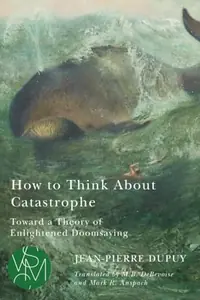
How to Think about Catastrophe: Toward a Theory of Enlightened Doomsaying Dupuy, Jean-Pierre


This edition can be ordered. No arrival date is confirmed.
Confront humanity's gravest threats with enlightened foresight, not despair.
In an era marked by humanity's unprecedented capacity for self-destruction, both direct and indirect, Jean-Pierre Dupuy offers a profound re-evaluation of catastrophe. This work challenges traditional perceptions, arguing that the lines between natural and industrial disasters have become dangerously blurred. Dupuy proposes a radical, science-backed form of apocalyptic thought, not to induce fear, but to forge a new metaphysics of time and an imperative ethical framework. His theory aims to equip us with the intellectual tools necessary to navigate and potentially avert the existential dangers we collectively face.
This work emerges from contemporary philosophical discourse on risk and ethics, challenging traditional apocalyptic narratives within the esoteric tradition of enlightened doomsaying. It bridges metaphysical inquiry with urgent existential concerns regarding humanity's capacity for self-destruction.


📝 Description: How to Think about Catastrophe: Toward a Theory of Enlightened Doomsaying Dupuy, Jean-Pierre
💎 Expert review
📖 Why choose it
Why this book is worth reading
Readers seeking a rigorous intellectual framework for confronting existential threats will find profound value in this text. It is ideal for those who wish to move beyond despair and instead cultivate enlightened foresight as an ethical imperative. The book equips you with unique metaphysical tools to navigate the blurred lines between natural and industrial disasters. By re-evaluating catastrophe through a science-backed lens, it offers clarity rather than fear. You will gain a new understanding of time and responsibility, transforming anxiety into actionable wisdom for averting collective dangers.
⭐ Reader reviews
Reader rating
Dupuy presents a radical metaphysics of time that demands serious engagement from its audience. This is not a light read for those seeking comforting platitudes or simple solutions to complex global crises. It requires patience with dense philosophical arguments about the nature of disaster and ethics. Readers who prefer narrative-driven histories or practical self-help guides will likely find this abstract and difficult. However, for those willing to grapple with the intellectual weight of 'enlightened doomsaying,' it offers a necessary, albeit demanding, perspective on our shared vulnerability.
❓ Frequently asked questions
📖 Who should read this
Seekers of profound philosophical insight into our global predicaments will find this essential. If you are ready to challenge your assumptions about the future and embrace a proactive, intellectually rigorous approach to existential threats, this book is for you.
🎯 Key themes and symbolism
Enlightened Doomsaying
Dupuy introduces a concept of 'enlightened doomsaying,' moving beyond mere prediction of disaster. It's an intellectual discipline that acknowledges the inevitability of potential self-destruction without succumbing to fatalism. Instead, it harnesses this awareness to spur proactive ethical and philosophical shifts, transforming dread into a catalyst for responsible action and a re-imagining of our collective future.
Ethics for Futurity
Central to Dupuy's argument is the urgent need for a new ethical paradigm tailored to our perilous times. He posits that traditional moral frameworks are insufficient for addressing global, systemic threats like climate change or nuclear war. This book advocates for an ethics rooted in a responsibility toward future generations, demanding a radical shift in our understanding of temporality and moral obligation to ensure survival.
Blurring Catastrophic Lines
The text meticulously deconstructs the conventional distinctions between various forms of catastrophe, from geological events to technological failures. Dupuy argues that in our interconnected world, human actions increasingly influence and exacerbate so-called 'natural' disasters. This blurring necessitates a unified theoretical approach to understanding and responding to all forms of cataclysm, recognizing their shared underlying vulnerabilities and causes.
💬 Quotes from the book
“The true catastrophe is not merely its arrival, but our intellectual and moral unpreparedness to truly perceive and respond to its inevitability.”
“Our ancient distinctions between a 'natural' and an 'anthropogenic' disaster crumble under the weight of our interconnected vulnerabilities, demanding a singular theory of collapse.”
📜 Historical context
📚 Glossary
- Enlightened Doomsaying
- Metaphysics of Temporality
- Anthropogenic Catastrophe
📔 Questions to reflect on
- How does the concept of 'enlightened doomsaying' challenge or affirm your own approach to thinking about future global challenges?
- Consider a 'natural' disaster you've witnessed or studied. In what ways might human actions or societal structures have blurred its distinction from an 'industrial' or 'anthropogenic' event?
- If we were to adopt a new 'ethics for the sake of the future,' what personal or societal sacrifices might that entail, and are we prepared to make them?
You might also like
See more →