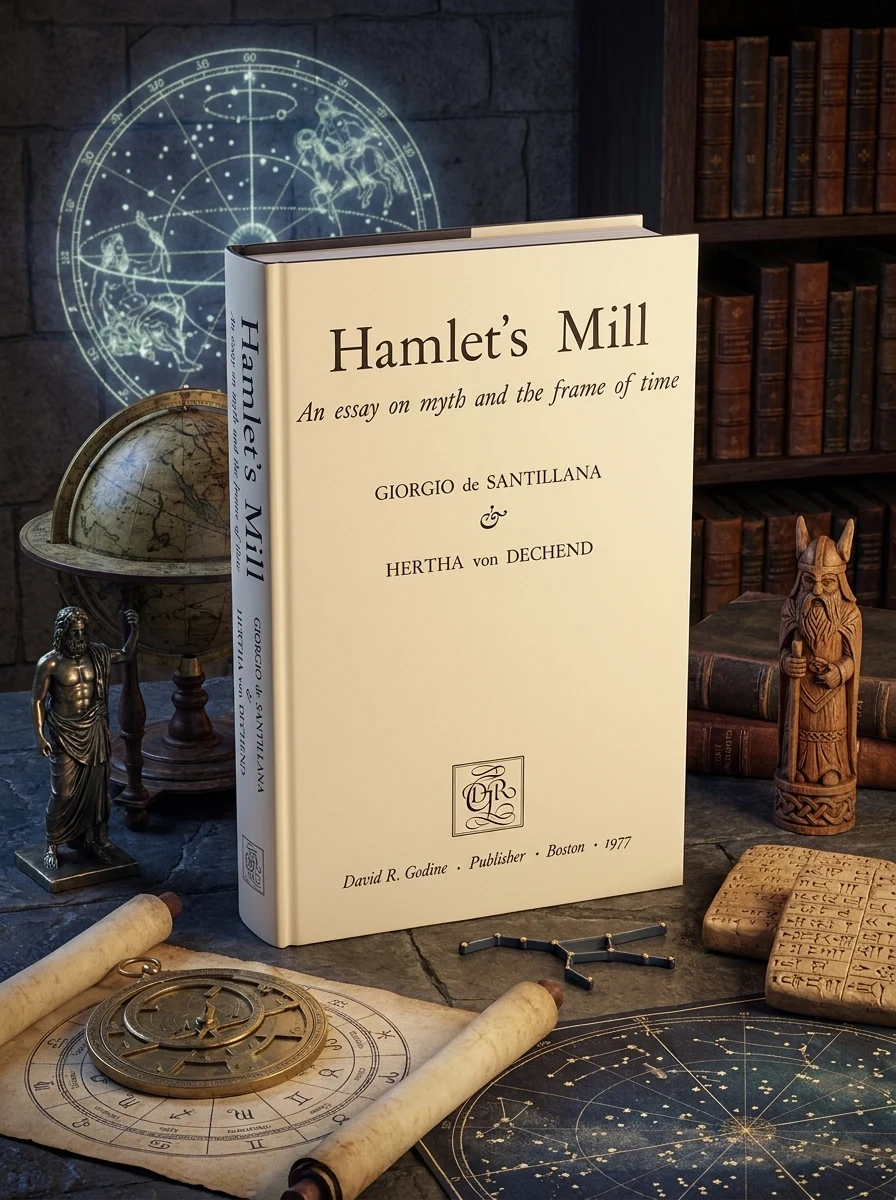
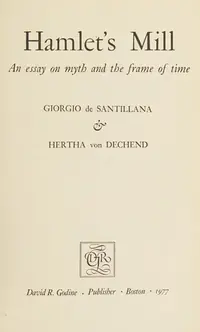
Hamlet's Mill: An Essay Investigating the Origins of Human Knowledge and Its Transmissions Through Myth


This edition can be ordered. No arrival date is confirmed.
Uncover the universe's ancient secrets hidden within humanity's oldest stories.
Delve into the profound insights of Hamlet's Mill, a groundbreaking investigation into the radical origins of human knowledge. This seminal work argues that ancient myths, far from being mere fables, are sophisticated repositories of celestial cosmology and precise astronomical data. The pantheons and narratives of diverse cultures, the authors contend, served as a universal, pre-literate language for transmitting intricate celestial mechanics. It challenges the conventional separation of science and mythology, suggesting that what we perceive as divine sagas are, in fact, encrypted records of an advanced, forgotten astronomy, suppressed by later historical shifts in thought.
This work sits firmly within the esoteric history tradition, bridging mythology and early scientific thought. It challenges conventional historical narratives by proposing that ancient myths were sophisticated astronomical records rather than mere fables.


📝 Description: Hamlet's Mill: An Essay Investigating the Origins of Human Knowledge and Its Transmissions Through Myth
💎 Expert review
📖 Why choose it
Why this book is worth reading
Readers fascinated by the hidden architecture of human history will find this book transformative. It invites you to look past the surface of ancient myths and see them as precise, encrypted data about the cosmos. If you have ever wondered if our ancestors possessed advanced astronomical knowledge that was lost to time, this text provides a compelling framework. It is ideal for those who enjoy connecting disparate cultural narratives to reveal a unified, celestial truth. You will gain a new lens through which to view history, seeing divine sagas not as fiction but as sophisticated transmissions of scientific understanding suppressed by later historical shifts.
⭐ Reader reviews
Reader rating
This seminal investigation offers a radical perspective on the origins of human knowledge, arguing that myths are repositories of celestial cosmology. While intellectually stimulating for those willing to engage with its complex arguments, it may frustrate readers seeking straightforward historical accounts or empirical evidence. It does not suit those who prefer conventional separation between science and mythology, as it insists they are one and the same in ancient contexts. The dense theoretical framework requires patience and an open mind regarding suppressed astronomical data. However, for the right audience, it is a profound re-evaluation of how we interpret our oldest stories.
❓ Frequently asked questions
📖 Who should read this
If you are captivated by hidden meanings in ancient tales, possess a keen interest in the history of science, or seek to challenge conventional views on knowledge origins, this profound journey awaits. Those pondering intricate connections between cosmos and human culture will find its arguments compelling.
🎯 Key themes and symbolism
Myths as Astronomical Codes
This book proposes that the gods, their dwelling places, and their actions within ancient myths are not arbitrary, but rather symbolic representations of celestial bodies and their intricate movements. These narratives form a precise, universal language for encoding complex astronomical observations made by pre-literate societies, revealing a hidden scientific layer beneath the storytelling.
Forgotten Ancient Science
The authors meticulously argue that early civilizations possessed an advanced understanding of the cosmos, which was ingeniously preserved and transmitted through mythological narratives before the advent of widespread written language. This sophisticated knowledge, they suggest, was later lost or significantly misinterpreted as a new Greco-Roman worldview emerged, altering the course of scientific and cultural development.
Challenging Western Paradigms
Hamlet's Mill fundamentally questions the linear progression of knowledge often assumed in Western thought, which typically separates 'primitive' myth from 'advanced' science. By demonstrating the scientific rigor embedded within ancient myths, the work compels readers to re-evaluate conventional assumptions about the development and transmission of human wisdom, suggesting a cyclical or even regressive intellectual history at times.
💬 Quotes from the book
“The divine dramas played out across ancient skies were not merely tales of gods, but precise astronomical observations veiled in narrative.”
“We have long underestimated the intellectual rigor of our ancestors, dismissing as fable what was once considered profound cosmic truth.”
📜 Historical context
📚 Glossary
- Celestial Cosmology
- Preliterate Astronomy
- Cipher
📔 Questions to reflect on
- How does the idea of myths as sophisticated scientific records alter your perception of ancient cultures and their intellectual capacities?
- Consider a familiar myth from your own culture or another. Can you identify any characters, settings, or events that might symbolically represent celestial phenomena or astronomical cycles?
- In what ways might contemporary scientific knowledge or fundamental truths be subtly encoded or obscured within our own modern cultural narratives, popular beliefs, or even fictional stories?
You might also like
See more →