Chinese Astrology
Stock reported in the catalog; fulfillment is confirmed with your request.
Unearth ancient cosmic secrets where East meets West in a dance of celestial symbols.
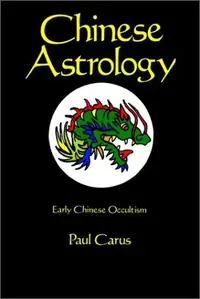
Delve into Paul Carus's distinctive exploration of Chinese mysticism, where the intricate frameworks of Eastern astrology are presented alongside their Western counterparts. This scholarly volume meticulously illustrates the fascinating parallels between symbolic systems from Chinese, Indian, Roman, and Egyptian traditions. Beyond a mere introduction, Carus meticulously traces an intellectual lineage, revealing how concepts like the Yih System, P'an-Ku, and Feng-Shu Lo-Pan form a continuous thread in Chinese thought. It's a compelling inquiry into the potential cross-cultural exchanges that shaped early astrological understanding.
This scholarly volume situates itself within the comparative study of esoteric traditions, bridging Eastern Chinese mysticism with Western astrological frameworks during the era of Open Court publishing.


📝 Description: Chinese Astrology
💎 Expert review
📖 Why choose it
Why this book is worth reading
Scholars and serious enthusiasts of comparative mythology will find immense value in this text, as it meticulously maps the intricate parallels between Chinese, Indian, Roman, and Egyptian symbolic systems. Carus offers more than a simple introduction; he traces the intellectual lineage of concepts like the Yih System and P'an-Ku, revealing how early cross-cultural exchanges shaped astrological understanding. Readers seeking to understand the continuous thread in Chinese thought and the dance of celestial symbols where East meets West will appreciate this deep dive into cosmic secrets and mystical frameworks without needing prior expertise in all listed traditions.
⭐ Reader reviews
Reader rating
While intellectually rigorous, this volume is not for casual hobbyists or those seeking practical daily horoscope advice. It requires patience for its scholarly tone and dense exploration of historical lineages rather than actionable guidance. Readers looking for quick, digestible summaries of zodiac signs will likely find the academic depth tedious. However, for those willing to engage with the complex interplay between Eastern mysticism and Western counterparts, it provides a rare, detailed look at how Feng-Shu Lo-Pan and other systems form a cohesive intellectual history. It is a work for the dedicated student of esoteric history, not the casual reader.
❓ Frequently asked questions
📖 Who should read this
If you're drawn to the cosmic architecture of ancient cultures, fascinated by the origins of symbolic systems, or a scholar seeking a deeper understanding of Chinese intellectual history beyond the usual figures, this work offers a rich and thought-provoking journey. It's for anyone pondering humanity's shared spiritual heritage.
🎯 Key themes and symbolism
Comparative Astrological Systems
Carus undertakes a unique side-by-side analysis, presenting Chinese astrological methodologies in direct conversation with Western traditions. This comparative approach not only clarifies the distinct features of each but also highlights surprising structural and philosophical commonalities, inviting readers to consider a broader, interconnected history of celestial divination.
Universal Symbolic Language
The book draws attention to the intriguing similarities found across a diverse array of ancient symbolic systems, from Chinese and Indian to Roman and Egyptian. Through detailed tables and insightful commentary, Carus prompts contemplation on whether these shared visual languages hint at a more profound, undocumented exchange of ideas across early civilizations.
Continuum of Chinese Philosophy
Moving beyond typical introductions to Confucius or Lao Tze, Carus meticulously chronicles the evolution of Chinese mystical thought. He illuminates the historical thread connecting foundational concepts like the Yih System, P'an-Ku, and the principles of Feng-Shu Lo-Pan, positioning them as integral components within a rich, unfolding intellectual tradition.
💬 Quotes from the book
“The astonishing convergence of symbolic forms across disparate ancient cultures compels us to re-evaluate the isolationist narratives of early civilization.”
“By juxtaposing the intricate celestial frameworks of the East with their Western counterparts, a deeper understanding of humanity's universal quest for cosmic order emerges.”
📜 Historical context
📚 Glossary
- Yih System
- P'an-Ku
- Feng-Shu Lo-Pan
📔 Questions to reflect on
- Considering the symbolic parallels between ancient astrological systems, what might this suggest about a universal human unconscious or shared archetypes?
- How might the documented exchanges between early civilizations have shaped not only astrology but other spiritual or scientific practices we know today?
- If symbols possess a common resonance across cultures, what implications does this have for our understanding of truth or meaning in esoteric studies?
🏛 Books from this publisher Open Court
All books from this publisher →
You might also like
See more →
 91
91

 91
91