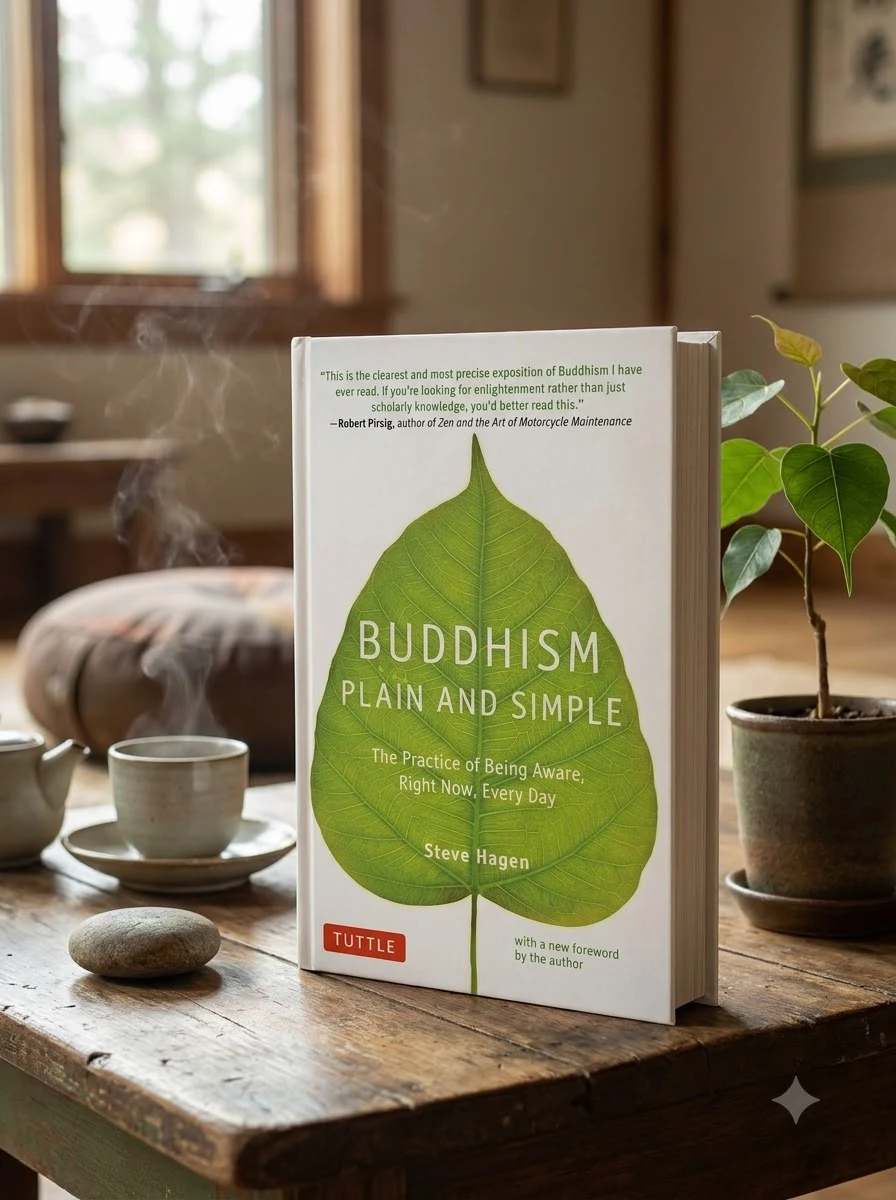

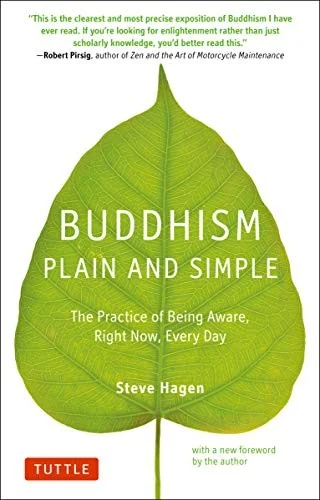
Buddhism Plain and Simple: The Practice of Being Aware Right Now, Every Day
A clear guide to core Zen teachings and everyday awareness written by teacher Steve Hagen.
Drawing from decades of Zen practice and instruction, Steve Hagen presents a direct approach to mind training. The text bypasses complex ritual and historical debate to focus entirely on direct perception. By centering on present-moment experience rather than fixed belief, Hagen provides practical insights into fundamental human questions. This guide helps individuals cultivate clarity, mental freedom, and sustained alertness in daily life.
Buddhism has expanded across the West, with over one million American and two million European practitioners. This text sits within contemporary Western Zen practice, offering accessible teachings originally established over a decade ago.


📝 Description: Buddhism Plain and Simple: The Practice of Being Aware Right Now, Every Day
💎 Expert review
📖 Why choose it
Why this book is worth reading
Readers seeking a grounded, jargon-free entry into mindfulness will find immense value in this guide. It is perfect for newcomers to Buddhism who feel intimidated by complex philosophy or those wishing to deepen their daily practice without academic burden. By focusing on the profound simplicity of present-moment awareness, it empowers individuals to transform their relationship with time and thought. Anyone craving a clear, attainable path to mindful living and genuine insight, rather than intellectual abstraction, will gain practical tools for a more present existence.
⭐ Reader reviews
Reader rating
Hagen successfully distills Zen teachings into accessible language, making abstract concepts tangible for everyday application. However, this approach may not suit readers seeking rigorous academic analysis or historical depth of Buddhist doctrine. Those expecting dense philosophical debate or traditional scriptural commentary might find the focus on direct experience too simplistic. It is best for those prioritizing practical utility over scholarly critique. While it lacks complexity for advanced scholars, its clarity and warmth make it an excellent primer. The text avoids elitism, but its strength lies in accessibility rather than intellectual challenge.
❓ Frequently asked questions
📖 Who should read this
If you're drawn to Buddhist philosophy but feel intimidated by complex texts, or if you seek a practical, direct pathway to mindfulness and present-moment awareness, this book is an indispensable guide. It's for anyone ready to move beyond intellectual curiosity into genuine personal practice.
🎯 Key themes and symbolism
Cultivating Present Awareness
Hagen strips away complex doctrines to emphasize the direct, moment-to-moment experience of reality. The book acts as a guide to integrating mindfulness into daily life, encouraging readers to observe their thoughts, feelings, and surroundings without judgment, fostering a profound connection to the immediate present and awakening inherent wisdom.
Essential Buddhist Principles
This work masterfully condenses millennia of Buddhist philosophy into its foundational truths, presenting them without esoteric language or cultural adornment. It aims to make the core message of liberation accessible to a modern audience, demonstrating that profound spiritual insight doesn't require intricate rituals or dense scholastic study, but rather a clear understanding of fundamental concepts.
Beyond Intellectual Understanding
Hagen challenges the notion that spiritual growth is primarily an academic pursuit. Instead, he guides the reader towards an experiential awakening, suggesting that true understanding emerges from direct engagement with the teachings rather than abstract theorizing. The book fosters a practical pathway to insight, emphasizing the transformative power of personal application over mere scholarly accumulation.
📜 Historical context
📚 Glossary
- Awareness
- Enlightenment
- Zen
📔 Questions to reflect on
- How has your understanding of "awareness" evolved after considering its role in daily Buddhist practice?
- Reflect on a recent moment where you felt fully present. What were the circumstances, and how did that experience differ from your usual state of mind?
- In what specific area of your daily routine could you begin to cultivate more intentional, non-judgmental awareness?
📖 Read on the blog
🏛 Books from this publisher Tuttle Publishing
All books from this publisher →






You might also like
See more →


Have a question about this item?
Ask about the edition, condition, delivery or anything else — we reply by email or phone, usually within a day.
