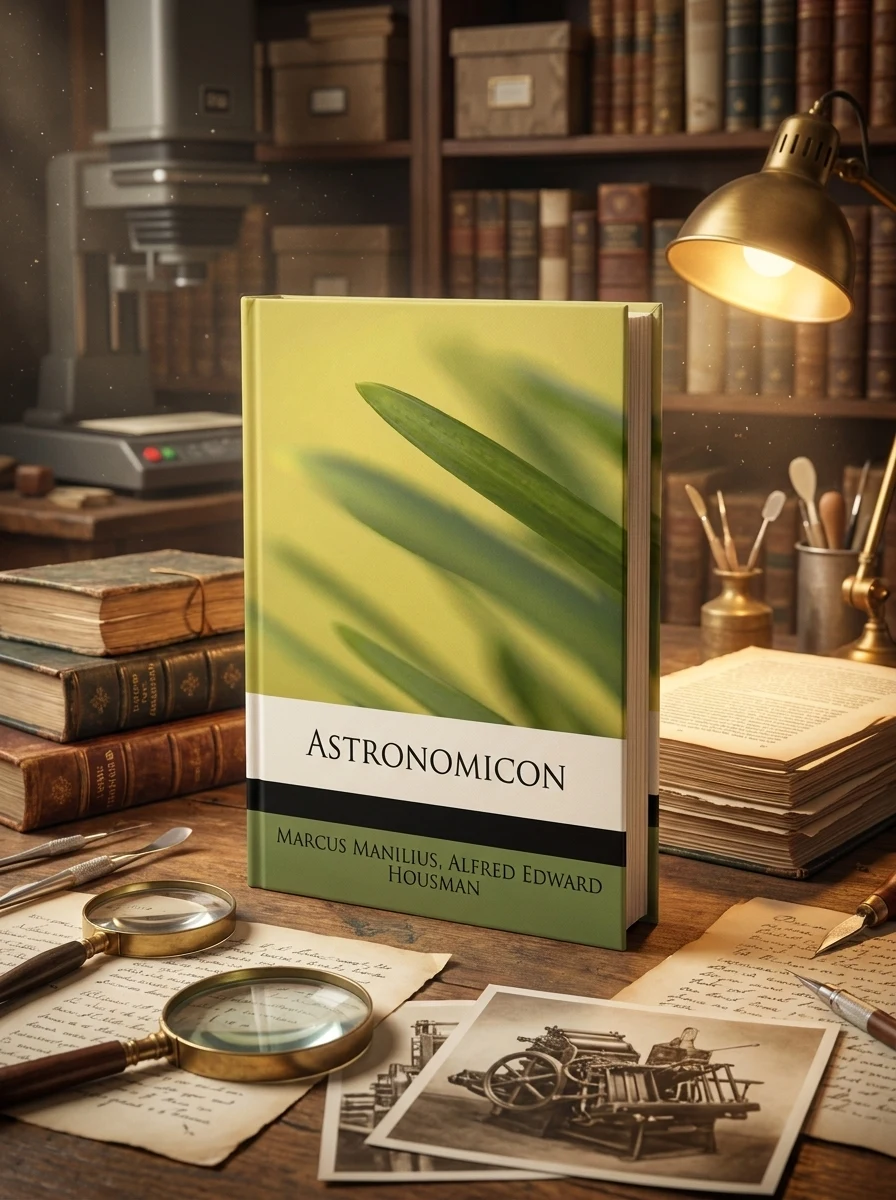
Astronomicon Manilius, Marcus
Manilius, Marcus; , Housman, Alfred EdwardStock reported in the catalog; fulfillment is confirmed with your request.
Uncover the celestial tapestry that shaped ancient Roman destiny and thought.
Step into the cosmos as envisioned by Marcus Manilius in his monumental *Astronomicon*, a rare surviving Latin didactic poem from the Roman Golden Age. This profound work systematically explores the principles of astrology, detailing the constellations, planetary movements, and their perceived influence on human fate. More than a simple guide, it's a philosophical inquiry into the order of the universe, blending scientific observation with spiritual contemplation. Readers will discover the intricate logic behind ancient celestial mechanics and the pervasive belief in cosmic determinism that shaped classical thought, presented with remarkable poetic artistry.
This work stands as a rare surviving Latin didactic poem from the Roman Golden Age, deeply embedded in the classical tradition of blending scientific observation with spiritual contemplation. It reflects the pervasive belief in cosmic determinism that significantly shaped ancient Roman destiny and thought.


📝 Description: Astronomicon Manilius, Marcus
💎 Expert review
📖 Why choose it
Why this book is worth reading
Readers fascinated by the intersection of ancient astronomy and esoteric philosophy will find profound value in this monumental exploration. It offers a unique window into how the cosmos was envisioned to shape human fate during the Roman Golden Age. Those who appreciate the intricate logic behind celestial mechanics and the artistic beauty of Latin verse will discover a rich tapestry of spiritual and scientific inquiry. This book is ideal for scholars and enthusiasts seeking to understand the philosophical underpinnings of classical thought, revealing how ancient minds connected the stars to destiny through remarkable poetic artistry.
⭐ Reader reviews
Reader rating
This edition presents Marcus Manilius’s *Astronomicon* with Housman’s scholarly attention, preserving a vital piece of Latin didactic poetry. It is essential for those interested in the historical development of astrological thought and Roman intellectual history. However, it does not suit readers seeking modern scientific accuracy or light, accessible entertainment, as its dense poetic structure and ancient cosmological framework require significant dedication. Those uncomfortable with archaic language or complex metaphysical arguments may find the text demanding. It is best appreciated by those willing to engage deeply with the spiritual contemplation and systematic exploration of constellations that defined classical celestial mechanics.
❓ Frequently asked questions
📖 Who should read this
If you are drawn to the origins of astrology, the philosophical currents of ancient Rome, or the poetic grandeur of classical Latin, this volume beckons. Delve into a foundational text that bridges early scientific inquiry with profound spiritual and divinatory traditions, offering a unique glimpse into the cosmic worldview of antiquity.
🎯 Key themes and symbolism
Celestial Influence & Fate
Manilius meticulously outlines the ancient understanding of how planetary alignments and stellar positions were believed to predetermine human destinies and world events. The text delves into the intricate calculations and interpretations used to divine personal fortunes and historical trajectories, presenting a worldview where the heavens are the ultimate architects of all earthly occurrences.
Philosophy of the Stars
Beyond mere prediction, *Astronomicon* explores the philosophical implications of a divinely ordered cosmos. Manilius posits a universe governed by immutable laws, where humanity is intricately linked to the celestial spheres. This isn't just a technical manual but a deep meditation on humanity's place within the grand, interconnected tapestry of the heavens.
Ancient Stellar Science
The work provides invaluable insights into the astronomical knowledge of the Roman era, detailing constellations, planetary orbits, and the zodiacal system. While viewed through an astrological lens, it reflects the empirical observations and mathematical sophistication of classical antiquity, offering a window into the foundational scientific understanding that predated modern astronomy.
💬 Quotes from the book
“The heavens, eternal architects of fate, weave threads of destiny from distant stars.”
“Observe the wandering lights, their fixed courses, for in their dance lies the secret script of time.”
📜 Historical context
📚 Glossary
- Didactic Poetry
- Zodiac
- Celestial Sphere
📔 Questions to reflect on
- How does the ancient concept of cosmic determinism, as presented by Manilius, compare with modern understandings of free will and destiny?
- Reflect on the role of scientific observation in an era dominated by astrological belief. Where do you see the intersection of science and spirituality in Manilius's work?
- If you were to map your own life's events onto a celestial chart, what connections or patterns might you perceive, and how might that influence your perspective?
✍️ More books by this author Manilius, Marcus; , Housman, Alfred Edward
All books by this author →
You might also like
See more →




 91
91