Finding where to start with Rudolf Steiner can be difficult because his writings cover many connected subjects: human consciousness, spiritual development, cosmology, history, and the relationship between visible and invisible aspects of existence. A new reader may encounter advanced concepts before understanding the basic ideas that shape Steiner’s approach.
This reading order is designed for readers approaching Steiner’s work as a serious study. It begins with books that introduce his main concepts, then moves toward systematic works, inner development, Western esoteric traditions, and specialized subjects. The order is not a requirement, but it provides a foundation for understanding Steiner’s vocabulary and methods.
Begin with Steiner’s foundational ideas
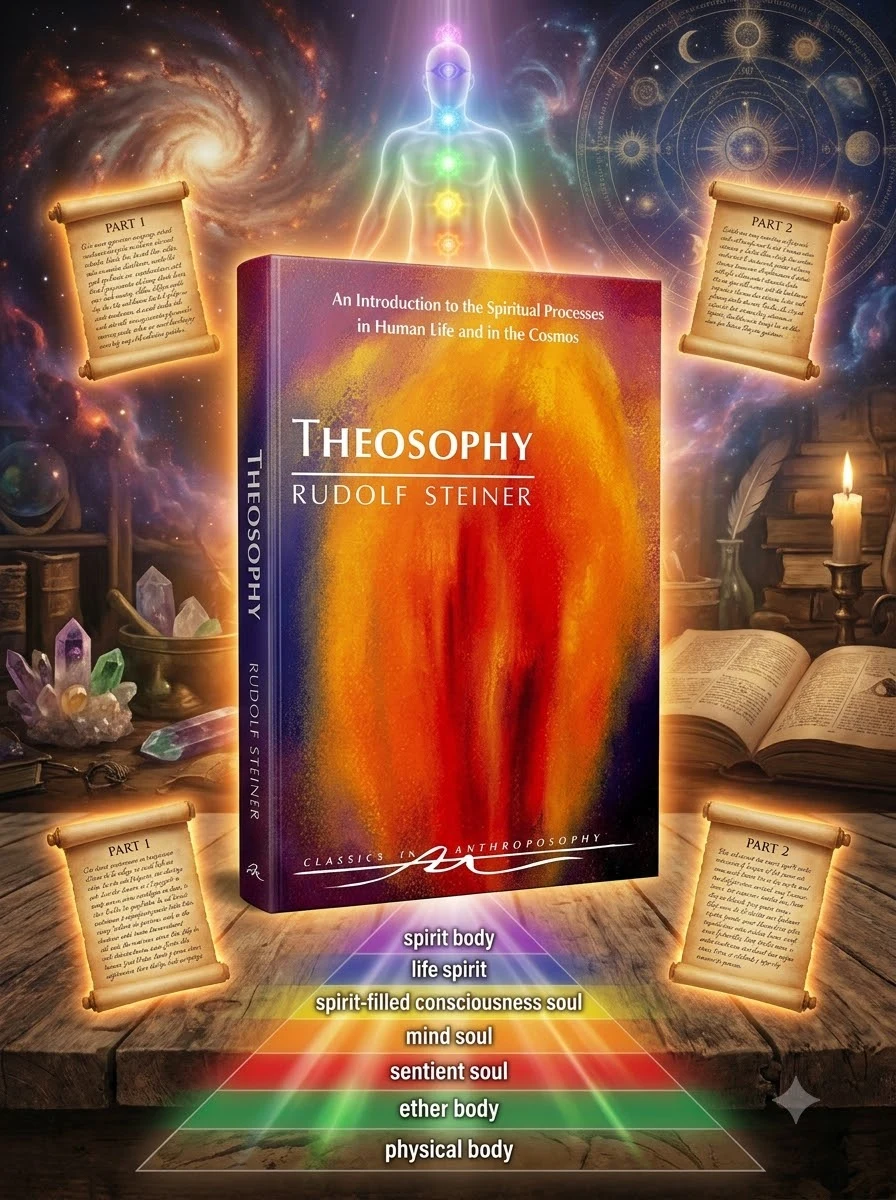
1. Theosophy: An Introduction to the Spiritual Processes in Human Life and in the Cosmos (Cw 9) — Rudolf Steiner
Theosophy: An Introduction to the Spiritual Processes in Human Life and in the Cosmos (Cw 9) is a strong first choice for readers who want a structured introduction to Steiner’s spiritual philosophy. The book presents his ideas about human nature, spiritual development, and the connection between individual life and larger cosmic processes.
As an entry point, this work helps establish many of the terms and concepts that appear throughout Steiner’s later writings. Readers interested in Anthroposophy often begin here because it offers a broad framework before moving into more specialized studies. It is especially useful for those who prefer an organized explanation of Steiner’s ideas rather than starting with individual lectures.
2. How to Know Higher Worlds — Rudolf Steiner
How to Know Higher Worlds follows naturally because it focuses on inner development and spiritual discipline. Steiner describes practices and attitudes connected with cultivating attention, self-reflection, and personal growth.
This book is different from a purely theoretical introduction. It asks readers to consider their own habits of thought and perception. After becoming familiar with Steiner’s basic framework, readers may find this a useful transition from learning concepts to considering practical spiritual exercises.
Study Steiner’s central systematic works
3. An Outline of Occult Science — Rudolf Steiner
An Outline of Occult Science is one of Steiner’s major works of spiritual philosophy. It presents a broad and systematic view of humanity, cosmic development, and spiritual knowledge.
The book is often better approached after gaining some familiarity with Steiner’s terminology. Its structured style appeals to readers who want a comprehensive presentation rather than a short introduction. Several editions exist in the catalog, allowing readers to choose an option that fits their budget while studying the same central work.
4. The Threshold of the Spiritual World — Rudolf Steiner
The Threshold of the Spiritual World offers a focused exploration of spiritual perception and experiences connected with the boundary between ordinary awareness and spiritual investigation.
This shorter work can serve as a companion after reading Steiner’s broader introductions. It is suited to readers who want a concentrated text about inner perception and the methods Steiner associated with spiritual understanding.
5. The Threshold of the Spiritual World: Aphoristic Contemplations (Cw 17) Steiner, Rudolf
The Threshold of the Spiritual World: Aphoristic Contemplations (Cw 17) Steiner, Rudolf provides another presentation of Steiner’s thoughts on spiritual investigation through concise contemplative passages.
This edition is a possible choice for readers who appreciate shorter reflections and want to revisit themes connected with spiritual perception. It works well alongside longer systematic studies because the format encourages careful reading and reflection.
Explore traditions and spiritual history connected with Steiner
6. The Secret Stream: Christian Rosenkreutz and Rosicrucianism — Rudolf Steiner; Christopher Bamford
The Secret Stream: Christian Rosenkreutz and Rosicrucianism introduces readers to Steiner’s connection with the Western esoteric tradition of Rosicrucianism. The book is useful for understanding historical and symbolic influences related to Steiner’s spiritual work.
Readers who want context around Christian Rosenkreutz and the traditions associated with him may find this title a helpful addition after learning Steiner’s foundational ideas. It provides background for themes that appear throughout his writings on spiritual development and human evolution.
7. A Christian Rosenkreutz Anthology — Paul Marshall Allen; Carlo Pietzner; Rudolf Steiner; Ita Wegman
A Christian Rosenkreutz Anthology offers another way to explore the figure of Christian Rosenkreutz and related material connected with spiritual traditions.
This book is best considered a specialized addition rather than a first introduction. It is most useful for readers who already have familiarity with Steiner’s general approach and want to examine material connected with Rosicrucian themes in greater detail.
Continue into Steiner’s specialized subjects
8. Cosmic Memory: The Story of Atlantis, Lemuria, and the Division of the Sexes (Cw 11) — Rudolf Steiner
Cosmic Memory: The Story of Atlantis, Lemuria, and the Division of the Sexes (Cw 11) explores Steiner’s accounts of humanity’s distant spiritual history. It is one of his more distinctive works, focusing on themes related to origins, development, and esoteric cosmology.
This title is better approached after reading introductory works because it uses ideas developed throughout Steiner’s broader system. Readers interested in spiritual history and cosmological questions may find it a natural continuation of earlier studies.
9. The Spiritual Hierarchies and the Physical World: Zodiac, Planets & Cosmos (Cw 110) Volume 110 — Rudolf Steiner
The Spiritual Hierarchies and the Physical World: Zodiac, Planets & Cosmos (Cw 110) Volume 110 focuses on Steiner’s spiritual interpretation of cosmic relationships. It is intended for readers who want to examine connections between spiritual philosophy, planetary symbolism, and the Zodiac.
Because this work addresses specific themes, it is usually more accessible after a reader has developed familiarity with Steiner’s wider ideas. It provides a focused area of study for those interested in cosmic subjects within his framework.
10. Between Death and Rebirth: In Relation to Cosmic Facts (Cw 141) Volume 141 — Rudolf Steiner
Between Death and Rebirth: In Relation to Cosmic Facts (Cw 141) Volume 141 examines Steiner’s ideas concerning existence between earthly lives and spiritual development beyond physical experience.
This is a later-stage reading choice because it assumes familiarity with many concepts introduced in earlier books. Readers interested in reincarnation, human destiny, and spiritual continuity within Steiner’s system may find this work a valuable continuation of their studies.
How to choose your first Rudolf Steiner book
For most new readers, Theosophy: An Introduction to the Spiritual Processes in Human Life and in the Cosmos (Cw 9) provides the clearest starting point. It introduces the basic structure needed for understanding later works. After that, How to Know Higher Worlds offers a closer look at personal spiritual practice.
Readers who prefer a more complete theoretical system can continue with An Outline of Occult Science. Those interested in Western mystery traditions can move toward The Secret Stream: Christian Rosenkreutz and Rosicrucianism and related works. Readers drawn to spiritual history, cosmic themes, and questions about human origins can then explore the later titles in this list.
Steiner’s writing often rewards slow reading. Taking notes, reviewing unfamiliar terms, and allowing time for reflection can help readers work through complex passages. His books cover subjects that include spiritual philosophy, occult sciences, human development, and interpretations of the Christ principle.
A practical reading path is to begin with foundations, continue into inner development, study the central systematic works, and then move into specialized topics. This approach gives readers the background needed to understand the connections among Steiner’s many writings.