Free preview
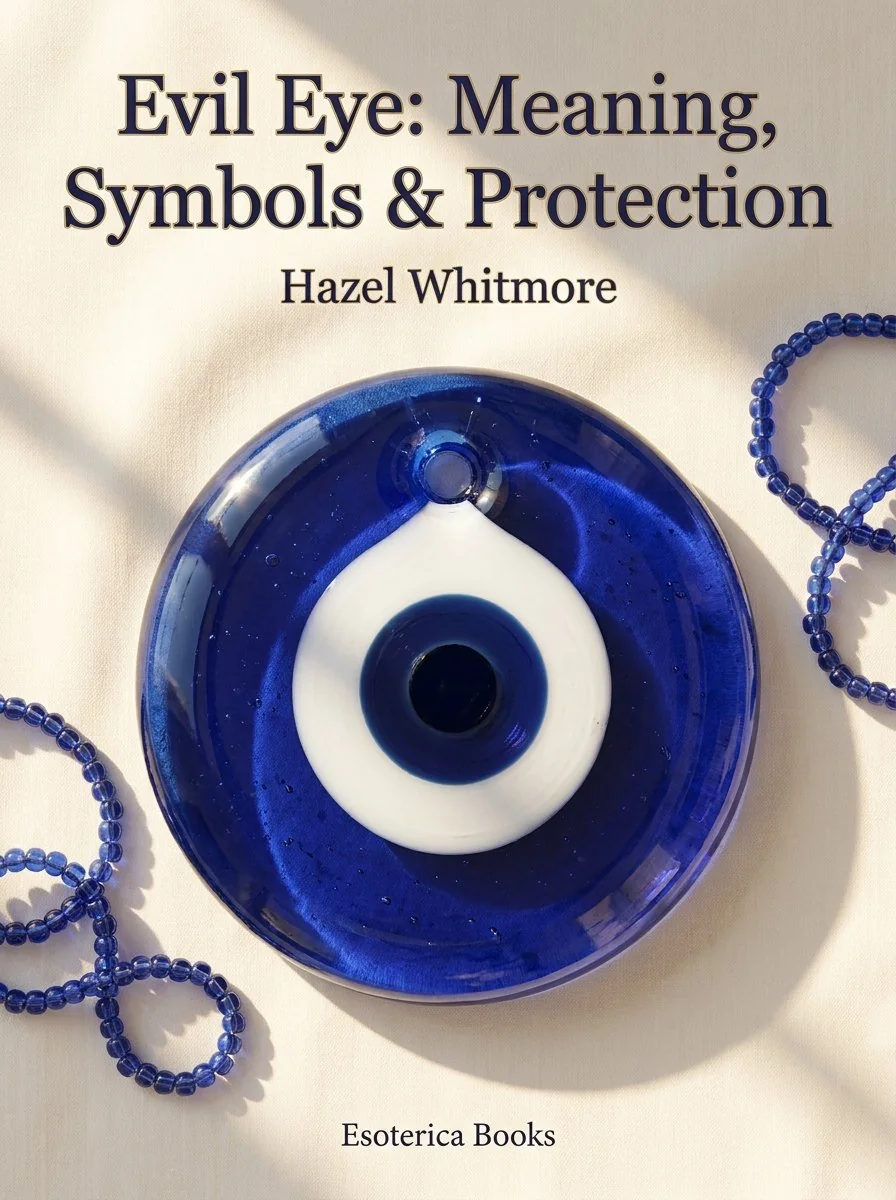
Evil Eye: Meaning, Symbols & Protection
by Hazel Whitmore
Get the e-book — $4.99Available — EPUB for your phone, tablet or e-reader
Contents
-
Look Again: What Is Your Evil Eye Really Saying?
Start with the charm you already own: examine its eye shape, colors, materials, and details, then discover the traditional ideas associated with each feature. A simple observation exercise turns a familiar object into an introduction to the evil eye's symbolism and purpose.
-
A Little Eye with a Big Story
Discover why the evil eye became a recognizable symbol of protection and how people understand the relationship between envy, misfortune, and the protective gaze. Clarify why the evil eye is considered bad in some contexts while its familiar charm is regarded as protective in others.

-
The Colors and Details That Catch Your Eye
Explore the familiar blue-and-white design alongside other color variations, beaded forms, and the eye motif itself. Learn how color meanings and material associations differ between contemporary interpretations and individual folk customs rather than treating one color chart as universal.

-
From the Mediterranean to Your Own Home
Explore the evil eye's broad cultural presence and its place in different communities without reducing them to one shared belief system. Understand the distinction between tracing a tradition's history and assuming every culture uses the symbol in the same way.

-
The Blue Bead and the Greek Tradition
Discover the Greek mati tradition, its familiar blue eye imagery, and the customs associated with wearing or displaying protective symbols. Consider how Greek interpretations have been carried into modern jewelry, gifts, and everyday decorative objects.

-
A Different Gaze: The Turkish Nazar
Explore the Turkish nazar boncuğu, its distinctive concentric eye design, and its place in Turkish decorative and folk traditions. Learn to recognize the object and distinguish cultural context from modern commercial interpretations of its protective purpose.
-
Wearing the Eye with Intention
Move from understanding the symbol to choosing how to incorporate it into daily life. Explore bracelets, necklaces, pendants, and beaded charms, including how to select an object that feels personally meaningful without assuming it guarantees good luck or protection.
-
A Thoughtful Home for a Protective Symbol
Consider traditional and contemporary ways to display an evil eye charm in an entryway, living space, or personal corner. Explore the idea of home protection as a symbolic household custom, with practical guidance on choosing a meaningful place for the object.
-
Cleansing, Care, and the Life of a Charm
Examine the different meanings people attach to cleansing an evil eye object, from ordinary jewelry maintenance to symbolic renewal rituals. Explore traditional references to salt and other simple materials while distinguishing personal customs from universal requirements and including safe handling guidance.
-
When the Symbol Feels Uncomfortably Close
Address common concerns about envy, unwanted attention, and the fear of receiving the evil eye. Offer a grounded, non-fear-based approach to traditional avoidance customs, personal boundaries, and symbolic practices without encouraging suspicion, retaliation, or attempts to influence another person.
-
Words, Hands, and Customs of Protection
Explore spoken blessings, hand-shaped protective imagery, and the relationship between the evil eye symbol and other protective traditions. Introduce the Hamsa as a related but distinct symbol, and discuss religious expressions such as dua with respect for their specific contexts and without presenting them as interchangeable rituals.
-
Make the Symbol Your Own, Without Losing Its Roots
Bring the E.Y.E. Method together in a personal practice: explore the tradition, understand the object, and engage with it through thoughtful everyday customs. Consider modern interpretations, including popular culture references, while keeping folk symbolism distinct from fictional portrayals and maintaining respect for the communities connected to the tradition.
About this book
You may already own an evil eye bracelet, necklace, or blue glass bead, yet still wonder what its colors mean, why people wear it, or whether it actually needs cleansing. With so many conflicting explanations online, it is easy to feel unsure about which customs are meaningful and which are simply repeated without context. You might have heard that a broken charm means it absorbed a negative gaze, or you may feel a sense of unease when someone mentions the "eye" in your presence.
One useful discovery changes how you approach the subject: the evil eye is not one universal belief with one set of rules. It is a widespread folk belief interpreted differently across communities, families, and religious contexts, while the familiar protective charm has its own distinctive symbols, materials, and customs. Understanding those differences makes it easier to appreciate your object without treating every popular claim as fact.
This guide gives you a practical way to explore the tradition, understand the details of your charm, and choose respectful ways to wear, display, clean, and care for it. You will come away better equipped to distinguish cultural meaning from superstition, make informed personal choices, and enjoy the symbol without unnecessary fear or promises of guaranteed protection.
Meet the E.U.E. Method: Explore, Understand, Engage with the Evil Eye
- Explore — Discover what the evil eye means across different folk traditions, beginning with the charm you already own and learning to recognize its cultural background without assuming every community shares the same beliefs.
- Understand — Read the visual language of the symbol by examining its eye design, colors, materials, shapes, and traditional associations while remembering that interpretations vary and no single color chart applies everywhere.
- Engage — Choose meaningful, respectful ways to wear, display, clean, and care for your evil eye charm, turning cultural understanding into a personal everyday practice without relying on fear or guaranteed outcomes.
Start with the Charm in Your Hand: A Five-Step Introduction
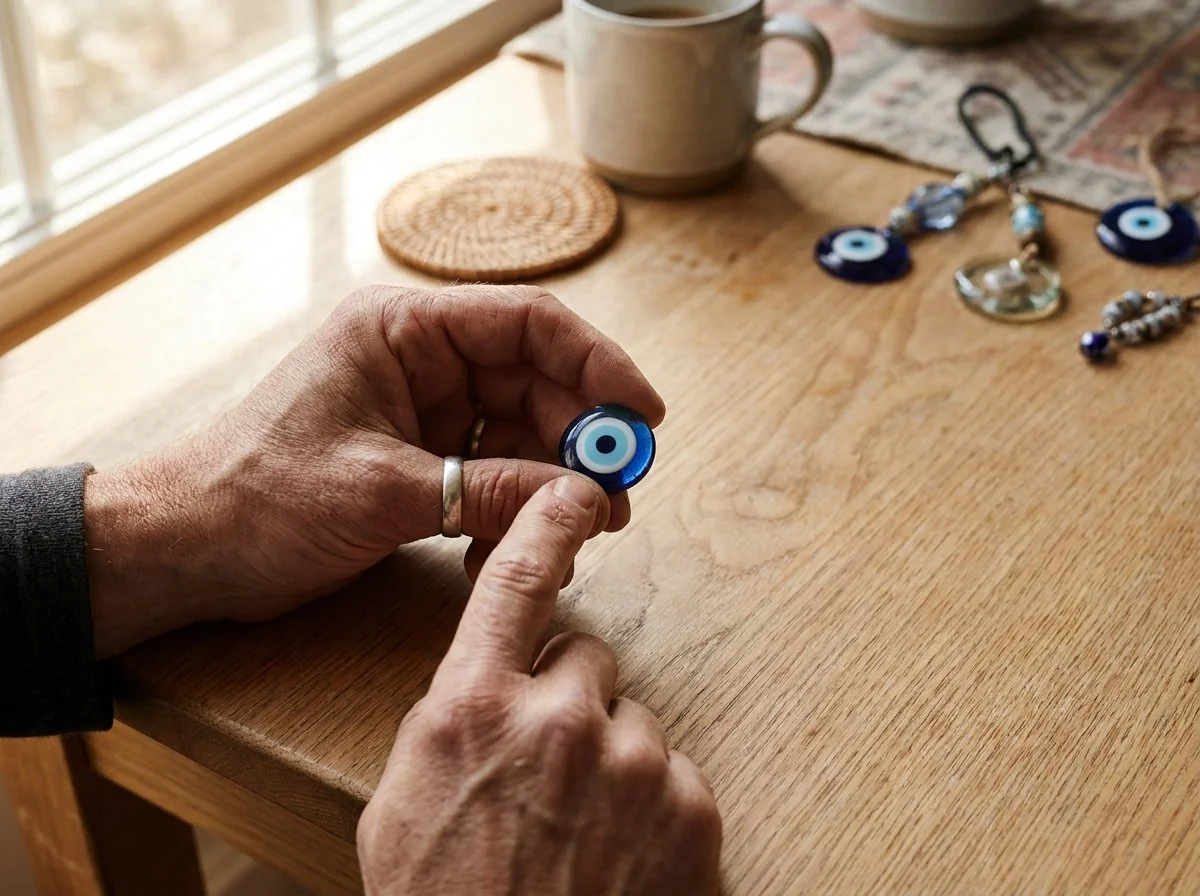
To begin your practice, find an evil eye charm you currently own or one you have recently acquired. Follow these steps to turn a simple object into a tool for reflection.
- Take a Closer Look (5 minutes): Hold your charm in your palm. Look closely at the shape of the "pupil" and the "iris." Is it perfectly circular, or is it an almond shape? Notice if the edges are smooth or if there are raised textures. Do not worry about what it "should" be; just observe what it is.
- Notice Its Colors (2 minutes): Identify the main color and the secondary colors. For example, you might see a deep cobalt blue, a light sky blue, white, and a tiny speck of black. On a small piece of paper, jot down the colors you see.
- Identify Its Style (2 minutes): Determine the general design. Is it a series of concentric circles (common in Turkish nazar boncuğu) or a more detailed, eye-like shape (common in Greek mati)? Is it a bead, a flat pendant, or a piece of jewelry?
- Give It a Meaning (3 minutes): Write down one sentence explaining why this specific object is in your life. Perhaps it was a gift from a friend, a souvenir from a trip, or something you bought because you liked the color. This anchors the object in your personal history rather than just a general concept.
- Set Aside One Assumption (3 minutes): Think of one "rule" you have heard about the evil eye—for example, "If it breaks, it means it worked" or "You must wash it in salt." Write that rule down as a question: "Is it true that a broken charm means it absorbed a gaze?" This prepares you to explore the tradition with curiosity rather than fear.
By the time you finish, that little eye may feel more familiar: you will have explored some traditions associated with it and considered how to give it a thoughtful place in your everyday life.
