Theurgy
Theurgy is ritual practice aimed at union with the divine. The term comes from late-antique Neoplatonism, where Iamblichus defended it as the necessary completion of philosophy, and it later shaped Renaissance magic and orders such as the Golden Dawn.
Where the word comes from
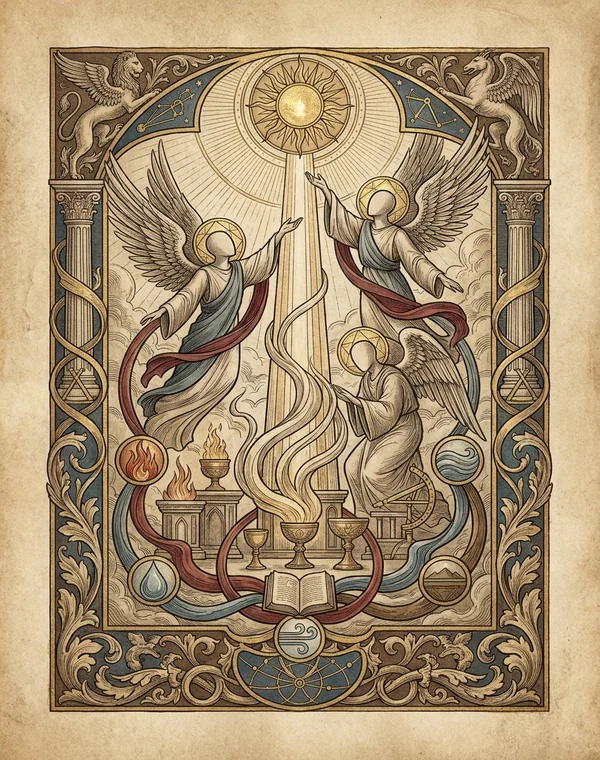
Theurgy is the Greek theourgia, from theos, "god", and ergon, "work": "divine work" or "god-working". The phrase can be read two ways, and ancient writers used both: work done for the gods, as in ritual, and work done by the gods through the practitioner. The first person known as a theurgist is Julian the Theurgist, a second-century figure credited, with his father Julian the Chaldean, with the Chaldean Oracles.
In depth
Theurgy names the ritual side of late Platonism. Plato had taught that the soul could ascend to the Good through philosophy. By the third century some of his followers doubted that reasoning alone could do it. The soul, they argued, had descended so fully into matter that it needed help from the divine itself, and the gods had provided that help in the form of rites, prayers and sacred objects.
The Chaldean Oracles
The key early source is the Chaldean Oracles, a collection of hexameter verses from the second century CE presented as revelations from the gods. They survive only in fragments quoted by later authors. They describe a supreme Father, a descending chain of divine powers, and a path of return for the soul through purification and ritual. The Oracles became almost scripture for later Neoplatonists.
Iamblichus and Porphyry
The classic defence of theurgy is Iamblichus' On the Mysteries (De Mysteriis), written around 300 CE in the voice of an Egyptian priest, Abamon. It answers a critical letter from the philosopher Porphyry, who had asked how rituals, offerings and names could possibly affect gods who are beyond passion and matter. Iamblichus' reply was that theurgy does not compel the gods. The ritual acts through sunthēmata or symbola, "tokens" that the gods themselves had sown into the world: certain stones, plants, sounds and names. Using them, the theurgist aligns the soul with the divine order until it can receive the gods' presence. Ritual does not change the gods; it changes the soul so that it can rise.
Proclus in the fifth century built this into a full system, and the emperor Julian (reigned 361 to 363) tried to use theurgic Neoplatonism as the basis of a restored pagan religion.
Theurgy versus goetia
Ancient writers were careful to separate theurgy from goēteia, sorcery. Goetia sought practical results, often by coercing spirits. Theurgy claimed to seek nothing but the purification and divinisation of the soul, and its practitioners regarded the gods as benefactors to be approached, not powers to be used. Critics, Christian and pagan alike, were not always convinced the line was so clear.
Later life of an idea
Christian writers absorbed much of the structure while rejecting the pagan gods. The sixth-century author known as Pseudo-Dionysius described the church's sacraments and hierarchies in terms borrowed from Proclus. In the Renaissance, Marsilio Ficino, who also translated the Hermetic texts, revived a cautious natural magic of planetary correspondences with theurgic aims, and Pico della Mirandola and later Cornelius Agrippa distinguished lawful divine magic from forbidden demonic magic in much the same way the Neoplatonists had.
The Hermetic Order of the Golden Dawn (founded 1888) consciously described its ritual work as theurgy: invoking divine names and god-forms to transform the magician, as opposed to evoking spirits for gain. Many modern ceremonial magicians and practitioners of Hellenic polytheism still use the term in that sense.
Where it appears
The Chaldean Oracles (2nd century CE). Fragmentary verse revelations that became the scripture of theurgic Neoplatonism.
On the Mysteries (Iamblichus, c. 300 CE). The classic defence of theurgy, written as a reply to Porphyry.
Elements of Theology (Proclus, 5th century). The systematic metaphysics behind later theurgy.
Theurgy and the Soul (Gregory Shaw, 1995). The modern study that reassessed Iamblichus.
What it means today
Theurgy matters because it answers a question that runs through the whole esoteric tradition: can ritual do something that thought cannot? The Neoplatonists said yes, and their reasons are still the most intelligent defence of religious ritual in the Western canon.
For modern readers, the practical core is simpler than the terminology. Theurgy is devotional practice with a transformative aim: prayer, symbol and ritual used not to get things but to become someone. That is why it sits at the "high" end of ceremonial magic, and why it is often read side by side with the Hermetica and with Christian mysticism.
Good starting points are the translations of Iamblichus' On the Mysteries and the Chaldean Oracles, then Gregory Shaw's Theurgy and the Soul, the book that restored Iamblichus' reputation among scholars.