Left-Hand Path
The Left-Hand Path is a family of esoteric currents that seek the strengthening and eventual self-deification of the individual, rather than its dissolution into a greater divine whole. The phrase began as a translation of the Tantric term vamachara.
Where the word comes from
The phrase is a Western rendering of the Sanskrit vāmācāra, literally "left-way conduct" (vāma, left, and ācāra, practice or behaviour). In Tantra it named ritual practice that deliberately broke orthodox Hindu purity rules, set against dakṣiṇācāra, the "right-hand" or conventional way. Helena Blavatsky and the Theosophists brought the pair into English in the 1880s, and in their hands "left-hand path" came to mean black magic, selfish occultism working against the spiritual evolution of humanity.
In depth
In current occult usage the Left-Hand Path (often shortened to LHP) describes any spiritual method whose aim is the survival, empowerment and refinement of the individual self. Its counterpart, the Right-Hand Path, covers traditions in which the self is surrendered: absorbed into God, into Brahman, into the One, or into the moral order of a community. The distinction is about the goal, not about whether a practice is dark or light, although for most of its history in English the label was an insult rather than a self-description.
From Tantra to Theosophy
The Indian original had nothing to do with devil worship. Vamachara Tantra used the pañcamakāra, the "five Ms": wine (madya), meat (māṃsa), fish (matsya), parched grain or gesture (mudrā) and ritual sexual union (maithuna). These were taboo substances and acts for a high-caste practitioner, and using them in a controlled ritual context was meant to break attachment to the categories of pure and impure. Many lineages performed the same rites symbolically.
When Blavatsky borrowed the terms she flattened them into a moral binary. The Right-Hand Path was the altruistic way of the adepts who served humanity; the Left-Hand Path belonged to the "Brothers of the Shadow" who used occult power for themselves. Aleister Crowley kept a version of this idea in his "Black Brothers", magicians who refuse to cross the Abyss and give up their ego, even though Crowley himself was later claimed by LHP writers as an ancestor.
The modern self-description
The reversal came in the second half of the twentieth century, when groups began to use the old insult as a banner. Anton LaVey founded the Church of Satan in 1966 and framed Satanism as a philosophy of rational self-interest. In 1975 Michael Aquino and others left it to form the Temple of Set, which described its work explicitly as the Left-Hand Path: the cultivation of an immortal, self-created psyche, modelled on the Egyptian god Set as the principle of isolate intelligence. In Sweden, Thomas Karlsson and fellow students founded Dragon Rouge in 1989, drawing on Qliphothic Kabbalah, Tantra and Nordic material.
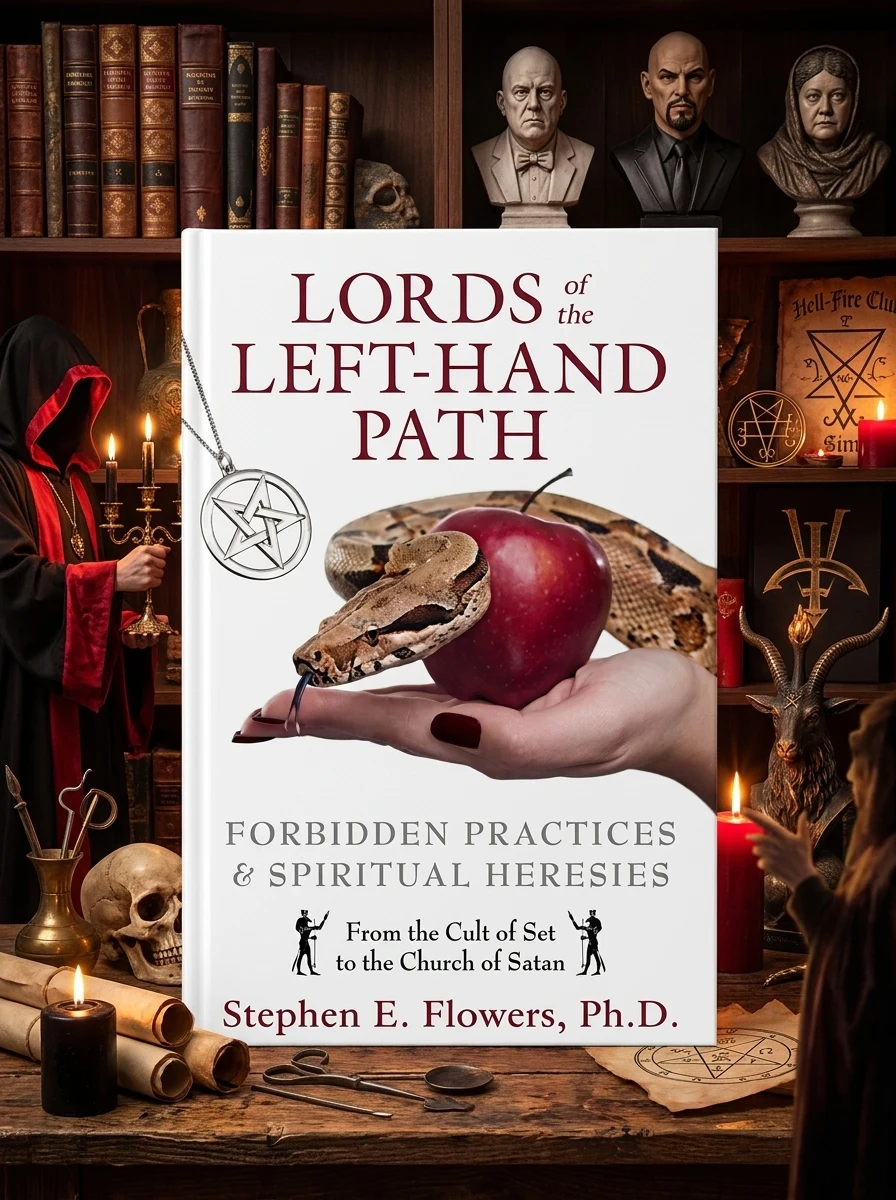
Stephen E. Flowers gave the movement its best-known history in Lords of the Left-Hand Path (1997), which reads figures from ancient Egypt to the Temple of Set through this lens. Academic study followed, most notably Kennet Granholm's work on Dragon Rouge and on what he calls "dark enlightenment".
What practitioners share
LHP groups disagree about gods, ethics and technique, but a few themes recur:
Self-deification. The goal is not union with a god but becoming one, or at least becoming a permanent, conscious centre of will that does not dissolve at death.
Antinomianism. Breaking taboos, moral or religious, is used as a tool to discover where external conditioning ends and the real self begins. In serious groups this is a psychological discipline, not permission for cruelty.
Individual responsibility. Because there is no higher power to save or forgive, the practitioner owns every result. Most LHP texts insist on this more strongly than any rule set.
Dark imagery as a map. Set, Satan, Lilith, the Qliphoth and the "sinister" side of mythology are treated as symbols of isolation, knowledge and change, the forces that separate a mind from the undifferentiated whole.
Common misunderstandings
The LHP is not the same thing as Satanism, although some Satanist groups belong to it. Nor is every Tantric practice "left-hand", and nothing in the Sanskrit term implies evil. Finally, the Right-Hand Path is not synonymous with Christianity; it includes Vedanta, most of Buddhism, Neoplatonic mysticism and a good deal of Western ceremonial magic.
Where it appears
Lords of the Left-Hand Path (Stephen E. Flowers, 1997). The standard popular history, from ancient Egypt to the Temple of Set.
The Secret Doctrine (Helena Blavatsky, 1888). Where the English pair "right-hand" and "left-hand" path took on its moral meaning.
The Satanic Bible (Anton LaVey, 1969). The founding text of the Church of Satan, later read as an early LHP manifesto.
Dark Enlightenment (Kennet Granholm, 2014). An academic study of Dragon Rouge and the modern Left-Hand Path.
What it means today
The most useful way to read the distinction today is as a question every serious practitioner eventually has to answer: what is the self for? Right-Hand traditions answer that it is a mask to be dropped. Left-Hand traditions answer that it is a seed to be grown.
That makes the LHP less exotic than its imagery suggests. Much of modern self-help, with its talk of self-actualisation and personal sovereignty, is a diluted Left-Hand Path without the ritual. What the esoteric groups add is rigour: initiation grades, daily practice, and an honest admission that pursuing power over one's own mind has real costs.
For readers new to the subject, start with history rather than grimoires. Flowers gives the sweep, Granholm the sociology, and the primary texts of the Temple of Set and Dragon Rouge show what the path looks like from inside. Tantric sources are a separate study and deserve to be read on their own terms.