Egregore
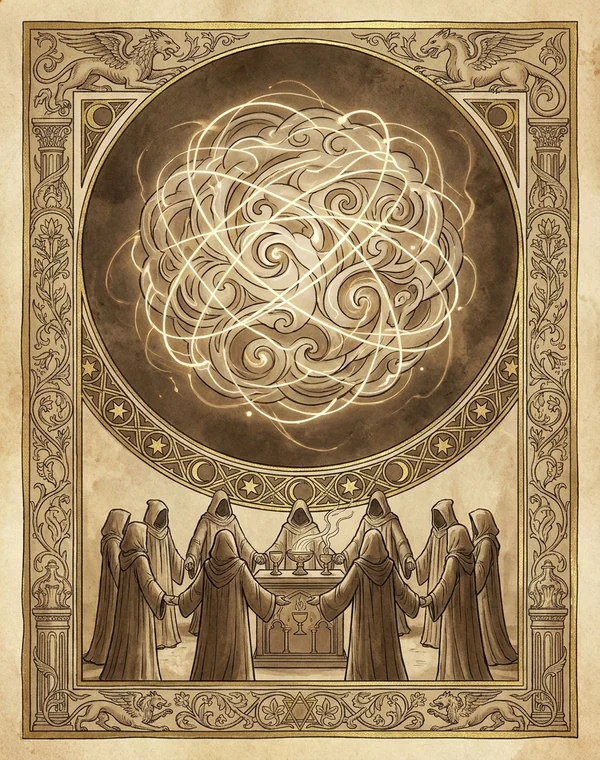
An egregore is a collective thought-form or group mind: a presence believed to arise from the shared attention, emotion and ritual of a group, and in turn to influence its members. The idea is used in Western esotericism, ceremonial magic and, loosely, to describe the character of movements, brands and online communities.
Where the word comes from
The word comes from the Greek egrēgoroi, "the wakeful ones" or "watchers". In the Greek text of the Book of Enoch this is the name of the Watchers, the angels who descended to earth and took human wives. The French occultist Éliphas Lévi used "égrégores" for these beings in the nineteenth century, and later French esoteric writers gave the word its modern meaning of a collective psychic entity.
In depth
In modern esoteric usage an egregore is a non-physical entity or field that forms around a group of people who share a strong focus. Prayer, ritual, symbols, repeated stories and emotional investment are said to "feed" it; in return it gives the group a sense of identity and power, and can shape members' thoughts and behaviour. Once it is strong enough, some writers say, the egregore can outlast its founders and pursue its own continuity.
From Watchers to group mind
The path from the Book of Enoch to the modern concept runs through French occultism. Lévi, writing in the 1850s and 1860s, used the word for the Watchers. By the late nineteenth and early twentieth centuries, writers in the circles around Papus and the French Martinist and Rosicrucian orders used "égrégore" for the collective spiritual current of an order or tradition, the invisible "chain" linking initiates across time. The term entered English esoteric writing in the twentieth century.
In magical orders
Many initiatory orders speak of their egregore as the living current of the order. Initiation connects the candidate to it; ritual, secrecy and continuity of practice keep it strong; schisms and neglect weaken it. In this sense the egregore is close to what Christian writers call the spirit of a community, and to the Hermetic idea of a "chain" of teachers.
Valentin Tomberg's Meditations on the Tarot, a Christian Hermetic work published anonymously after his death, gave the concept a sharper edge. It uses "egregore" for a collective creation that takes on autonomous life and can dominate the people who made it, and contrasts egregores with genuine spiritual beings.
In chaos magic and modern practice
Chaos magicians adopted the idea in practical form. A servitor is a small, deliberately created thought-form with a task; an egregore is a larger entity that grows from shared practice, sometimes intentionally, as when a group builds a god-form together. Some modern practitioners treat deities themselves as egregores built up by centuries of worship.
Everyday use
Outside occult circles, "egregore" has become a way of describing the felt personality of collectives: a sports club, a political movement, a company culture, an internet fandom or a meme that seems to spread by its own momentum. Here the term works as a metaphor for emergent group psychology, whether or not any literal entity is assumed.
How different paths see it
Where it appears
Book of Enoch (1 Enoch). The Watchers (Greek egrēgoroi), the root of the word.
Meditations on the Tarot (Valentin Tomberg, published 1980). A Christian Hermetic reading of egregores as autonomous collective creations.
Condensed Chaos (Phil Hine, 1995). Practical material on servitors and group thought-forms.
What it means today
The egregore is one of those esoteric ideas that make sense even to sceptics. Anyone who has felt the atmosphere change when they join a crowd, or seen a movement keep going after its leaders left, has an intuition of what the word points to.
Its practical lesson is about attention. If shared focus creates something that then shapes us, it matters what we feed. Esoteric writers from Tomberg to modern chaos magicians agree on this, even when they disagree on what an egregore really is.
For further reading, look at the discussions in Meditations on the Tarot, the works on magical orders and their "currents", and chaos magic manuals on servitors and group ritual.