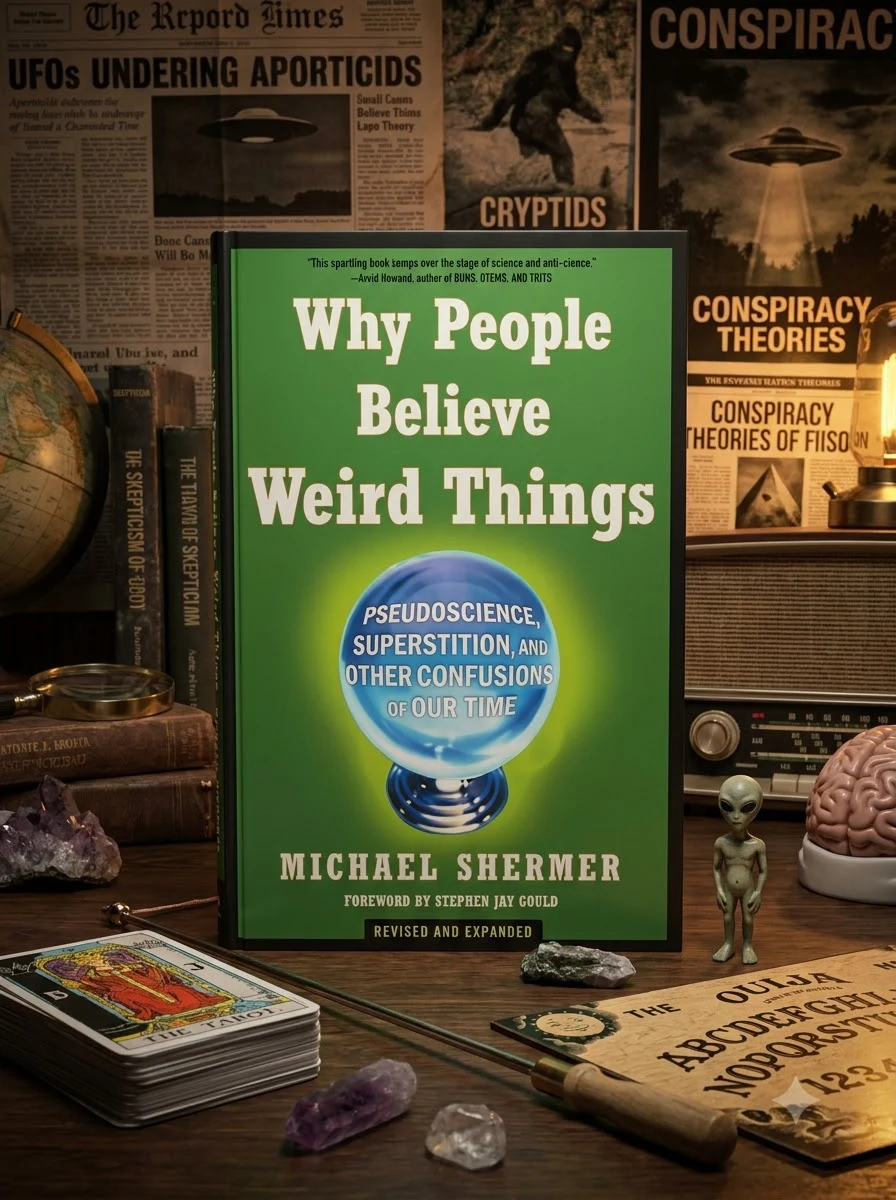

Why People Believe Weird Things: Pseudoscience, Superstition, and Other Confusions of Our Time (Revised and Expanded)
This edition can be ordered. No arrival date is confirmed.
Shermer dismantles the architecture of delusion with surgical precision and historical depth.
Michael Shermer, a seasoned science historian, launches a comprehensive critique of the cognitive mechanisms that allow pseudoscience to thrive in the modern era. This revised edition expands his original inquiry by examining why even brilliant scientists succumb to irrational beliefs. He dissects phenomena ranging from alien abduction narratives to Holocaust denial, revealing the psychological seduction of conspiracy theories and cults. By exposing the dangerous consequences of this illogical thinking, Shermer provides a vital toolkit for critical inquiry, helping readers distinguish between empirical evidence and comforting fiction.
This work stands as a definitive critique within the tradition of scientific skepticism, addressing the persistent allure of pseudoscience and superstition in modern society. It situates itself firmly in the discourse on critical inquiry, challenging the cognitive mechanisms that allow irrational beliefs to thrive among both the general public and brilliant scientists.


📝 Description: Why People Believe Weird Things: Pseudoscience, Superstition, and Other Confusions of Our Time (Revised and Expanded)
💎 Expert review
📖 Why choose it
Why this book is worth reading
Readers seeking to sharpen their critical thinking skills will find immense value in Shermer’s surgical dismantling of delusion. This book is essential for anyone who has ever wondered why intelligent people succumb to the psychological seduction of conspiracy theories, cults, or comforting fiction. By exposing the dangerous consequences of illogical thinking, Shermer provides a vital toolkit for distinguishing empirical evidence from pseudoscience. It is particularly beneficial for those interested in the intersection of psychology and history, offering historical depth alongside cognitive analysis. If you wish to understand why even brilliant scientists fall prey to irrational beliefs, this text offers profound insights into the architecture of delusion, empowering you to navigate modern confusions with clarity and intellectual rigor.
⭐ Reader reviews
Reader rating
Shermer delivers a comprehensive and historically grounded attack on the cognitive mechanisms fueling contemporary superstition. While the prose is accessible and the arguments are logically sound, readers seeking emotional validation for their spiritual beliefs may find this work unsatisfying or even hostile. It is not suitable for those who prefer comforting fiction over empirical evidence, as Shermer relentlessly exposes the structural flaws in phenomena ranging from alien abduction narratives to Holocaust denial. The book demands a willingness to confront uncomfortable truths about human irrationality. However, for the skeptical mind, it is an indispensable resource that clarifies the line between scientific inquiry and pseudoscientific confusion with precision and depth.
❓ Frequently asked questions
📖 Who should read this
Seekers of rational clarity who wish to understand the allure of the irrational. Ideal for skeptics, educators, and anyone tired of spiritual bypassing or scientific misinformation. It offers essential defense mechanisms against the seductive pull of conspiracy theories and pseudoscientific cults.
🎯 Key themes and symbolism
Cognitive Bias Mechanisms
Shermer explores how the human brain’s pattern-seeking nature leads to false correlations. He explains that our desire for coherence often overrides factual accuracy, making us susceptible to seeing meaning where none exists. This section details the neurological and psychological shortcuts that fuel superstition and pseudoscientific reasoning in everyday life.
Intellectual Vulnerability
A key addition to this edition focuses on how highly educated individuals, including prominent physicists, maintain irrational spiritual beliefs. Shermer argues that expertise in one field does not grant immunity to logical fallacies elsewhere. He critiques the use of scientific terminology to cloak mystical ideas, showing how credentialism can mask profound ignorance.
Social Consequences
Beyond individual error, the book analyzes the societal damage caused by collective delusions. Shermer examines movements like recovered-memory therapy and satanic panic, illustrating how shared false beliefs can lead to real-world injustice. He warns that unchecked pseudoscience erodes the foundation of rational discourse and public policy.
💬 Quotes from the book
“The mind is a pattern-recognition machine.”
“We believe what we want to believe.”
📜 Historical context
📚 Glossary
- Pseudoscience
- Recovered Memory
- Confirmation Bias
📔 Questions to reflect on
- Identify a belief you hold strongly. What evidence would prove it wrong, and why have you not sought it?
- How does your desire for control influence your acceptance of conspiracy theories or paranormal claims?
- Where do you see the line between spiritual experience and factual error in your own life?
🏛 Books from this publisher Holt Paperbacks
All books from this publisher →

You might also like
See more →





 91
91
 91
91