
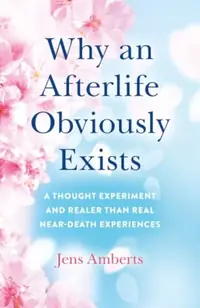
Why an Afterlife Obviously Exists: A Thought Experiment and Realer Than Real Near-Death Experiences
This edition can be ordered. No arrival date is confirmed.
Is an afterlife merely probable, or demonstrably undeniable?
Jens Amberts presents a compelling philosophical argument asserting the absolute certainty of an afterlife. Far from a leap of faith, this work meticulously builds its case upon the foundational insights derived from Near-Death Experiences (NDEs). Amberts skillfully constructs a framework demonstrating why the consistent patterns and profound veracity of NDE accounts offer not just anecdotal evidence, but an empirically certain foundation for post-mortem existence. He posits that NDE experiencers are not only truthful, but profoundly justified in their conviction of having encountered the actual afterlife.
This work sits firmly within the modern esoteric literature tradition that seeks to reconcile spiritual conviction with empirical observation, specifically drawing on the growing body of near-death experience research. It reflects the contemporary occult-philosophical movement's effort to ground metaphysical claims in experiential data rather than blind dogma.


📝 Description: Why an Afterlife Obviously Exists: A Thought Experiment and Realer Than Real Near-Death Experiences
💎 Expert review
📖 Why choose it
Why this book is worth reading
Readers seeking a robust, logical defense of spiritual continuity will find profound value in Amberts' meticulous construction. This book is ideal for skeptics and believers alike who crave evidence beyond mere anecdote. By framing the afterlife not as a leap of faith but as a demonstrable certainty derived from NDE patterns, Amberts offers intellectual satisfaction to those tired of vague mysticism. It provides a reassuring, empirically grounded perspective for anyone grappling with mortality, offering clarity and conviction through rigorous philosophical inquiry rather than emotional appeal alone.
⭐ Reader reviews
Reader rating
Amberts delivers a persuasive, tightly argued case that transforms subjective experiences into objective proof. The strength lies in his logical framework, which elevates NDE accounts from personal testimony to foundational evidence. However, this work does not suit readers who demand traditional theological doctrine or those who dismiss all experiential data as purely neurological hallucinations. It is a philosophical treatise first, requiring patience with abstract reasoning. Those seeking emotional comfort or literal religious instruction may find the tone too clinical and the argument too rigidly rational for their spiritual needs.
❓ Frequently asked questions
📖 Who should read this
If you're a skeptic seeking rigorous, logical arguments for life after death, or a serious student of NDEs looking for a robust philosophical framework, this book is essential. It challenges conventional disbelief with compelling reasoning, inviting you to reconsider your assumptions about mortality.
🎯 Key themes and symbolism
Empirical Afterlife Proof
This book elevates the concept of an afterlife from a matter of belief to one of verifiable certainty. Amberts argues that by meticulously examining the core characteristics of Near-Death Experiences, we uncover a pattern of evidence so consistent and profound that it effectively serves as empirical proof for continued consciousness beyond physical death.
NDEs as Veridical Evidence
Amberts champions Near-Death Experiences not as mere psychological phenomena or hallucinations, but as authentic glimpses into a transcendent reality. He provides a robust defense for why these accounts should be taken at face value, asserting that the consistency and transformative impact of NDEs justify their status as direct experiential data of the afterlife.
Philosophical Certainty
Leveraging a 'master attorney' approach, Amberts meticulously constructs a logical framework. He demonstrates that, given the robust data from NDEs, the existence of an afterlife transitions from being 'astronomically likely' to 'empirically certain.' The book guides readers through a rigorous thought experiment to solidify this philosophical conclusion.
💬 Quotes from the book
“To deny the afterlife, one must first deny the undeniable patterns woven through countless NDE accounts, a feat of intellectual acrobatics few can sustain.”
“This work is not an appeal to faith, but a structured demonstration where logical premises, drawn from lived experience, lead inescapably to a conclusion of post-mortem continuity.”
📜 Historical context
📚 Glossary
- Near-Death Experience (NDE)
- Metaphysics
- Thought Experiment
📔 Questions to reflect on
- If NDEs provide 'empirical certainty' of an afterlife, how might this certainty fundamentally alter human society's approach to life, death, and morality?
- Consider a personal experience or observed phenomenon that, for you, hints at a reality beyond the purely physical. How does Amberts's framework resonate with or challenge your interpretation?
- What are the most challenging skeptical arguments against NDEs as evidence for an afterlife? How might Amberts's 'attorney-like' approach address these?
🏛 Books from this publisher Iff Books
All books from this publisher →


You might also like
See more →







 91
91