
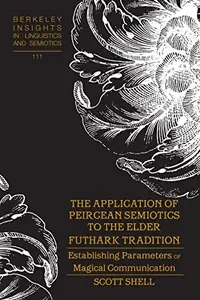
The Application of Peircean Semiotics to the Elder Futhark Tradition: Establishing Parameters of Magical Communication Rauch, Irmengard
Stock reported in the catalog; fulfillment is confirmed with your request.
Unravel the enigmatic magic woven into ancient runic inscriptions.
This groundbreaking work delves into the esoteric communication embedded within Elder Futhark runic inscriptions. By applying Charles Sanders Peirce's semiotic framework, it establishes objective parameters to discern whether specific ancient writings, such as those found on the Kragehul Spear Shaft or the Horns of Gallehus, carry magical intent. Rauch rigorously challenges conventional runology, proposing falsifiable criteria to bring scholarly precision to the study of magical communication within the Runemaster's own worldview. It promises to redefine academic discourse on runic magic.
This text sits at the intersection of rigorous academic semiotics and esoteric runic studies, bridging Charles Sanders Peirce’s philosophical framework with the ancient Elder Futhark tradition. It addresses the scholarly discourse surrounding magical intent in historical inscriptions like those on the Kragehul Spear Shaft.


📝 Description: The Application of Peircean Semiotics to the Elder Futhark Tradition: Establishing Parameters of Magical Communication Rauch, Irmengard
💎 Expert review
📖 Why choose it
Why this book is worth reading
Scholars and serious practitioners of runic magic will find this work invaluable for its groundbreaking attempt to establish objective, falsifiable criteria within the study of magical communication. Rauch challenges conventional runology by applying Peircean semiotics to ancient inscriptions, offering a precise methodology to discern magical intent in texts like those on the Horns of Gallehus. This book is essential for anyone seeking to move beyond vague interpretations and engage with the Runemaster's worldview through a lens of scholarly rigor. It redefines academic discourse by bringing precision to an esoteric field, making it a critical resource for understanding the structural parameters of runic magic.
⭐ Reader reviews
Reader rating
Rauch’s work is a dense, intellectual exercise that demands patience from its audience. While it offers a novel approach to analyzing Elder Futhark inscriptions through Peirce’s semiotic lens, it will likely frustrate readers seeking practical spells or mystical experiences. This book is not for casual hobbyists or those looking for immediate esoteric application; it is strictly for academics and theorists interested in the intersection of linguistics, philosophy, and ancient history. Those desiring accessible magical instruction will find its abstract parameters dry and unengaging, as it prioritizes scholarly precision over mystical allure.
❓ Frequently asked questions
📖 Who should read this
For the discerning scholar, the seasoned runologist, or anyone fascinated by the intersection of language, magic, and ancient cultures. If you seek a rigorous, academic exploration of runic magical communication, this book offers a precise methodology to decipher its mysteries.
🎯 Key themes and symbolism
Peircean Semiotics Applied
The book innovatively employs Charles Sanders Peirce's foundational theories of signs and symbols to analyze runic inscriptions. This framework provides a structured approach to understanding how meaning, particularly magical intent, was encoded and perceived by the ancient runemasters, offering a fresh lens for interpreting these ancient texts.
Defining Magical Communication
A central focus is on meticulously defining what constitutes "magical communication" within runic contexts. By examining various artifacts and their inscriptions, the author seeks to establish clear, measurable criteria that allow researchers to objectively differentiate between purely linguistic and overtly magical applications of the Elder Futhark, grounded in the cultural perspective of the time.
Academic Rigor in Runic Studies
This work actively challenges the field of runology to adopt more stringent, falsifiable methodologies when discussing magical elements. It advocates for an academic approach that moves beyond speculation, urging scholars to develop objective standards for analyzing runic magic, thereby elevating its study to a more empirically grounded and respected discipline.
💬 Quotes from the book
“To truly understand runic magic, we must move beyond conjecture and establish a semiotic framework that allows for the objective identification of magical intent within the Runemaster's own cultural context.”
“By meticulously analyzing specific artifacts, from the Lindholm amulet to the Eggja runestone, we can begin to codify the 'law of magical semiosis' and determine, with scholarly precision, what constitutes a magical inscription.”
📜 Historical context
📚 Glossary
- Elder Futhark
- Peircean Semiotics
- Umwelt and Weltanschauung
📔 Questions to reflect on
- How might applying a rigorous semiotic framework change your personal understanding or practice of runic divination or magic?
- Consider an ancient magical artifact you're familiar with. How would you attempt to apply "falsifiable criteria" to determine its magical intent based on its cultural context?
- If the concept of "magical communication" can be objectively defined, what implications does this have for how we study other esoteric practices academically?
🏛 Books from this publisher Peter Lang Inc., International Academic Publishers
All books from this publisher →

You might also like
See more →
 91
91

 91
91