US shipping Secure card payment Occult and esoteric books

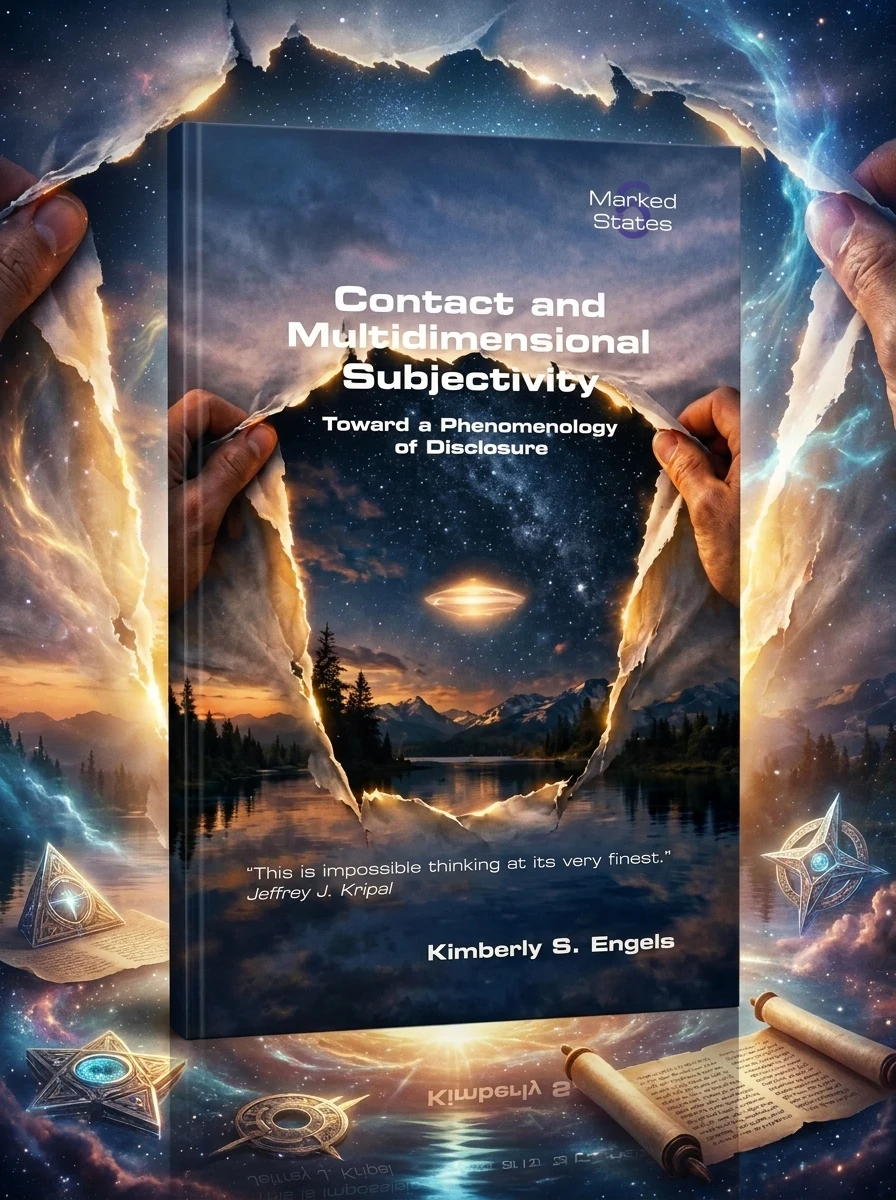
Contact and Multidimensional Subjectivity. Toward a Phenomenology of Disclosure

Engels, Kimberly S
Reader rating
4.7
(1 reviews) 167 sold
In stock

Stock reported in the catalog; fulfillment is confirmed with your request.

📚 ABOUT THE BOOK

What if encounters with the unknown redefine human reality and consciousness?

Kimberly S. Engels presents a groundbreaking philosophical inquiry into firsthand accounts of contact with non-human intelligences. Rather than dismissing these experiences as delusion or reducing them to technological threats, she treats them as legitimate sites of inquiry. This phenomenological approach opens profound new possibilities for understanding consciousness, the nature of reality, and ethical frameworks. Engels challenges us to view "disclosure" as a transformative event, capable of reshaping our fundamental understanding of existence and what it means to be human.

Key themes
Redefining Reality & Consciousness Ethics of Hyperdimensional Being
Historical context

This work sits at the intersection of contemporary continental philosophy and esoteric phenomenology, bridging academic rigor with occult inquiry regarding non-human contact. It aligns with modern efforts to legitimize spiritualism through rigorous philosophical frameworks rather than dismissive skepticism.


Difficulty
●●● Demanding
Fans will love it
Gilles Deleuze · Martin Heidegger · Carl Jung
🕊️ Spiritualism
🏛 College Publications 📅 2026 📖 276 pages 🌐 en 📐 Paperback ISBN: 9781848905078
Fun fact
This book is a groundbreaking philosophical deep dive into contact experiences, offering intellectual rigor to a field often lacking it. Engels excels at reframing "disclosure" as a profound phenomenological event, urging readers to rethink reality and ethics. Those seeking sensational stories or simple answers will be disappointed; this is for serious thinkers ready to grapple with complex ideas. It sets a new standard for academic engagement with anomalous phenomena.

📝 Description: Contact and Multidimensional Subjectivity. Toward a Phenomenology of Disclosure

What happens when accounts of contact with the intelligences behind UFOs/UAP are no longer interpreted through the lenses of delusion or extraterrestrial technological threat, but are instead allowed to appear on their own terms? Working closely with first-person accounts of contact, Kimberly S. Engels asks what new possibilities for thinking about humanity, consciousness, reality, and ethics emerge when these experiences are taken seriously as sites of inquiry rather than dismissed or reduced to preexisting explanatory frameworks. Disclosure appears as a phenomenological event-one that opens new ways of thinking, doing, and being. *********** When I read Kimberly Engels, I cannot resist an "I told you so." But this is that confirmation taken to a whole new level of philosophical sophistication... Engels proposes a kind of nondual signal that breaks down our assumed distinctions and boundaries, an ethics that does not focus only on individualism and agency but is more adequate to the actual hyperdimensional reality reported by experiencers... Engels understands that it is not all about crisis and control, that these are often the colonizing ego's fearful responses that we now need to think and imagine after... We need to be someone else, someone really related to all and everything. This is impossible thinking at its very finest. Jeffrey J. Kripal, author of How to Think Impossibly: About Souls, UFOs, Time, Belief and Everything Else The study of UFOs demands contributions from phenomenological methods. Kimberly Engels provides us with a groundbreaking study of this kind-providing a paradigm for what counts as taking the experience of the phenomenon seriously in all its relevant aspects. She gives us the tools to articulate the contents of uncanny experiences and follows the epistemological and ethical implications for how we should understand our relation to the phenomenon and those who encounter it. This work should now serve as the point of departure for a phenomenological study of uncanny experiences. James D. Madden, author of Unidentified Flying Hyperobject: UFOs, Philosophy, and the End of the World In this groundbreaking book, Kimberly S. Engels carefully defines the phenomenological method, then employs it in discussing experiences reported by people contacted by non-human intelligence. The results are revelatory and uncanny. Evidently, we are not alone in the universe. Highly recommended. Michael E. Zimmerman, Professor of Philosophy Emeritus, University of Colorado-Boulder

💎 Expert review

💎
Esoterica Books editorial team
Occult literature desk
Engels delivers a provocative philosophical inquiry that demands serious engagement from its audience. The text is dense, requiring readers comfortable with abstract phenomenological discourse to fully appreciate its arguments about consciousness and reality. It will not suit those seeking practical rituals, historical accounts of séances, or scientific debunking of paranormal claims. Readers expecting straightforward spiritual advice or empirical evidence may find the theoretical approach frustratingly detached from immediate experience. However, for those willing to navigate complex ideas about the 'unknown,' it offers a rare, intellectually honest validation of esoteric experiences within an academic context.
✓ EDITOR'S REVIEW

📖 Why choose it

📖

Why this book is worth reading

Readers fascinated by the philosophical underpinnings of spiritualism and the nature of consciousness will find this text indispensable. Kimberly S. Engels offers a vital alternative to dismissing contact experiences as mere delusion or technological threat. By treating these encounters as legitimate sites of inquiry, she provides a transformative framework for understanding how non-human intelligences might reshape our fundamental reality. This book is essential for those seeking to expand ethical and ontological boundaries through a phenomenological lens. It appeals to scholars and practitioners alike who wish to explore the profound implications of 'disclosure' on human existence without resorting to reductionist explanations.

⭐ Reader reviews

The starting rating comes from the team Esoterica Books —
⭐ Esoterica editorial review Editorial rating 4.7/5
★★★★
For those curious about the philosophical implications of UFO/UAP encounters, seeking rigorous thought beyond sensationalism. If you're ready to question fundamental assumptions about reality, consciousness, and ethics through the lens of contact, this book offers profound insights.

Reader rating

4.7
Based on 1 reviews
5
0
4
1
3
0
2
0
1
0
E
Esoterica Books editorial team

Engels delivers a provocative philosophical inquiry that demands serious engagement from its audience. The text is dense, requiring readers comfortable with abstract phenomenological discourse to fully appreciate its arguments about consciousness and reality. It will not suit those seeking practical rituals, historical accounts of séances, or scientific debunking of paranormal claims. Readers expecting straightforward spiritual advice or empirical evidence may find the theoretical approach frustratingly detached from immediate experience. However, for those willing to navigate complex ideas about the 'unknown,' it offers a rare, intellectually honest validation of esoteric experiences within an academic context.

❓ Frequently asked questions

Not directly. Engels' focus is on the *experience* of contact, exploring what it reveals about human consciousness and reality when taken seriously, regardless of external validation. It's about phenomenology, not proof.
This is a philosophical inquiry, not a how-to guide. It provides a framework for understanding the profound implications of contact experiences, encouraging a shift in perspective rather than offering techniques for initiation.

📖 Who should read this

For those curious about the philosophical implications of UFO/UAP encounters, seeking rigorous thought beyond sensationalism. If you're ready to question fundamental assumptions about reality, consciousness, and ethics through the lens of contact, this book offers profound insights.

🎯 Key themes and symbolism

Redefining Reality & Consciousness

This work challenges conventional understandings of reality and human consciousness. By seriously considering multidimensional encounters, Engels suggests a reality far more expansive than commonly perceived. It proposes that these experiences might offer pathways to a nondual understanding, breaking down assumed boundaries between self and other, and between our world and other dimensions.

Ethics of Hyperdimensional Being

Engels explores an ethics that transcends individualistic agency, acknowledging the complex, interconnected nature of hyperdimensional reality. She argues that traditional ethical frameworks, often rooted in crisis and control, may be inadequate. Instead, she seeks an ethics more attuned to a nondual signal, fostering responses beyond the "colonizing ego's fearful reactions."

💬 Quotes from the book

“By allowing these disclosures to speak on their own terms, we uncover an ethics not of individual will, but of hyperdimensional interrelation.”

“The 'crisis and control' paradigm is merely the colonizing ego’s fearful response to what demands a more expansive understanding of being.”

📜 Historical context

This work significantly advances the philosophical discourse surrounding anomalous experiences, bridging phenomenology with esoteric subjects often relegated to fringe studies. It builds upon traditions that seek to understand consciousness and reality beyond materialist paradigms, echoing earlier mystical and philosophical explorations while applying contemporary academic rigor to accounts of contact.

📚 Glossary

Phenomenology
Multidimensional Subjectivity
Nondual Signal

📔 Questions to reflect on

  1. How might acknowledging multidimensional realities alter your personal ethical framework?
  2. What existing "explanatory frameworks" do you tend to impose on unexplained phenomena, and what might you gain by suspending them?
  3. Consider an experience in your life that defied conventional explanation. How might a phenomenological approach illuminate it differently?

You might also like

See more →