Free preview
Moon Phases: Your Monthly Lunar Workbook
by Hazel Whitmore
Get the e-book — $4.99Available — EPUB for your phone, tablet or e-reader
Contents
-
Meet the Moon Where It Is
Begin with a simple first lunar check-in: find the Moon's current phase, sketch its appearance, and write one intention for the coming cycle. Discover the M.O.O.N. Method and create your first personal Moon journal entry without needing special tools or prior experience.

-
Eight Faces, One Beautiful Rhythm
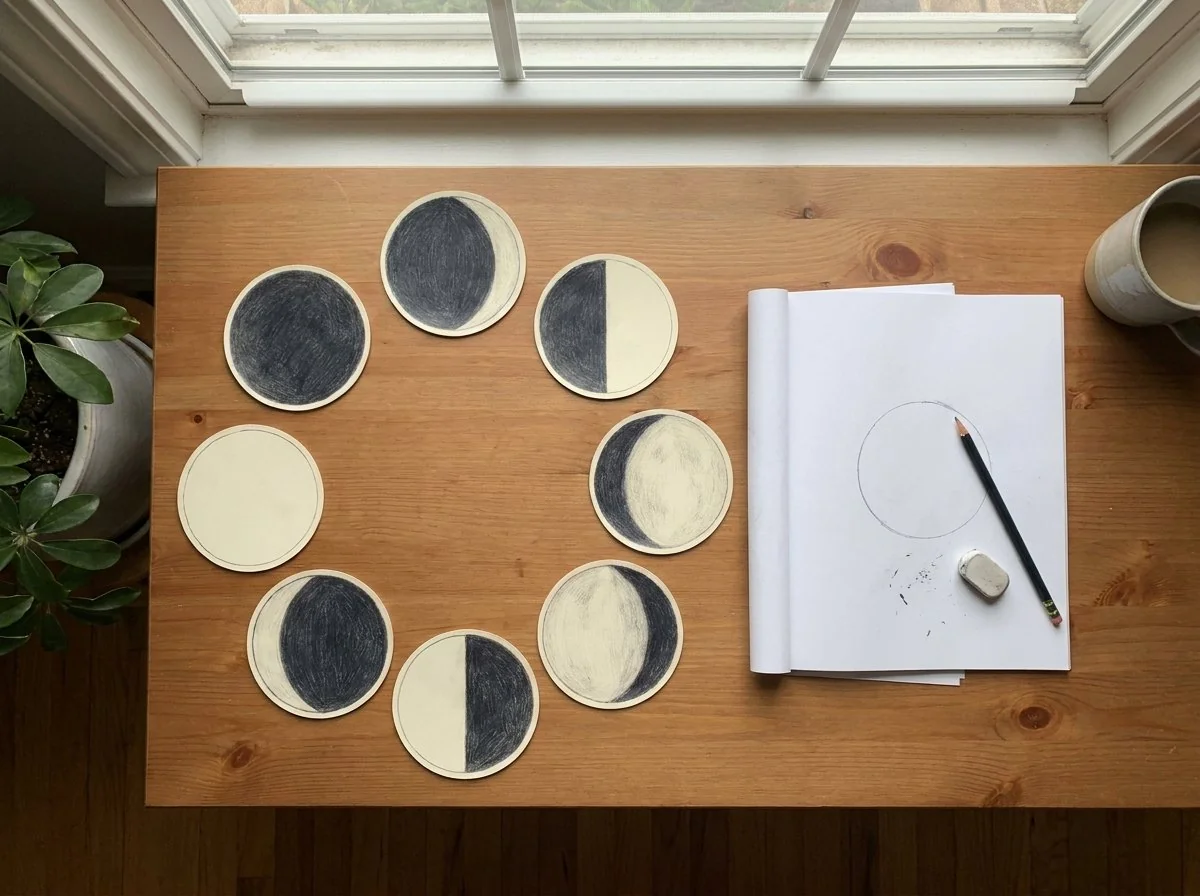
Get to know the new Moon, waxing crescent, first quarter, waxing gibbous, full Moon, waning gibbous, last quarter, and waning crescent. Learn moon phases in order, understand the difference between waxing and waning, and use a simple drawing exercise to recognize each stage.
-
Map the Moon's Monthly Journey
Understand how the Moon's changing position relative to Earth and the Sun creates its familiar illuminated shapes. Use an easy hands-on model, a simple diagram, and observation exercises to connect the lunar cycle with what you see in the sky.

-
Plant a Quiet Intention at the New Moon
Explore the new Moon as a traditional symbol of beginnings and possibility. Create a welcoming ritual, identify what matters to you, and use guided journaling to turn a broad wish into a thoughtful, realistic personal intention.

-
Follow the First Light of the Waxing Moon
Work with the waxing crescent and first quarter as symbols of curiosity, commitment, and forward movement. Explore simple waxing Moon rituals, small intention-setting exercises, and journal prompts that help you reflect on the steps you want to take.

-
Let Your Intentions Take Shape
Explore the waxing gibbous phase through the themes of patience, preparation, and refinement. Use a personal progress check-in, a guided reflection, and a simple symbolic ritual to consider what deserves more attention before the full Moon.
-
Stand in the Full Moon's Light
Discover the full Moon's traditional associations with illumination, gratitude, and completion. Create a meaningful full Moon ritual using journaling, quiet observation, and a personal inventory of what has become clearer during the cycle.
-
The Waning Moon and the Art of Letting Go
Follow the waning gibbous and last quarter through themes of gratitude, discernment, and release. Use reflective writing and gentle symbolic rituals to consider which habits, commitments, or expectations no longer belong in your next chapter.
-
Rest in the Moon's Final Crescent
Explore the waning crescent as a traditional symbol of rest, closure, and preparation for a fresh beginning. Practice a closing journal ritual, review the month's discoveries, and make room for a new intention without rushing the process.
-
Build Your Own Lunar Calendar
Learn to match calendar dates with the eight lunar phases and create a reusable monthly tracking system. Discover how to work with lunar calendars, record observations, and adjust your rituals when a phase falls on a busy day.
-
Make the Rituals Your Own
Move beyond following prepared instructions and develop a personal collection of phase-by-phase rituals. Explore optional candles, natural objects, reflective writing, and mindful observation, with practical safety guidance and respect for the different traditions that inform lunar symbolism.
-
Live in Rhythm, Not by Rules
Bring the complete lunar cycle together in a repeatable monthly workbook practice. Learn to draw and describe Moon phases from observation, review your journal, recognize recurring themes, and design a personal ritual sequence that can evolve naturally over time.
About this book
You may look up at the Moon and recognize its changing appearance without knowing which phase you are seeing, what comes next, or how to make sense of the lunar cycle without getting lost in complicated explanations and rigid ritual instructions. You might want to connect with the rhythms of nature but feel overwhelmed by conflicting information or the pressure to perform complex ceremonies. By the end, you will be able to follow a lunar calendar, create meaningful new Moon and full Moon rituals, use phase-by-phase journal prompts, and build a flexible monthly workbook practice that reflects your own intentions and observations.
The eight Moon phases follow a repeating rhythm over an approximately 29.5-day lunar cycle, and you can learn to recognize them, draw what you see, and connect each phase with traditional symbolism through a simple four-step approach.
The M.O.O.N. Method: Four Gentle Steps Through the Lunar Cycle
- Map — Identify the current Moon phase, locate it in the sequence of eight phases, and understand where it belongs in the approximately 29.5-day lunar cycle.
- Observe — Notice the Moon's visible illuminated shape, record what you see, and explore its traditional symbolism alongside your own thoughts and experiences.
- Open — Choose a personal intention, reflection prompt, or simple symbolic ritual that gives the current phase meaning without requiring elaborate preparations or rigid rules.
- Nurture — Carry your intention into ordinary daily life, revisit your journal, and adapt your reflections and rituals as the Moon moves through its cycle.
Your First Five-Minute Moon Check-In
You don't need a special altar or a collection of expensive tools to begin. You only need a notebook, a pen, and a moment of quiet. Follow these steps to complete your first check-in right now.
- Find the Moon's Place in the Cycle — Open a reliable lunar calendar (you can find these easily online or in any almanac) and identify the current phase. Find its name among the eight phases, then write that name at the top of a fresh journal page.
- Sketch What You See — Draw a simple circle to represent the Moon's visible disk and shade the portion that appears dark from Earth. If the Moon is not visible, use an astronomical phase diagram as a reference for the current phase. The Moon can also be visible during daylight.
- Name What You Want to Welcome or Release — Write one short sentence about something you would like to welcome into your life or something you are ready to reconsider or release. Keep it simple and realistic—for example, "I want to welcome more moments of calm" or "I am ready to reconsider how I spend my Tuesday evenings."
- Choose a Symbolic Action — Select one small action that represents your intention. You might write your intention on a separate piece of paper and tuck it into your journal, place a smooth stone or a small plant beside your notebook, or simply take three slow, deep breaths while focusing on your sentence.
- Make a Note for Your Next Moon Check-In — Write one observation or question you would like to revisit as the lunar cycle continues, leaving room for your thoughts and intentions to change naturally.
Turn the page and begin discovering how each Moon phase can become an invitation to observe, reflect, set intentions, and create a monthly practice that feels entirely your own.
