Hermetic Principles
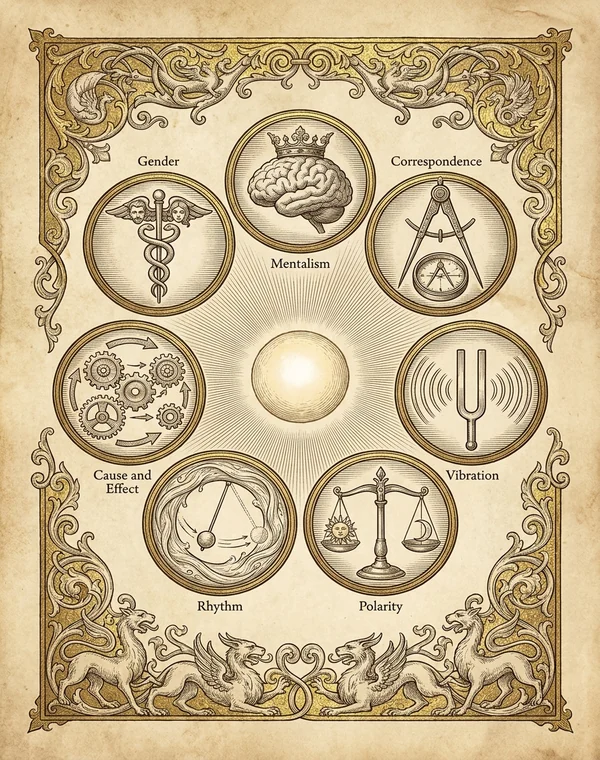
The seven Hermetic principles are Mentalism, Correspondence, Vibration, Polarity, Rhythm, Cause and Effect, and Gender, as set out in The Kybalion (1908). They are the best-known summary of "Hermetic" teaching today, though they come from American New Thought rather than the ancient Hermetica.
Where the word comes from
"Hermetic" refers to Hermes Trismegistus, "thrice-great Hermes", the legendary sage to whom the ancient Hermetic writings were attributed. The phrase "Hermetic principles" in the sense of a numbered list comes from a single modern book: The Kybalion: A Study of the Hermetic Philosophy of Ancient Egypt and Greece, published in Chicago in 1908 by the Yogi Publication Society under the name "Three Initiates".
In depth
The Kybalion presents seven principles as the core of a secret Hermetic teaching handed down from antiquity. Each is introduced with a short maxim in quotation marks, attributed to the "Kybalion", a supposed collection of ancient sayings.
The seven principles
The Principle of Mentalism: "THE ALL is MIND; The Universe is Mental." Reality is a creation of a universal mind, and the individual mind shares in its power.
The Principle of Correspondence: "As above, so below; as below, so above." Patterns repeat across levels of being, so knowledge of one plane gives insight into another. The phrase echoes the Emerald Tablet.
The Principle of Vibration: "Nothing rests; everything moves; everything vibrates." Differences between matter, energy, mind and spirit are differences in rate of vibration.
The Principle of Polarity: "Everything is Dual; everything has poles; everything has its pair of opposites." Opposites such as hot and cold, love and hate are extremes of one thing, differing in degree.
The Principle of Rhythm: "Everything flows, out and in; everything has its tides." Every movement is followed by a compensating swing back, like a pendulum.
The Principle of Cause and Effect: "Every Cause has its Effect; every Effect has its Cause." Nothing happens by chance; chance is a name for causes not recognised.
The Principle of Gender: "Gender is in everything; everything has its Masculine and Feminine Principles." Here the book means active and receptive principles on every plane, not biological sex.
Who wrote it
The "Three Initiates" never identified themselves. The book is now generally attributed, in whole or in large part, to William Walker Atkinson (1862 to 1932), a prolific Chicago writer of New Thought and "mental science", who ran the Yogi Publication Society and wrote under many pen names. Its vocabulary of mental vibration and mind power is typical of that movement.
The Kybalion and the ancient Hermetica
The ancient Hermetic texts, the Greek Corpus Hermeticum, the Latin Asclepius and related works of the early centuries CE, do not contain these seven principles or the word "Kybalion". They share some themes: the universe as the expression of a divine Mind (Nous), the kinship of the human mind with God, and the correspondence between cosmos and human being. But the systematic list, the emphasis on transmuting mental states, and much of the language are modern. Scholars of Western esotericism treat The Kybalion as a New Thought work in Hermetic dress, and an influential one.
Influence
Despite its origin, The Kybalion has been one of the most widely read occult books of the last century. The principles appear in modern Hermetic study groups, in the law-of-attraction literature, in ceremonial magic courses and all over social media. For many readers they are the first introduction to the idea that inner and outer worlds reflect each other.
Where it appears
The Kybalion (Three Initiates, 1908). The source of the seven principles as a numbered list.
The Emerald Tablet (Tabula Smaragdina). The origin of the phrase behind the Principle of Correspondence.
Corpus Hermeticum (2nd to 3rd century CE). The ancient Greek Hermetic treatises, with their doctrine of Nous.
What it means today
The honest way to use the Hermetic principles is to know what they are: a clear, practical early twentieth-century synthesis, not a translation of ancient wisdom. That does not make them useless. Correspondence, polarity and rhythm in particular are good tools for noticing patterns in thought and behaviour, and Mentalism is a strong statement of an idea found across many contemplative traditions.
Where readers go wrong is treating the book as proof about ancient Egypt, or reading "vibration" as physics. Read it alongside the real Hermetica, especially the Poimandres and the Asclepius, and the differences become as interesting as the overlaps.
Start with The Kybalion itself (it is short), then a good translation of the Corpus Hermeticum, and then a history of Western esotericism to see where each fits.