Emerald Tablet
The Emerald Tablet (Tabula Smaragdina) is a short, cryptic text attributed to Hermes Trismegistus, first known in Arabic and later translated into Latin. It is the source of the phrase "as above, so below" and was treated for centuries as the founding text of alchemy.
Where the word comes from
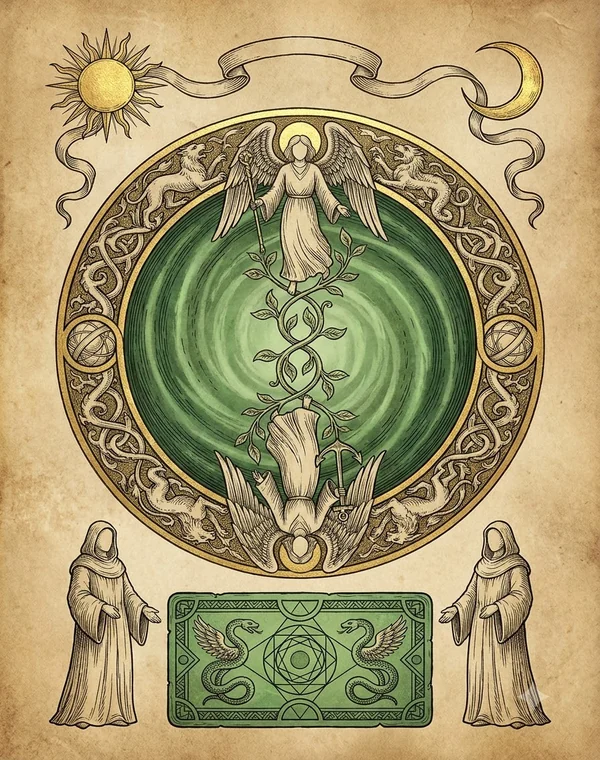
The Latin title Tabula Smaragdina means "emerald tablet". Legend says the text was found inscribed on a tablet of emerald or green stone held in the hands of Hermes Trismegistus in his tomb. In Arabic sources the discoverer is a sage named Balīnūs, generally identified with Apollonius of Tyana, who descends into a vault beneath a statue of Hermes and finds an old man holding the tablet.
In depth
The Emerald Tablet is only a paragraph long, twelve to fourteen short statements depending on the version, yet it has had more influence on alchemy and Hermetic thought than almost any other text.
Where it comes from
Despite its claimed Egyptian antiquity, the earliest surviving versions are Arabic. The best known appears at the end of the Kitāb sirr al-khalīqa, the Book of the Secret of Creation, attributed to Balīnūs and usually dated between the sixth and ninth centuries. Another Arabic version is found in the Secretum Secretorum, a popular "mirror for princes" attributed to Aristotle. The text entered Latin Europe in the twelfth century, one early translation being made by Hugo of Santalla, and it spread with the rest of the Arabic alchemical corpus.
What it says
In the common Latin tradition the tablet opens with a claim of certainty: it is true, without falsehood, certain and most true. Then comes its most famous line, which Isaac Newton translated as: "That which is below is like that which is above & that which is above is like that which is below to do the miracles of one only thing." From this comes the modern slogan "as above, so below".
The text goes on to describe the birth of a single thing from which all things come by adaptation. "The Sun is its father, the moon its mother, the wind hath carried it in its belly, the earth is its nurse." It instructs the reader to separate the earth from the fire, the subtle from the gross, gently and with great skill; describes an ascent from earth to heaven and a descent back, gathering the power of both; and promises the "glory of the whole world". It closes with the name of Hermes Trismegistus, "having the three parts of the philosophy of the whole world".
How alchemists read it
Medieval and Renaissance alchemists read these lines as a coded description of the Great Work: the preparation of the philosophers' stone through separation, sublimation and recombination of the "Sun" (sulphur, gold) and "Moon" (mercury, silver). The fourteenth-century commentary of Hortulanus, widely copied, treated every line as an operation in the laboratory. Others read it as cosmology: the correspondence of macrocosm and microcosm, heaven and earth, mind and body.
Isaac Newton made his own English translation with notes; the manuscript is among his alchemical papers at King's College, Cambridge. Later the tablet became a favourite of Rosicrucian, Theosophical and New Thought writers, and The Kybalion (1908) turned its opening line into the Principle of Correspondence.
Reading it today
There is no single correct reading. Historians of chemistry see a compressed description of distillation and sublimation. Jungians read it as the integration of opposites in the psyche. Hermetic practitioners use it as a meditation text, taking one line at a time. All three readings are old, and all three are defensible.
How different paths see it
Where it appears
Kitāb sirr al-khalīqa, the Book of the Secret of Creation (attributed to Balīnūs). The earliest known Arabic source of the tablet.
Secretum Secretorum (pseudo-Aristotle). A widely read work that carried another version into Latin.
Commentary of Hortulanus (14th century). The standard medieval alchemical reading, line by line.
Isaac Newton's translation (Keynes MS 28, King's College, Cambridge). Newton's English version with his own notes.
What it means today
The Emerald Tablet rewards slow reading. It is short enough to memorise, and most people who study it do; lines that seem opaque on the first pass open up once they are held in mind over weeks.
Two cautions help. First, the tablet's claimed Egyptian origin is legend: the history we can trace starts in the Arabic world, and that history is interesting in its own right. Second, "as above, so below" is only the first step of the text. Its real subject is a process of separation and reunion, and that is what alchemists spent centuries trying to carry out.
For a first encounter, read two or three translations side by side (Newton's is freely available), then a history of alchemy that places the tablet among its Arabic sources.