Goetia
Goetia is the magical evocation of spirits, and in particular the Ars Goetia, the first book of the seventeenth-century grimoire the Lesser Key of Solomon, which lists 72 spirits with their seals, ranks and powers.
Where the word comes from
The word comes from the Greek goēteia, "sorcery", from goēs, a sorcerer. The goēs was originally a mourner or wailer who sang laments for the dead, and the term came to mean someone who dealt with ghosts and spirits through incantation. By the classical period it was a slur, the low magic of charlatans, set against respectable religion. Late-antique Neoplatonists sharpened the contrast by opposing goēteia to theurgy, "divine work".
In depth
Today "Goetia" usually means one text: the Ars Goetia, the first of five books in the Lemegeton Clavicula Salomonis, known in English as the Lesser Key of Solomon. The Lemegeton was compiled in the mid-seventeenth century from older material, and survives in several manuscripts in the British Library, notably the Sloane collection. It should not be confused with the Key of Solomon (Clavicula Salomonis), an earlier and different grimoire.
The 72 spirits
The Ars Goetia lists 72 spirits, beginning with King Bael, "who ruleth in the East", and including Paimon, Beleth, Asmodeus, Belial and Andromalius, the seventy-second. For each it gives a rank (king, duke, prince, marquis, president, earl or knight), the number of legions it commands, the form in which it appears, the offices it performs and a seal or sigil. The offices are often practical: teaching languages or sciences, finding treasure, reconciling friends, revealing past and future things.
Most of this list was not invented by the compiler. It closely follows the Pseudomonarchia Daemonum, a catalogue of 69 spirits that the physician Johann Weyer printed in 1563 as an appendix to De praestigiis daemonum, his book arguing that accused witches were more often deluded than guilty. Weyer published the list to expose it; the grimoire tradition absorbed it anyway.
The operation
The method is Solomonic. The magician prepares through prayer, fasting and purification, then works inside a protective magic circle inscribed with divine names. The spirit is called to appear in a triangle outside the circle, and is compelled by names of God and by the authority attributed to King Solomon, who in legend bound spirits with a brass vessel and a seal ring. The spirit's own seal is worn or shown as a lamen. The work ends with a formal licence to depart. The theology is thoroughly Christian and Jewish in its names: the magician does not worship the spirits but commands them through God.
The 1904 edition and after
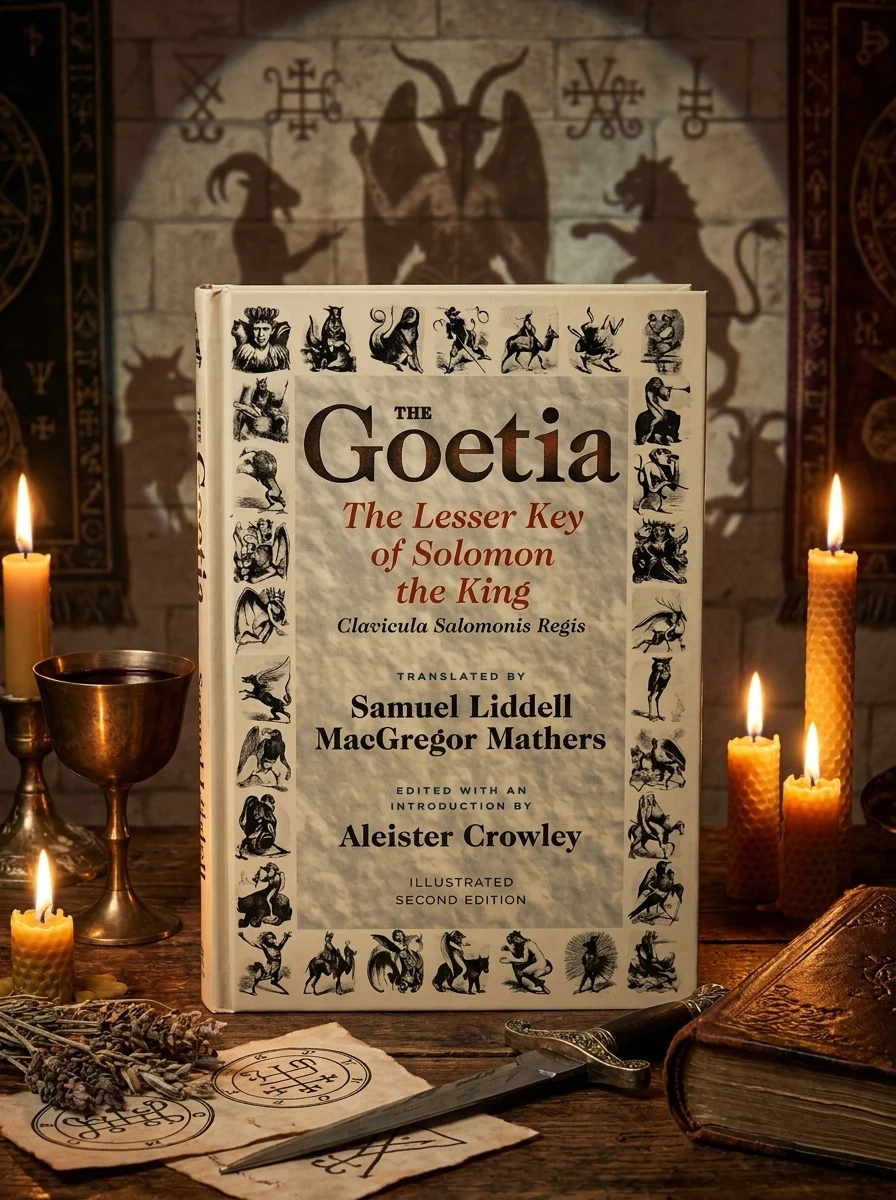
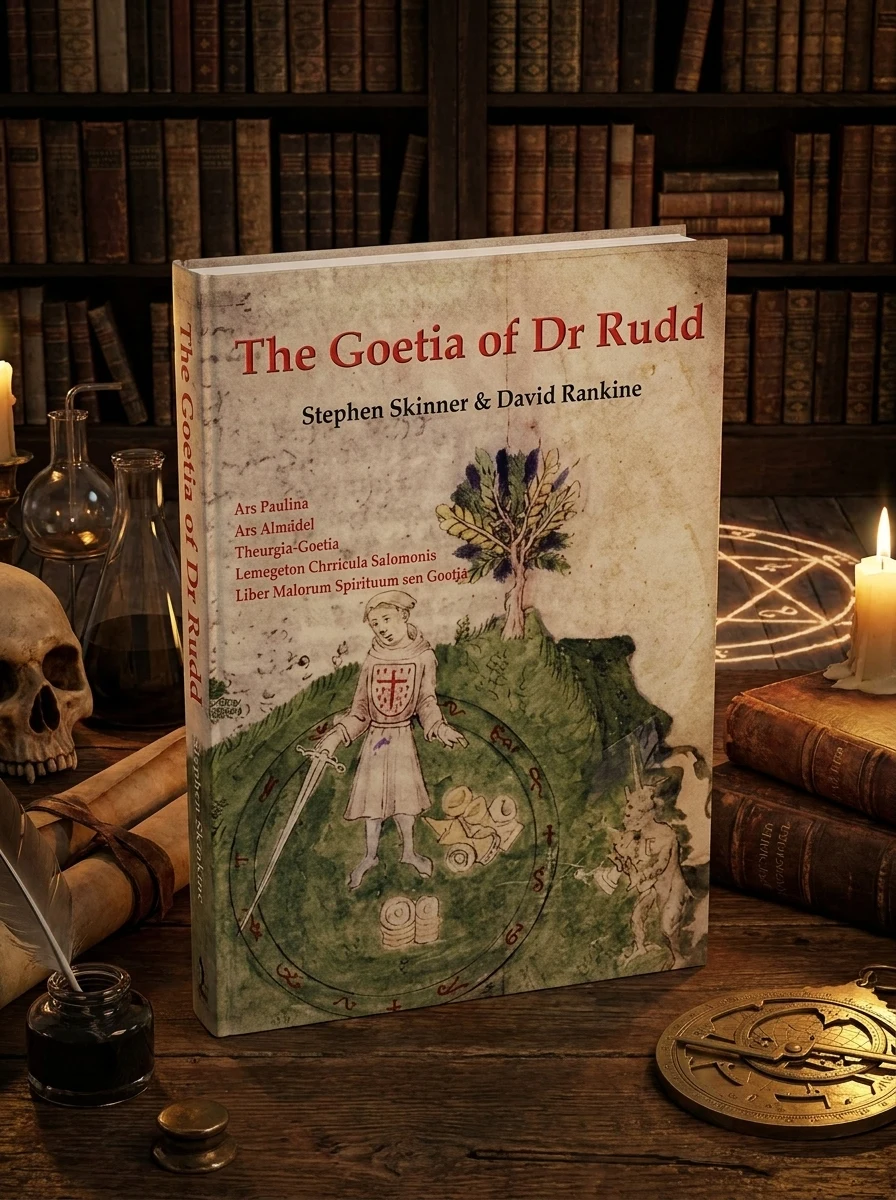
The version most readers meet is The Book of the Goetia of Solomon the King (1904), translated from the British Library manuscripts by Samuel Liddell MacGregor Mathers and edited and published by Aleister Crowley, who added a preface, a "Preliminary Invocation" and notes. That edition made the Goetia a standard text of modern ceremonial magic. More careful scholarly editions followed, above all Joseph H. Peterson's The Lesser Key of Solomon (2001), which works from the full manuscripts, and Stephen Skinner and David Rankine's The Goetia of Dr Rudd (2007), which presents a version that pairs each spirit with an angel of the Shem ha-Mephorash.
Modern approaches
Current practitioners split roughly three ways. Traditionalists follow the Solomonic procedure closely, names and all. Psychological readers, following Crowley's remark that the spirits are "portions of the human brain", treat them as aspects of the mind to be integrated. And some Left-Hand Path and demonolatry groups approach the same spirits as allies or deities rather than as beings to be constrained. Popular culture, from video games to anime, has made the names familiar far beyond occult circles.
Where it appears
The Lesser Key of Solomon (Lemegeton), Book I: Ars Goetia. The seventeenth-century source text listing the 72 spirits.
Pseudomonarchia Daemonum (Johann Weyer, 1563). The earlier catalogue of 69 spirits on which the list is based.
The Book of the Goetia of Solomon the King (Mathers and Crowley, 1904). The edition that brought the Goetia into modern magic.
The Goetia of Dr Rudd (Skinner and Rankine, 2007). A manuscript version pairing each spirit with a controlling angel.
What it means today
The Goetia fascinates for the same reason it worries people: it is the part of the Western magical tradition that deals openly with dangerous powers. Read historically, it is a document of early modern anxiety and ambition, part learned magic, part folk hope for treasure and favour, bound together with the prestige of Solomon.
For practical students the lesson most teachers repeat is preparation. The long preliminaries, the circle and the strict closing are not decoration; they are the whole ethic of the text. Beginners are usually advised to learn basic banishing, meditation and the Qabalah long before attempting evocation, and many never do evocation at all.
If you are reading rather than practising, start with Peterson's edition for the text itself, then the Mathers and Crowley edition to see how the twentieth century reshaped it.