Thelema
Thelema is the religious and magical philosophy founded by Aleister Crowley on The Book of the Law (1904). Its central teaching is that every person has a True Will, and that discovering and doing it is the whole of the law.
Where the word comes from
Thelema is the Greek θέλημα, "will", a word used in the New Testament for divine and human will alike. Before Crowley it had a famous literary life: in François Rabelais' Gargantua (1534) the giant founds the Abbey of Thélème, whose single rule is "Fay ce que vouldras", "Do what you will". Crowley took both the word and the motto. In Greek letter-numbering (isopsephy) thelema adds up to 93, the same as agape, "love", which is why Thelemites greet one another with the number 93.
In depth
Thelema begins with an event. In April 1904, on honeymoon in Cairo, Aleister Crowley and his wife Rose were drawn into a series of rituals which, Crowley said, ended with him taking dictation from a disembodied intelligence named Aiwass over three days, 8 to 10 April. The result was Liber AL vel Legis, The Book of the Law: three short chapters spoken in the voices of three Egyptian-styled deities. Crowley spent the rest of his life (he died in 1947) building a system around it.
The three core statements
Three lines from the book carry most of the teaching. "Do what thou wilt shall be the whole of the Law." "Love is the law, love under will." And "Every man and every woman is a star." Together they describe a universe of sovereign individuals, each on a unique orbit, whose proper relation to one another is love directed by will rather than love as sentiment or duty.
The key concept is the True Will. It is not what someone happens to want at a given moment. It is the person's real nature and purpose, their fitting path through life, which may be hidden under conditioning, fear and habit. Most of Thelemic practice is aimed at uncovering it, and much of its ethics follows from it: if everyone is a star, interfering with another's True Will is the one real wrong.
Gods and the Aeon of Horus
The Book of the Law speaks through Nuit, the infinite star-goddess of space and possibility; Hadit, the point of experience at the centre of every being; and Ra-Hoor-Khuit, a warlike form of Horus. Crowley read world history as a series of aeons: an Aeon of Isis (mother-centred religion), an Aeon of Osiris (the dying-and-rising father god, which he identified with Christianity), and the Aeon of Horus, the "crowned and conquering child", which he held began in 1904. The new aeon was to be marked by the growth of individual self-determination.
Practice and organisations
Thelema uses the full toolkit of Western ceremonial magick (Crowley's spelling, with a k, to separate it from stage conjuring): ritual, yoga, meditation, the Qabalah and tarot, and a disciplined magical diary. Among the central daily practices are Liber Resh, adorations of the sun at four points of the day, and the ritual Star Ruby.
Two bodies carry the tradition. The A∴A∴, founded by Crowley and George Cecil Jones in 1907, is a teaching order of individual student and teacher relationships. The Ordo Templi Orientis (O.T.O.), a fraternal order Crowley came to lead, adopted The Book of the Law and runs the public Gnostic Mass (Liber XV), Thelema's central communal rite. From 1920 to 1923 Crowley ran a small commune, the Abbey of Thelema, in Cefalù, Sicily, until Mussolini's government expelled him.
Key texts
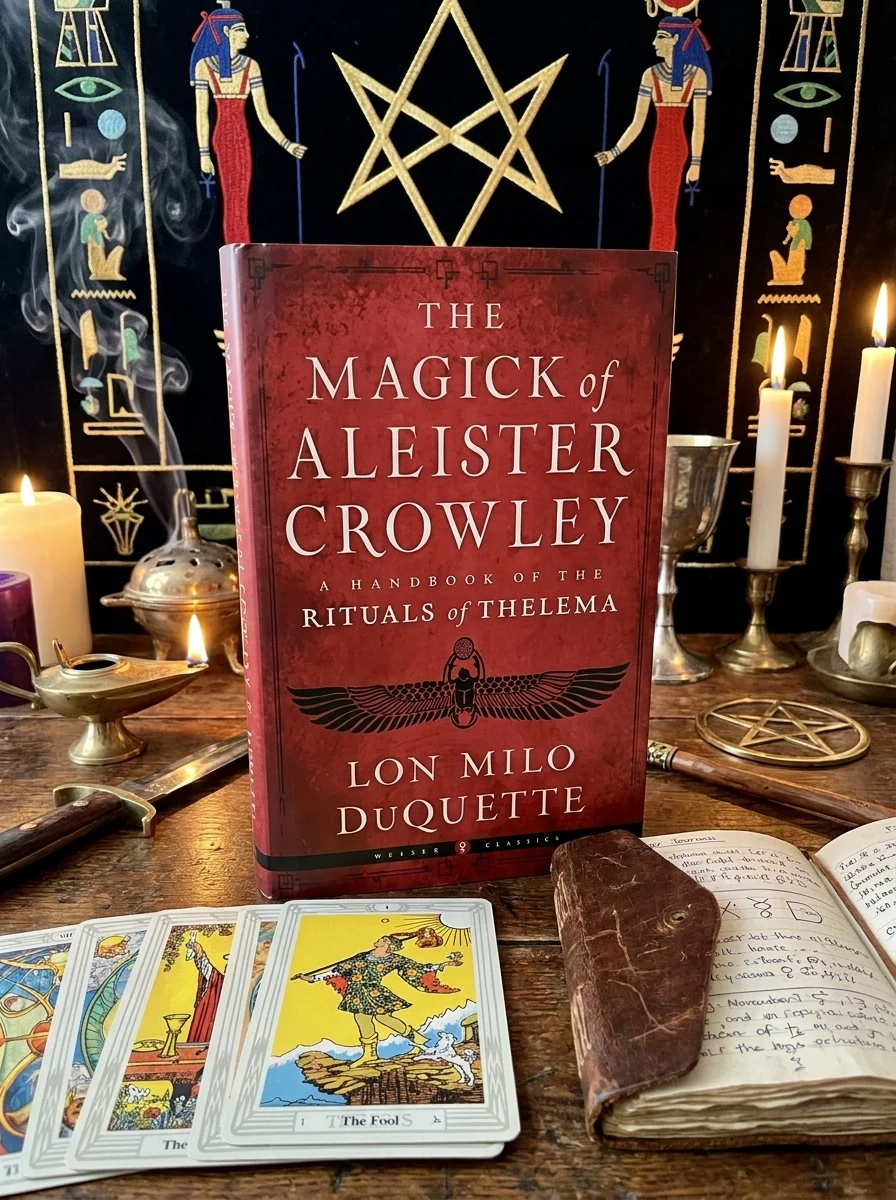
Beyond The Book of the Law, most students work through Magick (also called Book 4 or Liber ABA), which combines Crowley's yoga and magical theory; The Book of Thoth (1944), his study of the tarot painted with Lady Frieda Harris; and The Confessions, his "autohagiography". Israel Regardie, Lon Milo DuQuette and Richard Kaczynski's biography Perdurabo are the usual modern companions.
Where it appears
The Book of the Law (Liber AL vel Legis, 1904). The founding text, received in Cairo over three days in April 1904.
Magick: Liber ABA, Book 4 (Aleister Crowley). The main manual of Thelemic yoga and ceremonial magick.
The Book of Thoth (Aleister Crowley, 1944). Crowley's tarot, painted by Lady Frieda Harris.
Gargantua (François Rabelais, 1534). The Abbey of Thélème and its motto "Do what you will".
What it means today
Thelema is easy to misread from the outside. The slogan sounds like hedonism, and Crowley's reputation as "the wickedest man in the world" did not help. Read in context, it is a demanding path: the student is asked to keep a record of every practice, to test every experience, and to take full responsibility for the results.
Its lasting influence is wider than its membership. Gerald Gardner drew on Crowley's material when shaping Wicca; chaos magic took his experimental attitude; and much of the vocabulary of modern occultism, from "magick" to "True Will", comes from him. You do not have to accept Aiwass to find the idea of a single, discoverable purpose worth thinking about.
A sensible order of reading is The Book of the Law itself (short, strange, best read once without commentary), then Magick for the method, then a biography to put both in context.