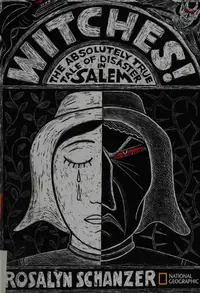
Witches: The Absolutely True Tale of Disaster in Salem
This edition can be ordered. No arrival date is confirmed.
Salem's shadows stretch across history, revealing the terrifying power of fear and accusation.
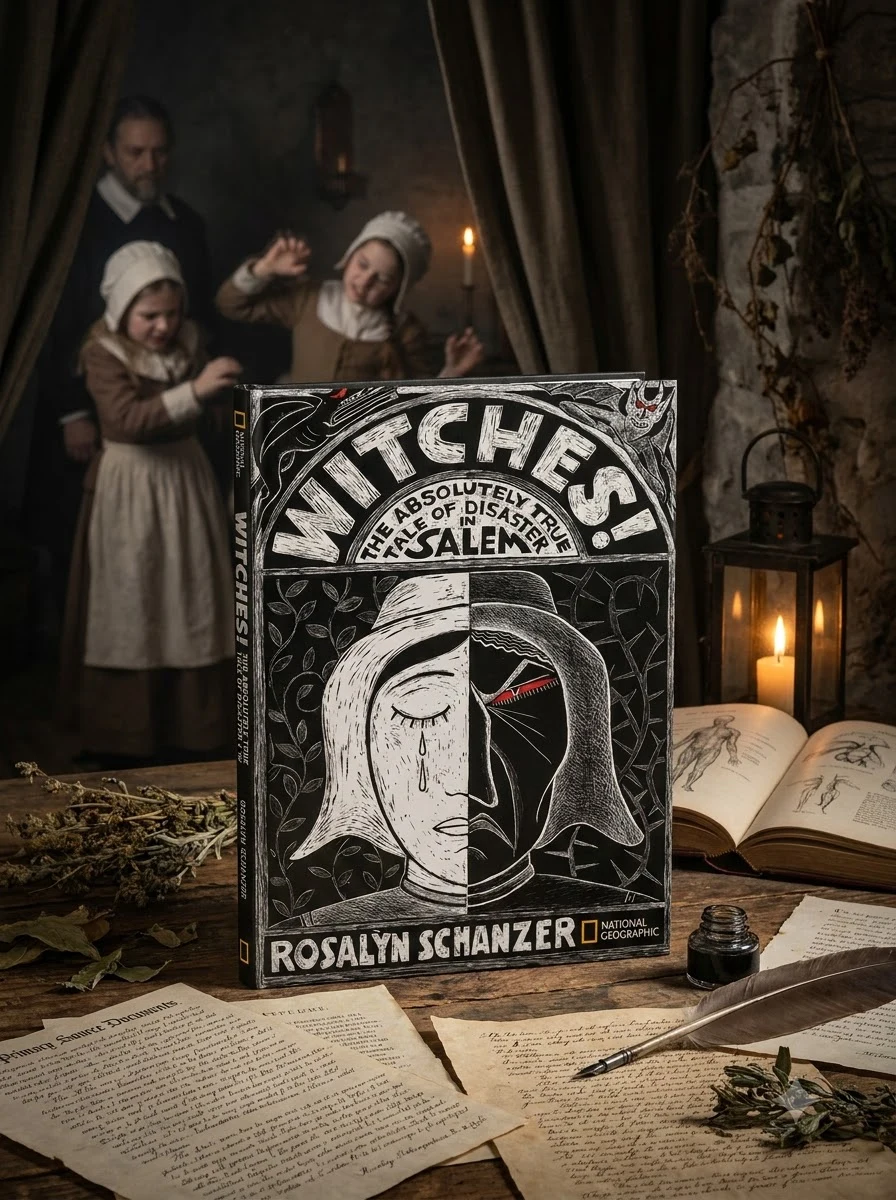
Journey into the chilling true narrative of the Salem Witch Trials, a dark chapter in early American history. This vivid account unravels how a perplexing illness affecting two young Puritan girls quickly spiraled into a devastating wave of accusations and mass hysteria. With evocative, stylized scratchboard illustrations, the book meticulously chronicles the roles of the afflicted, the accused, and the authorities, revealing the profound societal fear that led to numerous executions and shattered countless lives. It's a gripping exploration of how suspicion and superstition can ignite a catastrophic social breakdown.
This work situates the Salem Witch Trials within the broader tradition of American historical non-fiction, specifically targeting young readers through an accessible narrative framework. It aligns with educational efforts to demystify early colonial societal structures and the psychology of mass hysteria for a modern audience.


📝 Description: Witches: The Absolutely True Tale of Disaster in Salem
💎 Expert review
📖 Why choose it
Why this book is worth reading
Young readers and educators will find immense value in this vivid account, which transforms a complex historical tragedy into an engaging and understandable narrative. The book excels at illustrating how fear and accusation can spiral out of control, offering a crucial lesson on societal breakdown without overwhelming its audience. Schanzer’s meticulous chronicle of the afflicted, the accused, and the authorities provides a clear, gripping exploration of suspicion and superstition. For those interested in witchcraft or early American history, this title serves as an essential entry point. It empowers readers to understand the human cost of mass hysteria through evocative storytelling and stylized illustrations, making it a vital resource for fostering historical empathy and critical thinking about the power of fear.
⭐ Reader reviews
Reader rating
While this book succeeds in making the Salem Witch Trials accessible through vivid scratchboard illustrations and a gripping narrative, it is clearly tailored for a juvenile audience. Readers seeking rigorous academic analysis, deep theological debate, or adult-oriented psychological profiling will find this work overly simplified and lacking in scholarly depth. The stylized presentation, while engaging for children, may feel reductive to historians or those interested in the nuanced legal and religious complexities of the era. It is not suited for readers who prefer dense primary source analysis or mature thematic explorations of trauma. However, as an introductory tool for young minds, it effectively captures the terror of the time without glorifying the violence, serving its specific demographic well.
❓ Frequently asked questions
📖 Who should read this
For those fascinated by historical mysteries, the psychology of crowds, and the dark side of human belief. If you seek to understand how fear can twist perception and destroy lives, or if you're drawn to the origins of American occult history, this compelling account is essential reading.
🎯 Key themes and symbolism
The Contagion of Fear
How the initial, unexplained symptoms of two girls rapidly infected an entire community with terror and suspicion. It examines the mechanisms through which collective anxiety, amplified by religious fervor and societal pressures, can override reason, leading to widespread accusations and dire consequences for the innocent.
Peril of Accusation
This work vividly illustrates how mere accusations, unsupported by tangible evidence, could dismantle lives and societal order. It scrutinizes the judicial failures and the tragic power wielded by accusers, revealing the devastating impact of unchecked allegations on individuals, families, and the very fabric of justice in colonial America.
Puritanical Extremism's Grip
Explore the rigid religious and social structures of 17th-century Salem, where strict Puritan beliefs intersected with folk superstition. The book details how this fervent environment, coupled with anxieties about the unknown and perceived spiritual threats, created fertile ground for the witch hunt to take root and flourish, with tragic results.
💬 Quotes from the book
“The doctor, baffled by their inexplicable fits, could only offer a grim diagnosis: the Devil's hand was upon them, and with it, the shadow of witchcraft.”
“As accusations flew like dark whispers, neighbor turned against neighbor, and the very foundations of communal trust crumbled under the weight of terror.”
📜 Historical context
📚 Glossary
- Spectral Evidence
- Puritanism
- Mass Hysteria
📔 Questions to reflect on
- Consider a time when collective fear or rumor led to an unjust outcome. How did individual actions contribute to or resist that tide?
- How might the lack of scientific understanding in 17th-century Salem have contributed to the belief in witchcraft as an explanation for illness or misfortune?
- Reflect on modern-day 'witch hunts' or moral panics. What parallels can you draw with the Salem trials, and what lessons can we learn?
You might also like
See more →
 91
91